SlideMagic Blog

Frequent updates about all things presentations since 2008. Subscribe to never miss a post.

RSS
all posts

Category PowerPoint

·Gadgets

Software developers, please fix this

More and more applications will be a platform to deliver presentations, which means more and more applications need to do the following things:

  1. Have a good full screen mode
  2. Respond to Logitech and Apple remote controls
  3. Support dual monitors including slide preview mode, where you can see the upcoming slide on your laptop screen (not on the screen the audience is watching)

Adobe Acrobat does not have preview mode, and does not respond to an Apple remote. Apple Preview only seems to have slide shows with automated page transitions. OK, Preview might not be intended for running presentations, but Adobe at least should build in features that make Acrobat a good alternative to PowerPoint and Keynote for presenting slides.

Tablet devices would be another category. It is easy now to hook up an iPad to an HD screen. Again, presenting slides should be thought of as a required application.

·Colors

Dark or light slide background?

A dark or light background for your presentation slides? Dark backgrounds work better for very large stages, where a big bright screen takes away the attention from the speaker. In smaller meeting rooms, a light background work better.

It is very inconvenient to edit and work with 2 masters of the same presentation, it is a lot of work and you always end up with inconsistencies. Presentations with a dark background give less flexibility to work with colors, and are harder to print (there are still audiences that do this, especially when presenting to institutional investors).

So as a result, I recommend sticking to a light background for most business presentations, unless you have a very specific, high-profile event that merits the design of a custom slide deck.

·Cartoons

Dilbert on PowerPoint

PowerPoint has become such a core element of corporate culture that it features often in Dilbert comic strips. These one is from yesterday for example:

Image no longer available

The full archive of Dilbert is now searchable by keyword, and you can license images for use in your presentations just like a stock photo site. For example, this search shows a whole lot more Dilbert comics on PowerPoint.

·Delivery

Changing the presentation culture

If you are reading this blog, you are probably already part of the tribe of people that want to change the way the world present ideas to each other. The problem is how to convert the other 99% of your co-workers. I see two routes.

Robust PowerPoint templates. Leaving aside the discussion of what is a beautiful PowerPoint template, and what is not (you know my preference for the white page), and assume that the design has been agreed. Usually, people stop here, but there is important programming work to do afterwards. Setting the fonts and the colors to the right default, removing the standard bullet point opening framework from the slide master, etc. This is a computer programming, not a design job that should make the PowerPoint template “idiot-proof”. This is the technical route.

Low-risk events. It is hard to experiment with a new way of presenting in a high-stakes external presentation (i.e, your next earnings announcement). Instead, pick an internal presentation. Maybe the annual sales conference? Have an employee who is converted to the tribe give his presentation in a new and unusual way. Give unusual restrictions for the slide decks to be used in the internal conference: instead of telling people not to exceed 5 slides, tell them that they are not allowed to use bullet points in their deck. As people get exposed to a different way of presentation, the confidence might be getting stronger for the next generation of people to join your tribe, and bit by bit, take the new presentation culture to external presentations as well.

·Layout

Presentation = web site

The new web site of the Acumen Fund is a great example of how presentation and web design is blending. Gone are the navigation menus, environmental statements, and other wasted screen real estate. Instead, the site is a vertical series of visuals that equally could have gone into a presentation.

I often recommend this web site design approach to early-stage start ups. Once you have designed your investor presentation deck, you can simplify slides, take out the confidential ones (financials, pipeline, IP) and you have the ingredients for a great, simple web site, that shows potential investors clicking through to your URL a message that is consistent with your pitch.

By the way, Acumen is doing some great work to tackle poverty. If you are interested, join the community here to find out more.

·Images

Compressing images in PowerPoint

PowerPoint files with images can get very large. As soon as a file exceeds 10MB, it becomes difficult to collaborate on it via email. This probably one of the main reasons office collaboration will ultimately go into the cloud, but before that time arrives we need to deal with the current situation.

You can find the standard compression options in the format menu after you have clicked an image. Sometimes, more brutal force is required though. Somehow, if you right click an image in PowerPoint, save it is a JPG, delete it, and then copy paste it back in, the files size has shrunk a lot.

In the heat of CTRL-C, CTRL-V work, PowerPoint sometimes puts in images as bitmaps or PNG files that take up a lot of space. This trick trims them down again.

Be aware that compressing files hurts the quality of the images. So if this is a presentation destined for a huge screen at an important conference, keep the original photos somewhere in a safe place in order to be able to re-construct the full size version once you have agreed on the final document with your team.

·Investor presentation

Oops, forgot the sales pitch

Big market disruption, check. Experienced team, check. Company traction, check. Trimmed down the investor pitch deck to 10 minutes, check.

But you forgot one thing: the sales pitch. Yes, this is an investor presentation and not a sales presentation, but still, every pitch to an investor should include an example pitch to a potential customer. The investor needs to get a feel that a customer will actually buy your product. The sales story on the slides is important, but even more important than that: they way you present the slides as a salesman.

·Art

Every sentence should matter

I recently made the switch back to literary fiction after it took me around 25 years to overcome the bad memories of high school teachers forcing me to read this genre against my will.

Reading these books showed me just how empty corporate language is. Over the years I have developed a pretty high speed-read rate. Non-fiction books, annual reports, PowerPoint bullets can all be digested in very limited time without missing a beat of the content.

So, when I tried to apply this to literary fiction I was forced to back up. Every sentence actually matters. The world would be a much better place if corporate language stuck to this principle.

·Layout

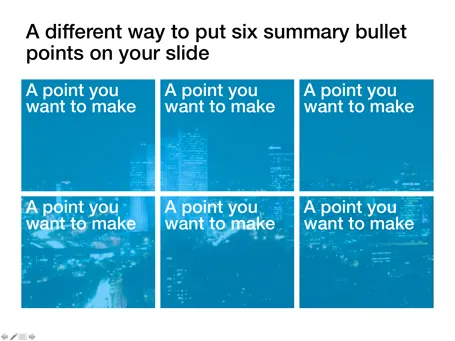
Disguising bullets in boxes

Fancy frameworks (pentagons, triangels) are bullet slides in disguise. Here is a concept that I recently used to put the 6 most important building blocks of a business on a slide. Keep the text really short.

·Investor presentation

What a potential investor really means when she requests a business plan

The traditional business plan used to be a 200 page Microsoft Word document. A large part of it was filled with fluffy market background information and more fluffy industry buzzwords, frameworks and mission statements. It was always out of date. Its primary purpose was to rest your hand on it and say: “We have a business plan”. Nobody would really read it.

In most startups, the business plan is replaced with a large PowerPoint slide deck that evolves rapidly over time. A selection of the slides in this document are upgraded to be used in standup presentations. The vast majority of them are dense appendix material.

Daniel Tenner wrote a good blog post about what it means when an investors asks whether you can email her a business plan. In short, after the initial pitch, the investor wants a document that can be emailed (forwarded to partners) that answers some fundamental questions about your venture. The content should be good, the content can be short, and you can afford to invest less in the design of the slides.