SlideMagic Blog

Frequent updates about all things presentations since 2008. Subscribe to never miss a post.

RSS
all posts

Category Investor presentation

·AI

No more disguised examples?

Many confidential presentations often use disguised case examples of clients, potential investments, drugs in development. AI has become incredibly good at uncovering even the most vague ones. Before sending your deck, double-check them in an LLM to see what comes up…

·Investor presentation

Honeycomb pitch deck

A reader pointed me to a pitch deck review of Honeycomb’s latest fund raising round. (See the post on TechCrunch). The deck itself can also be found and downloaded on SlideShare (which seems to have undergone a revamp).

The deck obviously worked, because the company managed to raise the $50m round. But I doubt that the slides in the deck were the key driver of this success. They slides look decent, but this is not stellar design. The purple branding seems a bit off from the corporate colors, some slides contain “white paper speak” that is typical in enterprise software, and the graphics between the slides are not completely consistent.

Honeycomb is a later-stage software company which can easily be x-rayed by investors who understand software: growth rates, CACs, etc. etc. It is the numbers (which are not in this deck but were shared in later-round due diligence discussions) that will reveal exactly where the company is going.

The important pitch is probably the “audio track” along side the slides: Honeycomb has managed to carve out a new software category that is/will become a key component of every enterprise’s IT budget. I am sure the CEO nails this in an in person presentation.

Always put other company’s pitch deck design and outlines in the context of your own company.

·Layout

Showing busy bios on a web site

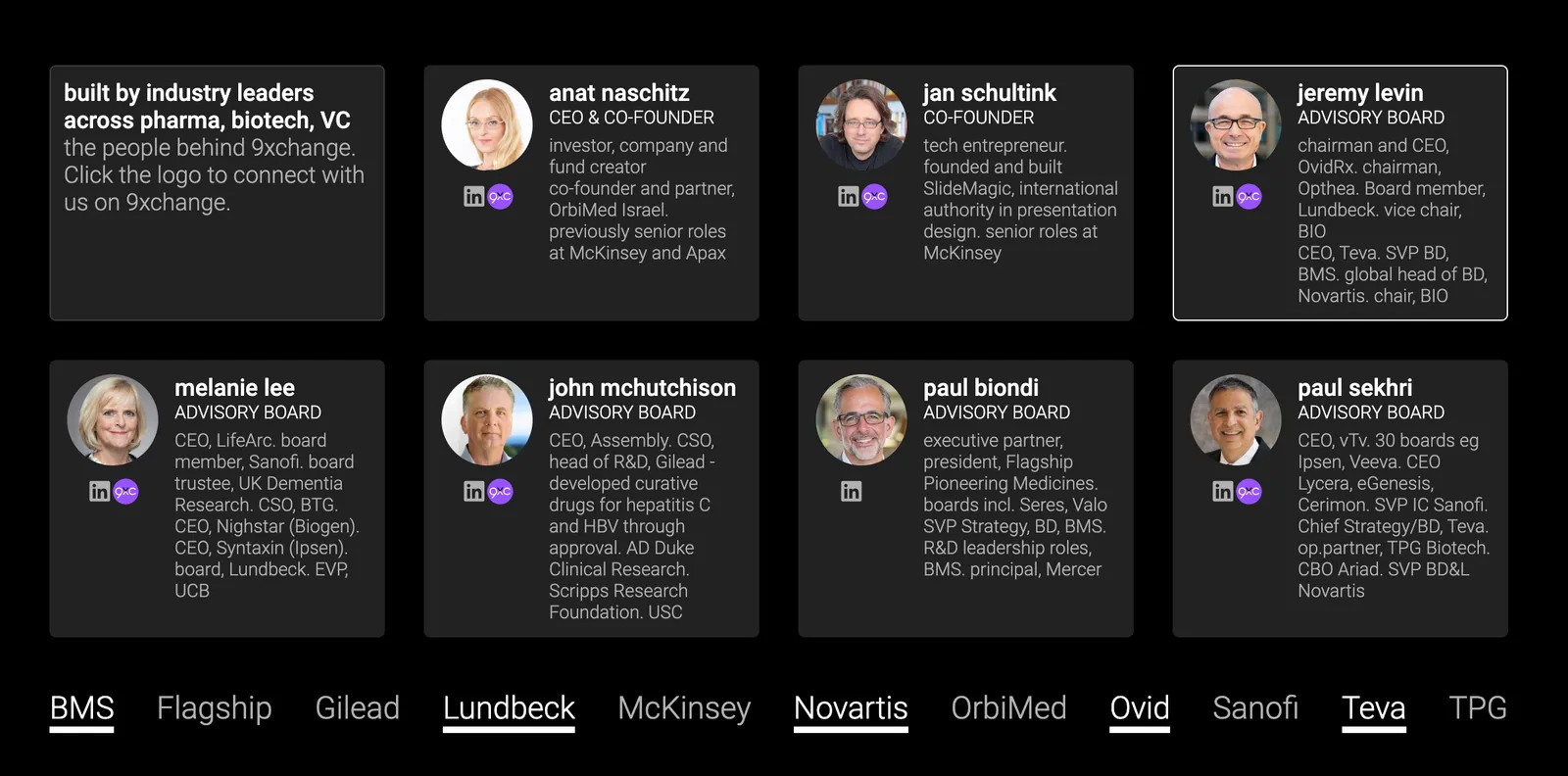
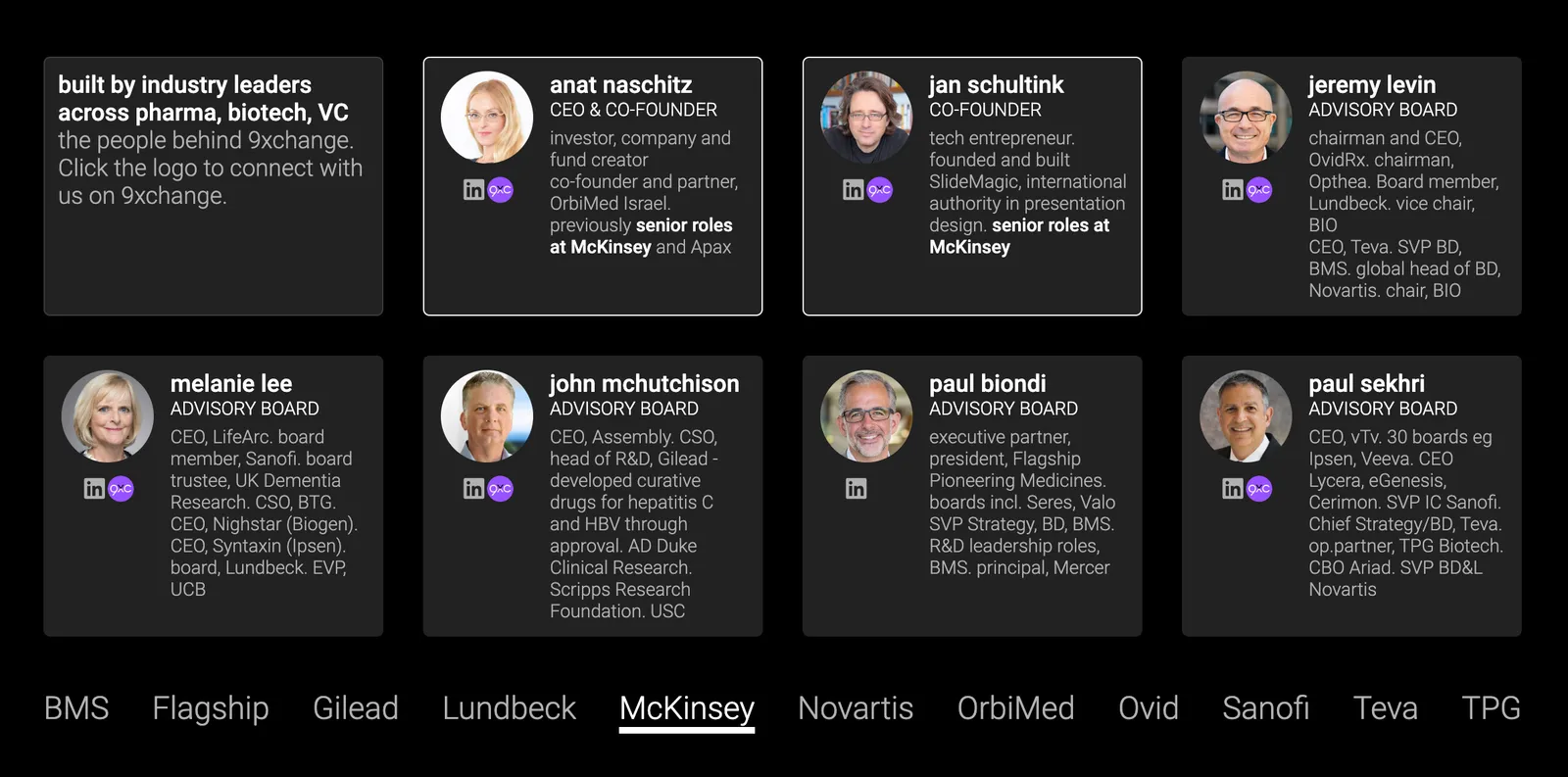
My venture 9xchange is new in the world of healthcare, wo we need to establish credibility by showing that we have significant experience and are backed by significant people. Here is what I came up with (see the 2 screenshots below).

I put up a dense grid with the bios of the people involved. Below this table, are a few recognizable brands from the world of healthcare. When you hover (or click on a tablet) over a person’s bio, a relevant subset of the brands light up.

Alternatively, when you hover over, or click the brands at the bottom, relevant people get highlighted, including the relevant small print in their CV.

You can check out the progress of the work on the 9xchange website.

·Images

Showing screen shots in a pitch deck

In most cases, it is not worth the time and effort in a short presentation to take the audience through a demo or a series of screenshots of your application. At this stage in the pitch process, understanding the exact flow of your application is not critical.

What can matter though is the simple question of whether you have a decent product or prototype or not. The role of a screen shot here is not to show the exact detail of your app, but more a proof point.

One way to make this point is to use an office background with some screens, and paste a number of screens on the monitors. That’s what I did in a recent deck for my other venture 9xchange. I made the office background black and white, to make the screens pop a bit more.

(Look how I managed to Photoshop the screen shot behind the standing desk light)

·Sales presentation

Three audiences for your company brand

A company brand has at least 3 audiences:

  • Employees (including the founders), that need an inspiring and cool place to work
  • Users that are looking for a brand that fits and appeals to the target market
  • Investors who are looking at a fundable organization with fundable founders

Think about conflicting requirements when picking your name. Priorities might also change over time. Investors are very important early on, users a bit later. Your first collaterals (decks, a web site) are probably directed at investors.

This post was sparked by overhearing two conversations: one about whether picking a cartoon character as a company name would hurt appeal to investors, and one where a company named itself after an industry it explicitly claimed not be in.

·Investor presentation

Send a different deck?

After the meeting you promised to send the slides of your presentation in an email. But the deck you used, was the short one, and you have a better/longer one sitting on the shelf. It does have a different structure and graphical look and feel though. Should you send it instead?

Probably not. The slides you send are a quick reminder of the meeting, a permission to email the meeting attendees with your follow up question. Very few people might actually look at the slides in detail. And if they do, each slide is a visual placeholder for the story you told in the meeting. Sending a completely different deck might confuse them.

If you want to send the other presentation, do so in addition, and clearly mark it as something different from what they have seen.

More pro tips for follow up decks:

  • If slides contained semi-confidential information that was OK to show for 5 seconds, you can take them out in this version to prevent people from studying things in detail (financials, roadmaps, etc.)
  • Always send things in PDF, not the source file (PowerPoint .pptx, or SlideMagic .magic)
  • If you are using SlideMagic, consider expanding the explanation panels on each slide, and write the summary of the messages of the slide in a few paragraphs, handy for people to understand a page better when you are not there in the room to explain things verbally.
·Sales presentation

Scripted improvisation

I just came back from an industry conference that involved all day, back-to-back, 25-minute meetings in small hotel rooms. Professional speed dating. Very similar in setup to the days I spend interviewing MBA graduates for roles at McKinsey at INSEAD.

These meetings are a challenge. You get tired (especially if you are jet legged), the setting is repetitive, and very unpredictable meeting dynamics and energy in the room. The setting is not right for a formal presentation. You have very limited time, the room is tiny without a screen to project slides, and the setting is very informal. The risk in this setting is that you never get to get your point across in the middle of small talk, room changing logistics and/or the distraction of cleaning staff replenishing the soft drink supply in the room.

In this informal setting, most presenters would “wing it”. Start a pitch in a conversational, improvised way, and see where it takes you.

I would recommend to do the opposite. Have a super tight, very short story, completely engrained in your mind. It is super-scripted, 100% the same in every meeting, and hits exactly the points you want to hit, in the right order. You have practiced and used the script so many times, that you can deliver it jet lagged, distracted without thinking, and most importantly, sounding completely non-scripted. It may sound strange, but the more you practice delivering a these short pitches, the more natural they sound.

As the story goes on auto pilot, you are sure that your messages get delivered, and your brain can focus on reading body language, and connecting with your meeting guests in pre- and post small talk. And remember, in these short meetings, your objective is to get to the next interaction, rather than landing the whole deal.


·Investor presentation

"I won't invest, but am willing to help..."

In some cases, an investor might take a meeting or call with zero chance of investing. The investor liked you, the investor is returning a favor to a friend….

The opening sentence of the meeting is likely just that: ‘Zero percent chance that I will invest” followed by a pretty good reason “You are a medical device company, and I only invest in drugs”.

After such an opening, some startups might still try. The result: still no investment, and an investor who is slightly annoyed and cuts the meeting short.

It is better to change objective, and see where this person could actually be helpful.

·Investor presentation

If it does not fit on a page, it is not good

Celebrity investors often joke that if your pitch cannot fit into a napkin, the pitch must be bad. This is feedback from a super famous investor, who receives dozens of pitches each day, gets pitched everywhere she goes. Yes, if you happen to bump into this investor in the corridor, launch into a 30 minute pitch and get cut off after 45 seconds, you are probably not good at adjusting the pitch to the environment you are in.

Each presentation setting is different. If you meet the celebrity investor’s team in a follow up meeting, and you give a super high level, superficial pitch that is over in 1 minute, you will not have scored many points to get you to meeting 3….

·Investor presentation

The one with the orange shirt

In big conferences you see a lot of presentations, and meet a lot of people, and it can be hard to be remembered after a quick corridor chat. For each conversation try to remember something unusual or memorable that happened. “I was the one that pointed you to a local vintage guitar shop”.