SlideMagic Blog

Frequent updates about all things presentations since 2008. Subscribe to never miss a post.

RSS
·Colors

Think of image colour

Image libraries (including the ones that are available in within SlideMagic) have become so huge that you can afford to be very picky when it comes to image searches. Next time, don’t just use a keyword, but also pay attention to colour. And not just your accent colour of your brand book, but also complementary colours. We will add this colour filtering to the feature pipeline of SlideMagic.

I am in the process of a total overhaul of the SlideMagic web site and using this principle myself, focusing on images that fit with SlideMagic blue, or its opposite, orange.

(Still great to see how SlideMagic’s automatic image cropping gets it right in most of the cases)

·Story

A bit less logic, a bit more story

Most project or research result reports go like this:

  • Objective: what were you trying to do?
  • Approach: how did you do it?
  • Results: what is the data you got?
  • Conclusion: what did you find?

This is almost a chronological recording of your work. Logical, organized, exhaustive. Your peer scientist, boss, teacher, will approve, you did the work thoroughly and got to some interesting findings.

It is not the most exciting structure though. Most novels or movies do not follow a chronological timeline. To make things more interesting, you need to take your audience through a story, which might mean breaking the logical flow a bit.

  • Conclusion: what did you find?
  • Objective: why was this so special, why was it never found before?
  • Results: what is the (tiny) subset of all your data that proves your point?
  • Approach: why was this so tricky to achieve, what hurdles did you overcome to get there?

The key to story writing in business is to pick off the questions your audience is likely to have next. The biggest one first (often surprisingly: “what are we talking about?”), which leads to the next big one (“Isn’t Google doing this already?”), which leads to the next one, (“That does not sound like a big deal to me?”), etc. etc… The sequence of questions are different for each situation, depending on your topic and your audience.

The results upfront approach works well in business: leaving your audience guessing will just distract them. When it comes to movies, you might want to leave the plot reveal to the very end…


Continue reading →
·Story

Making it personal

Audience or customer segments can be very abstract. Mid thirty women in socio economic class C… C-level executives with operational responsibility.

To make things more personal, you can replace the abstract definition by someone you know that fits the segment. A friend, a colleague. What if I had to present to her?

Photo by Mario Purisic on Unsplash

Changes to the commenting system

After more than a decade, I switched of the commenting system on the blog. In a world with Twitter, commenting volume was relatively low on the blog and often abused by spammers posting below posts from years ago. The Disqus commenting engine I used started off great, but has turned into a huge burden of tracking code over time after the company was sold by its initial owners. The SlideMagic blog now loads a lot faster and offers more privacy.

Photo by Margarida CSilva on Unsplash

·Templates

Explained: vaccine 90% effective, vaccinated still expected to be 50% of infected

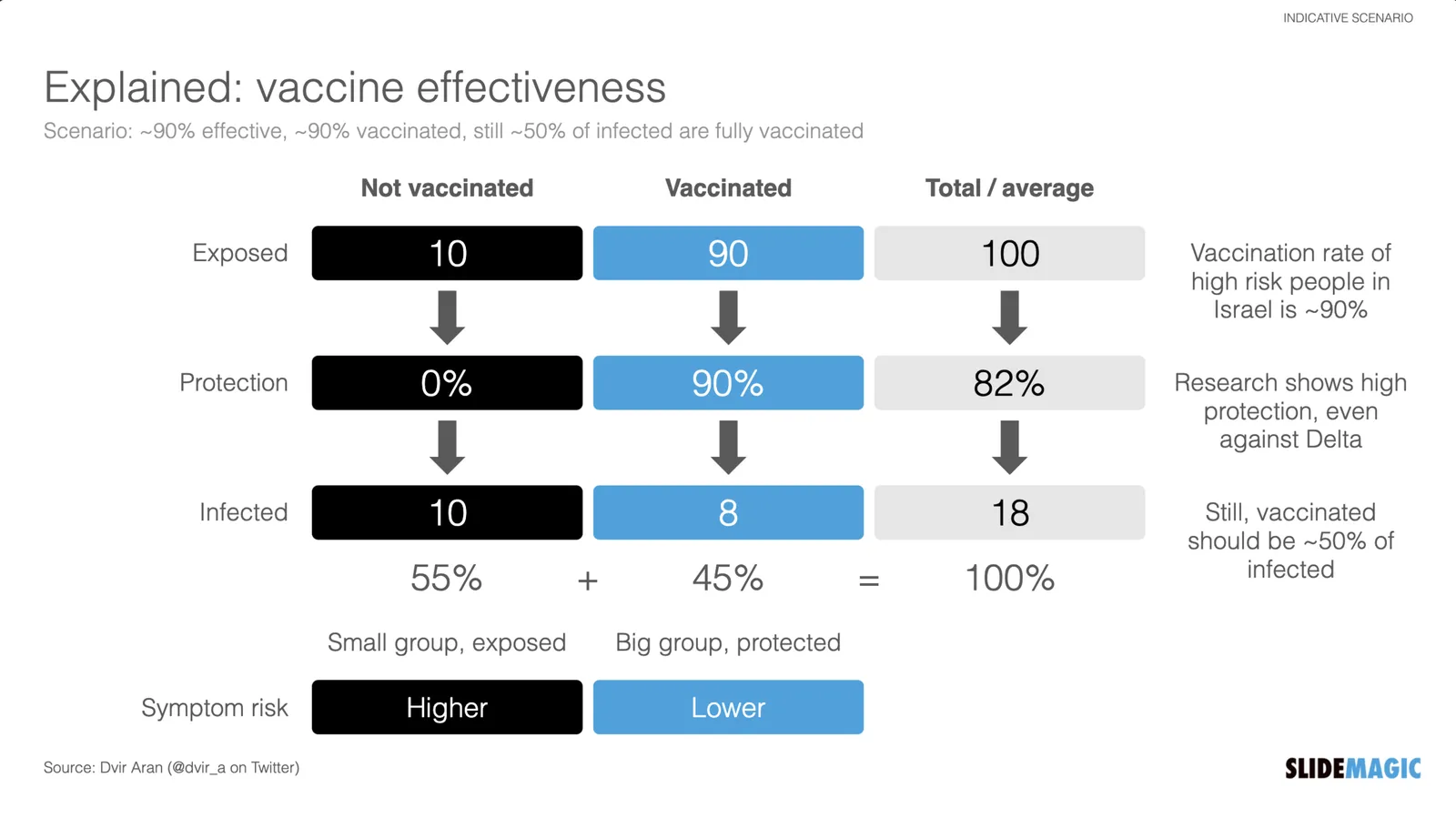
There is a lot of confusion here in vaccinated Tel Aviv, now that around 50% of people infected with COVID appear to be full vaccinated. Newspapers are heavily quoting the “64% i.s.o 90% for the Delta variant” which does not seem to be based on the correct calculation of vaccine effectiveness.

I used an explanation by Dvir Aran to make a slide that explains how it is expected that 50% of infected people are fully vaccinated, even with a 90% vaccine effectiveness.

The logic is as follows:

  • Take 100 people who are seriously exposed to the virus

  • Assume a 90% vaccination rate (the case for the at-risk population in Israel at the moment):

    • A small group is exposed: 10 people
    • A big group is protected 90 people
  • Assume a 90% vaccine effectiveness:

    • 10 out of 10 unvaccinated people will get infected
    • 8 out of the 90 vaccinated people will get infected
  • Of the total of 18 infected people, 8 will be fully vaccinated, so around 50/50

Of those 18, the majority of cases with symptoms and serious complications will be unvaccinated of course.

I have added this slide to the SlideMagic library, search for “COVID” and it will pop up, or download it here. Pro subscribers can convert this chart to PowerPoint, if you have to. (Students, you can claim a free membership!).

·SlideMagic

SlideMagic student program

We are working on new pricing plans, one of which is a free plan for students. Ahead of any formal announcements and websites, blog readers can already take advantage of this options. Email support at slidemagic dot com from your school/university email address (after you created a regular free account), and we will switch you on the new program for one academic year.

Photo by Good Free Photos on Unsplash

VC pitch cliches

If you are pitching VCs for money, it is a good double check to scroll through these suggestions how to ruin a VC pitch in 5 words or less.

Some of these are funny, some of these are not. But more interestingly, it reveals the cliche jargon that people are using in these pitch meetings. The first check is if your pitch is directly dependent on one of these. The second check though is whether a VC or other investor who might not know you very well, is a bit tired (you are pitch #15 of the day), and just got distracted by a message on her phone, might actually perceive that you are making this mistake, are just the same as all the others.

How do you come across when people are not paying attention 100%?

Photo by Daniela Holzer on Unsplash

·Culture

How to hire a design agency

Hiring a creative agency is a bit different from negotiating with a building contractor or a car dealer. And talking to a small 1 - 2 person firm as a different story than dealing with a large design firm. Let’s talk about hiring a small firm (I used to be one these myself).

A good designer is busy and can basically decide which projects to take on and which not. Good designers will be expensive, but there are limits to budgets that people have for creative work, so besides “can you afford me” there is a range of other factors which makes a good designer pick you.

What is a good designer after: delivering beautiful work for clients that inspire and are fun to work with.

  • Crazy deadlines, “you know how this works, we really need something yesterday”. If you are not an existing client, is unlikely to fly. Working under extreme time pressure is not only unpleasant, it also hurts the quality of the work you can deliver. If the designer is will to accept this, it might be bad sign for the buyer
  • Disrespect: showing up late for calls, not replying to emails, taking other calls are all indications for how it is to work with you and whether you are going to pay the bill (in time) when all the work is finished
  • Taste mismatch, if the sort of examples you discuss totally do not match the style of the designer, the project is a no go.
  • Getting pushed outside of your speciality, “you would have no problem finding someone who can turn this into video right?” Any good designer would refuse this since the end result is almost guaranteed to be suboptimal.
  • Creative freedom, if your hands are tied, and you need to follow someone else’s ideas literally, you will get bad end products.
  • “We are big, and can give you lots of work, so please discount”. Big design agencies need to fill their fixed cost base of designers with a predictable work stream, the freelance designer who is running out of hands to work with has no such issue.
  • “Can you give us some ideas, examples [free of charge]?”. If the designer agrees, she is not busy.
  • Very complicated processes: lots of different people involved, lots of decision makers. Big design firms can deal with high maintenance clients via project managers and account managers and more managers. One person creative shops cannot.
Continue reading →

Goldman Sachs predicts the Euro 2020...

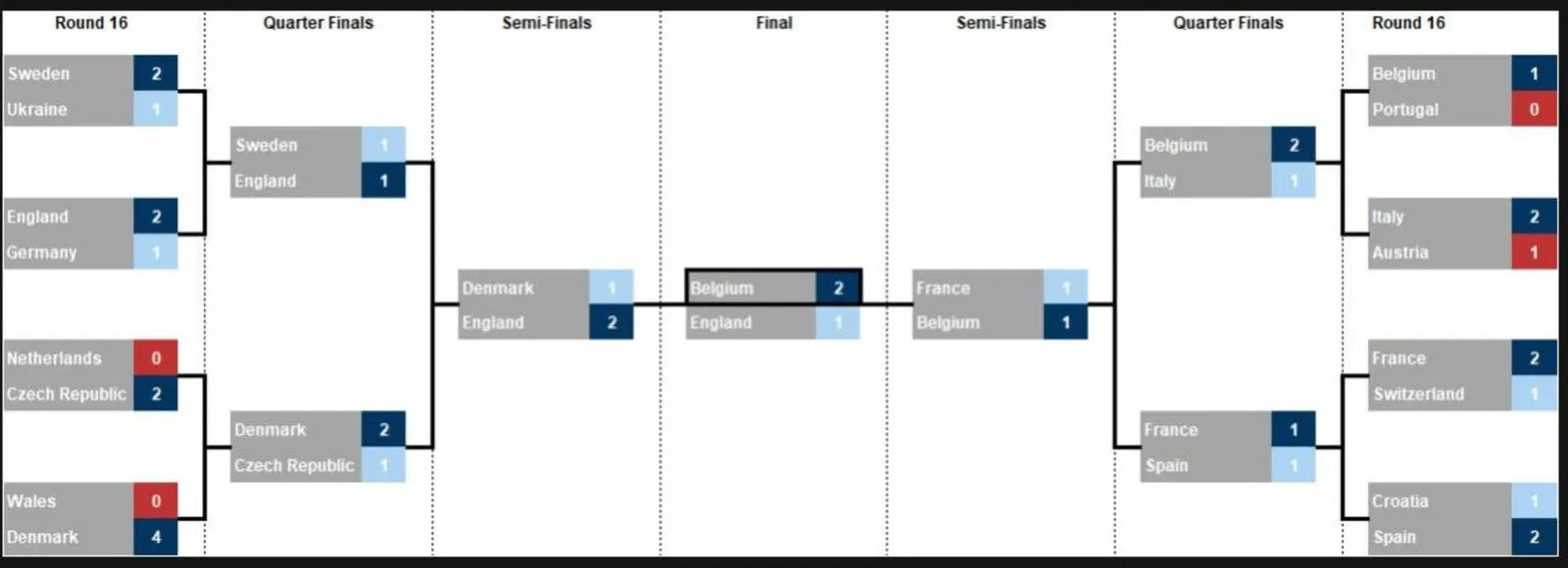
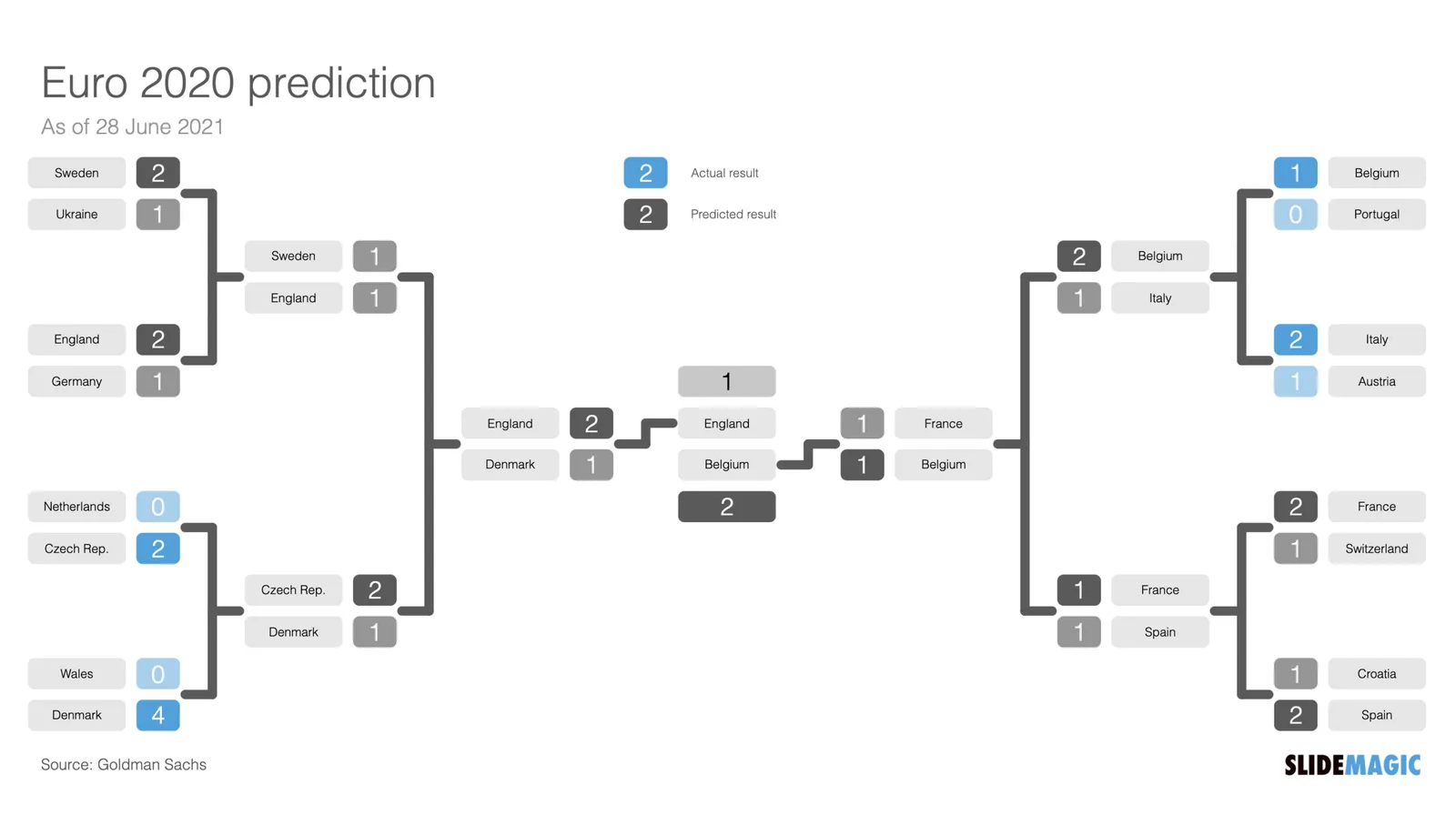
The economists of Goldman Sachs traditionally have a go at predicting the outcome of major soccer tournaments using models that are usually deployed in the field of economics. As of 28 June, the predication was as follows (you see it is outdated already).

I have added a slide layout based on this to the SlideMagic presentation platform. This type of layout can come in handy for any sort of scenario analysis, not just soccer. It is free to use for anyone inside our desktop app (download it here), search for “soccer” and it will show up.

I made a few changes to the layout:

  • Better use of colour
  • Flip the position of the score numbers on the ride side, to create a more balanced layout
  • Make sure the order of the teams in the matches corresponds to the results of the previous match
·Story

Corporate vs consumer audience

Here is a fragment from the introduction of the upcoming Windows 11 operating system by Microsoft’s CEO Satya Nadella.

I think I sort of get what he trying to say, but it is not obvious. This looks like a derivative of the many internal Microsoft discussions that must have taken place how to position Windows against Mac OSX, iOS, and Android, but now with these names taken out. It makes sense for Microsoft employees that were part of these discussions, to a consumer, a bit less so.

He also builds up to a major message in the beginning that ends in making the “consumer agency” point. For most foreign English speakers, “agency” is usually a group of people that work in advertising (or even presentation design). The other meaning is not very well known and it is risky to make this the headline of your whole pitch.