SlideMagic Blog

Frequent updates about all things presentations since 2008. Subscribe to never miss a post.

RSS
all posts

Category Story

·Story

Slides -> Text -> Slides

Most project presentations consist of slides ripped from the project working documents. Pages you used to learn and discover things to analyze and make conclusions. They are not the best visuals to communicate the project outcomes to outsiders.

  • Their layout is likely to be messy and detailed, designed to be read at close distance
  • The structure of your project document is likely to be methodological, like a workplan that makes sure you cover all the bits of work required.

Here is an alternative approach to make your final presentation:

  1. Leave your project working papers for what they are
  2. Write a long-hand text (1 page) that explains what the conclusions and next steps are, supported only by facts that are critical in supporting the recommendations. (Not a “this is what we did” paper)
  3. Now, make a completely new slide deck based on just that text document
·Story

Sounding like ChatGPT

Here is a headline from last night’s GOP candidate debate: Christie accusing Ramaswamy of “sounding like ChatGPT”

We might hear this more often in the future when it comes to debates and presentations. Things that make you sound like ChatGPT:

  • Highly structured stories: intro, your supporting points, the wrap up
  • Very polite language
  • Zero human emotion, humor, anger, cynicism, fatigue
  • No spontaneous tangents
  • Arcs of a few paragraphs each

You get the point. It is similar to “sounding like a marketing content writer”, a style that has been around a bit longer.

·Story

The case against recycling...

… of slides.

It takes time and effort to create a good presentation. So when a next meeting comes up, it is tempting to borrow from a previous presentation that was already created. And typical presentations that are readily available are:

  • Investor presentations of the last fund raising round
  • Board presentations
  • Product / sales presentations

We recently needed to pitch a tailored, one-off, joint service offering with a strategic partner. The first draft of our presentation:

  • About company A (lots of slides, with an investor presentation flavor)

    • The market need for what company A does
    • The generic solution of company A to solve this market need
    • The team of company A
  • About company B (lots of slides with a product presentation flavor)

    • The technology of company B
    • The results and achievements of company B
  • What company A and B can do for you (1 - 2 slides)

Basically 2 generic company introductions, with a few minutes left to talk about the joint solution we were pitching to the client. We changed things around to focus almost everything about the specific problem of the client, and the company introductions were reduced to appendix background reading.

·Creativity

If AI gives poor results...

…when you prompt it to generate your presentation, maybe you are on to something new! AI generators predict what to write based on information it ingested before.

Now what if your AI generator comes up with a brilliantly written pitch?

·Story

Things ChatGPT is good at (and not)

ChatGPT can be a useful productivity tool for presentations:

  • Get a basic story line / section outline for. a presentation
  • Improve the language of a text
  • Etc.

When using it, it is important to understand what underlying technology it uses, so you can see understand where it is strong, and where it is not.

  • ChatGPT predicts words based on your prompt and the previous words it has already generated. Therefore, it is really good at “completing” texts that are very common on the Internet. High school essays, business plans, corporate annual reports, product documentations, product reviews, computer code. If your presentation fits one of these, it will work great, if it does not, results are not very reliable.
  • ChatGPT cannot yet do live web searches to enrich its answers. Everything it “knows” is based on its training data set that was cut off in September 2021. Any information that became available after that, is not incorporated in the results.
  • The majority of text available online is in English, so results in other languages will not be as strong.

Back in the early 2000s, Yahoo! was trying to categorize the Internet. Google beat it with a simple approach of tracking to which site other sites point for a certain subject. ChatGPT is a sort of super template: instead of looking for / categorizing text in templates, it simply reads all the templates and predicts what sentence is most likely to come next given the previous ones.

Continue reading →
·Story

Let others do the selling for you

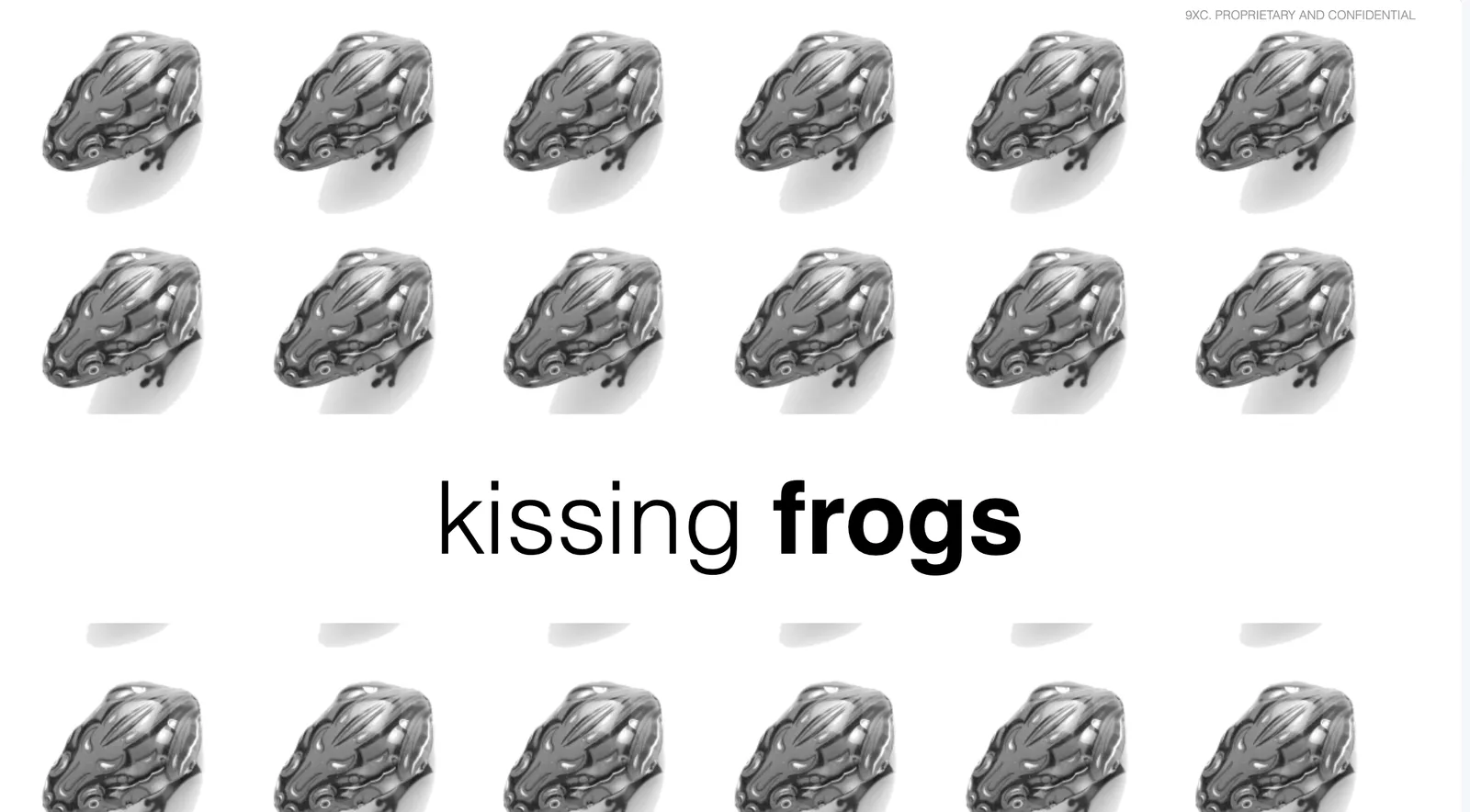
During our very short (see yesterday’s post) speaking slot to launch a new partnership for 9xchange, we used the slide below. Deal making in healthcare is inefficient because everyone needs to kiss too many frogs in order to uncover their prince.

It got stuck in people’s head, and during the following presentations, presenters kept on referring back to frogs in their own talks. Free publicity.

·Story

Introduction emails

People are speed-reading emails. If you got someone willing to introduce you to someone else, and she says “send me an email that I can forward”, she is very likely to do just that, hit forward.

  • Don’t expect much text editing, explaining, or pitching from your contact. Yes, she know your company. Yes, she knows what you want from the introduction. The person to whom it gets forwarded has little idea. Do the hard work for her.
  • Writing the intro line for her (“I had a coffee yesterday with my good friend, and it struck me that the customer segment targeting positioning of their value proposition exactly matches or long-term vision for the business unit”), is likely going to have the line “See below, interested?” above it.
  • You are pitching for the next interaction with the person you get introduced to, not the closing of the deal itself. On the one hand, this will make writing this email a lot simpler, on the other hand, it means that you have make it super personal and relevant, a standard pitch won’t do it.
·Story

Write for your audience

Every communications books and marketing strategists says it. Who is your audience? And many presenters would answer I know: the “C-level executive who is eager to get efficiency and transparency benefits for a better price than the current offerings in the market segment in between premium and super premium”.

That does not sound like a real person to me. Maybe it is someone new on the job who wants to impress her boss. Maybe it is someone buried under so many projects that she does not see how she has time to take on another one. Maybe it is someone who does not like that you get back to emails only after 5 days. Maybe it is someone who ia upset that you still keep talking about things she said she was not interested in. Maybe it is someone who needs to convince a colleague to use your product.

If you cannot visualize your target audience as a person, you might not have found it yet.

·Story

The song is always too long

Advice from a music teacher to amateur musicians: “You think the song is too short, the audience (almost always) will perceive the song as too long”. When you are an amateur musician, who sticks her out by performing on stage, you get instant sympathy, even without having heard a single note. If you play decently, people will enjoy your performance as well. But, because you are not (playing like a) famous rock star, patience / novelty might run out after a while. “Ah, she is going for another verse”.

Have the courage to keep it short.

·Layout

Selective highlighting

This chart in the WSJ shows how you can focus on data points that matter to your story, while literally ignoring other data points that are less relevant.

This slide is obviously super complex, but you can also apply this style with more mondaine, everyday slides.

Instead of complex animations, it is easer to copy a version of your chart in consecutive slides, and adjust the coloring and messaging to highlight the points.

This approach also makes sure that your story is visible in environments without animations (PDF, mobile devices)