SlideMagic Blog

Frequent updates about all things presentations since 2008. Subscribe to never miss a post.

RSS
all posts

Category Software

·Gadgets

MacBook with 2 external screens

The new Apple 27" Thunderbolt display enables you to connect 2 giant external displays to a laptop, something that has not been possible until now without additional hardware.

Large screen real estate has its advantages. It is easier to design presentation slides when you have a large workspace in front of you. Extra space also enables you to open multiple windows, for example a PDF file with comments on the previous version of your presentation, or an Excel file with the data that need to go into your pie chart.

Now, 27" is a lot of space (2550x1440 pixels) and for most ordinary people, one screen will do. A presentation designer might actually need two (putting her in the same category as financial traders, air traffic controllers and social media addicts). I like to design on a clean and calm canvas. All the small windows with bits of information distract me. So I use that second screen as my messy desktop, literally pushing bits, pieces, and windows aside when I do not need them, preserving my pristine and uncluttered design environment in front of me.
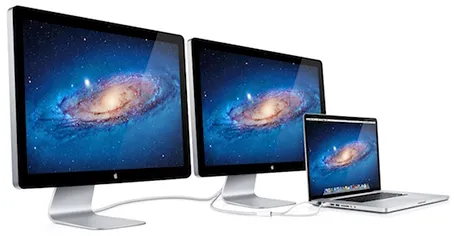
Now some technical details. An Apple Thunderbolt screen can only be connected to a recent MacBook laptop that actually has a Thunderbolt port. But more importantly, the dual screen configuration only works on the most recent 15" and 17" MacBook pros, not on the 13" MacBook Pro, and not on the MacBook Air. (This might actually be an argument for getting a MacBook Pro over a MacBook Air) at the time of writing, October 2011).

Continue reading →
·Gadgets

First sketches with the Wacom Inkling

The Wacom Inkling Digital Sketch Pen (affiliate link) is a tool that lets you draw with a regular pen after which a sketch can be transferred to Photoshop or Illustrator for further editing. No, it does more than a regular scanner. First of all, it allows you to draw in layers and preserve them in the editing software. Secondly, the hardware is so small that you can take it any where you want.

My box arrived yesterday in the mail and the experience confirms what I have seen so far in the promotion video (my sketching skills have some way to go though). The product comes in a box the size of a regular pencil case. The pen and the receiver fit in nicely. Clip the receiver at the top of the page, and start sketching. It is as simple as that. One button opens a new file/page, another button adds another layer. The software is easy to install and works great.

The only drawback for me is that sketching has to happen with a ball point. I prefer a soft tip pen, or best of all a thick pencil to draw. There might be technical reasons why Wacom stuck to a ballpoint for sketching, but hopefully they will release a pencil-based scanner in the near future.

·Delivery

Better webinar software?

I now did a few online webinars and I found it a great way to connect live with an audience without the need to travel, and without the requirement to get a large group of people together in one physical location.

Having said that, the experience from the presenter point of view is far from optimal. You are talking into a microphone, staring at your screen without any feedback. Here are some suggestions to make better webinar software and make the webinar experience a bit closer to that of a live presentation.

  1. Avatars. Encourage people to upload avatars when joining a webinar as an audience member, and more importantly, have these avatars show up on the presenter’s computer. In that way you get a sense of a real audience in front of you. I am sure as technology progresses it would be possible to create a virtual audience shot of live video avatars
  2. Kill presenter distractions. Applications that I use show statistics of people online, people leaving, people joining, people that are active, versus people that are checking their email in another browser window. Some applications require the presenter to let people into the session during the presentation. This information is useful, but there should be a way to switch it off, enabling the presenter to focus on her story. In real life, the presenter on stage does not need to open the back door to let someone back in to the room.
  3. Find a better way to moderate questions. At the moment, questions get punched into a small chart window. There is a constant flow of information, and chart windows are too small to be able to read the text. In a real live presentation setting, people do not shout their questions at the presenter all at the same time. There should be a 2-stage process: 1 audience members need to indicate that they want to ask a question, then the presenter need to give them the floor, and only then can the question be asked. Either through a live voice, or through a text box that has big fonts and can easily be read by everyone.
Continue reading →
·Gadgets

Software developers, please fix this

More and more applications will be a platform to deliver presentations, which means more and more applications need to do the following things:

  1. Have a good full screen mode
  2. Respond to Logitech and Apple remote controls
  3. Support dual monitors including slide preview mode, where you can see the upcoming slide on your laptop screen (not on the screen the audience is watching)

Adobe Acrobat does not have preview mode, and does not respond to an Apple remote. Apple Preview only seems to have slide shows with automated page transitions. OK, Preview might not be intended for running presentations, but Adobe at least should build in features that make Acrobat a good alternative to PowerPoint and Keynote for presenting slides.

Tablet devices would be another category. It is easy now to hook up an iPad to an HD screen. Again, presenting slides should be thought of as a required application.

·PowerPoint

Adobe Acrobat needs to get presenter view

Last week in New York, I used both Keynote and Adobe Acrobat for the first time on stage in a live presentation. Keynote worked great (it is designed to do just that). Presenting in Adobe Acrobat (PDF) was interesting.

I presented at a large conference (this one) where it is hard to switch hardware (I needed a Mac for Keynote) in the middle of the conference program without disrupting the experience of the audience (engineers walking back and forth, screens going on and off). Hence, I went for a PDF version of the deck. (An earlier post on why I think we are going to use PDF for presentations more and more)

With CMD-L you can put Adobe Acrobat in full screen mode, and it responds perfectly fine to the Logitech remote control I am using. The only adjustment you have to make is to make sure that any animated slide builds are spread out over multiple pages.

The one thing I am missing though is the ability to have presenter view in Adobe Acrobat: having a pre-view of the next slide displayed on the monitor that only the presenter can see. Adobe, are you listening? (An old post about PowerPoint presenter view)

To take this a bit further. The one thing that Apple can do to increase the penetration of Keynote is to develop a Windows application that can run Keynote presentations with animations. Editing is not necessary.

·PowerPoint

Photoshop for presentation designers

Photoshop is growing on me, after having confused me for many years. Photoshop is catering to multiple audiences. Professional photographers need the sophisticated tools for correcting camera images. Advertising designers need the engine for creating complex layer compositions.

What is useful for presentation designers? (search help in Photoshop for exact instructions how to find them):

  • The magic wand to remove image backgrounds (the Microsoft PowerPoint option is really poor)
  • Image size and canvas adjustments to get to the exact right size of an image at 300DPI
  • Content-aware fill to extent backgrounds
  • Content-aware extend to extend backgrounds
  • The spot healing tool to fix extended backgrounds
  • The color-replace function to change colors that are slightly off (i.e., make orange red)
  • And (a bit advanced) the vanishing point filter to put text on 3D objects

Whenever a new version of Photoshop is released, I am not so much looking forward to more features, but better implementation of existing ones.

What features have I missed?

·PowerPoint

Presentations on tablets

I am increasingly interested in designing documents for tablets. They could work great in one-on-one meetings (or even stand alone). I have not found the right platform to develop them yet though.

PDFs do not always work (especially when converted using the Microsoft Office plug in) and show up within the frame of the iPad PDF reader (menu bars, chart thumbnails).

HTML5 looks promising. Onswipe aims to be an HTML5 publishing platform for magazines that also could be useful for presentations. If you visit the Marie Claire web site on an iPad for example you see what it can do (it looks like an app, but it is a regular HTML page). But you also see the limitations. A browser-based environment makes page switching slow, and again, you still have the navigation frameworks of the browser application.

Custom apps. Over the past weeks, I taught myself Adobe InDesign, and loaded up software that can turn Adobe InDesign files into custom iPad apps. My computer science background is trying to convince me actually download the entire IOS 4.3 SDK to have a look inside to see what it takes to program an iPad app from scratch. It is a heavy-handed approach though.

Do you have experience with this? Let us know in the comments.

·PowerPoint

Emailing presentations without verbal explanation

Sending a deck to someone who will open it without verbal explanation is a problem. The slides work great on stage, but reading them stand alone does not provide the required context. There is no obvious solution:

  • Making changes to slides (either modifying them all together, or adding text box subtitles to them) is a lot of work, and maintaining two master files is a big pain
  • Converting them to video and adding audio tracks prevents people from skimming through, they might just give up mid-presentation
  • Adding comments in the note pages does not look very nice, and many people do not know how to find them in PowerPoint.

So at the moment, I am trying something different. Over the past week I trained myself up on Adobe InDesign and am creating a framework to drop high-res images of slides into a template that adds a nice formated paragraph of text to the right of the slide. When you PDF the document, it creates the feeling of a spread with facing pages in a nice book that reads very well on a wide screen monitor. It looks beautiful, and it is easy to modify. Let’s see how it works out for my clients.

·Images

We need a replicator in PowerPoint

I am making a second attempt to master the art of motion graphics, this time through Apple software. It is much easier to use than Adobe’s. The more I think of it I come to realize that the ability to replicate objects infinitely and from different 3 dimensional angles could be as useful as flying and bouncing text in presentations (regular readers know what I think of over used animation features). With a good replicator, PowerPoint could produce slides like this:

Via Ads of the World.

·Gadgets

Using your laptop monitor as a 2nd monitor

Computer screens have gotten bigger and bigger, and I suspect that most users will use the extra screen real estate to keep multiple windows open on their desktop. One for email, one for Twitter, one for PowerPoint, one for Skype. Designers do not have this luxury to spread everything out in front of them, they need a big calm design environment with minimal distraction. My PowerPoint or Keynote screen is always set to the maximum.

I used to work with a laptop in clam shell mode in my office: the laptop is closed, and a big external monitor is used as a display. For copying and pasting, inserting Excel charts in PowerPoint, I was constantly moving windows around. Until yesterday, as I looked at the closed laptop screen.

So now I created a dual monitor screen set up. My slide design application is up full screen on the large monitor, and my laptop screen is used as a collection bin for all kind of bits. It has been a liberation. My 17" laptop actually is big enough for the little side apps that I am running in that screen. Great.

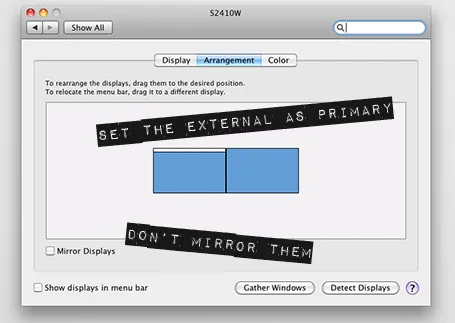
If you are on a Mac, here is how to do it: