SlideMagic Blog

Frequent updates about all things presentations since 2008. Subscribe to never miss a post.

RSS
all posts

Category Story

·Story

Management vocabulary

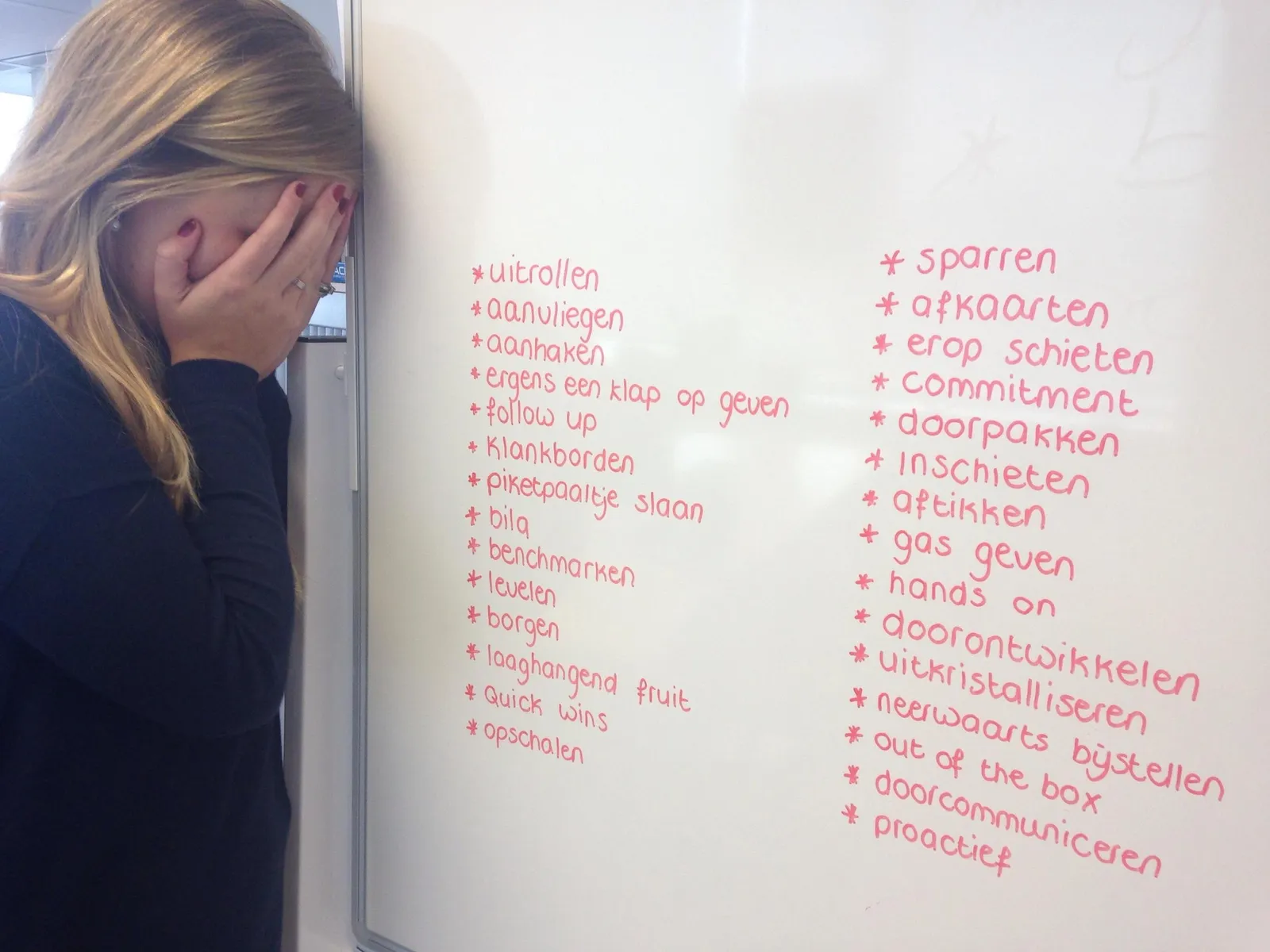
This picture by Anouk Zwager has an interesting list of common management vocabulary in the Netherlands. Part of these words sound perfectly fine to an English speaking audience, but in a Dutch context, with many words in the Dutch language available it just does not feel right.

I will try to translate, some of them might not work:

  • To roll out
  • To make an areal approach
  • To hook up
  • To smack on something
  • To sound board (verb)
  • To hit a marker stick in the ground
  • “Bila” short for bilateral discussion
  • To benchmark
  • To level
  • To secure (like you do with a ship wreck)
  • Low hanging fruit
  • Quick wins
  • To scale up
  • To wrestle
  • To harmonize
  • To shoot at something
  • Commitment
  • To press ahead
  • To shoot on goal
  • To tick the box
  • To hit the gas
  • Hands on
  • To “further develop”
  • To crystallise
  • To adjust downwards
  • Out of the box
  • To “communicate further”
  • Pro-active

Imagey by Jaci XIII on Flickr

·Story

Spending time on the problem

In a pitch there is always pressure to keep things as short as possible. It is therefore tempting to compress the problem you are solving is as few words as possible: “[x] is not very flexible”, because hey, people know this, right?

I tend to drag out the problem section of the pitch a bit:

  • Remind people of the problem in an emotional way, that they “feel” it, usually with a picture or a statistic
  • Point out what is the cause of this problem, it is often soften very trivial that people did not realise. (“Did you know the reason is that there are no batteries light enough to do this?”)
  • Point out why it is so hard to solve the cause (not the problem itself). ("The law of physics that you cannot have this, and this at the same time)

Now you have set up the audience to show why your solution is so clever.

Image: Wolfgang Pauli and Niels Bohr demonstrating ‘tippe top’ toy at the inauguration of the new Institute of Physics at Lund; Sweden

·Story

Problem and solution go hand in hand

I usually spend 80% of the production section of a pitch on the problem, and 20% of the solution. That might seem an uneven balance. But in fact, these two sections are one and the same thing, they go hand in hand. The way you frame the problem, sets up the way you introduce the solution.

Image: Wikipedia

·Story

Corporate language simplification is next

A lot of the progress of humanity boils down to improving and simplifying communication. There were huge wins when we figured out how to speak and coordinate hunting strategies, learned how to read/write/print books, speak long distance instead of taking the ocean liner, video, etc. etc.

More subtle improvements happened as well. Clear, simple language impacts the premium/position that bosses, priests, doctors, lawyers, politicians, can command. Long-winded corporate memos and formal letters made way for informal emails and now messaging to get to the point, quickly.

What we lose in style, we gain in efficiency and clarity. Gone are the beautifully hand-written letters without grammatical errors. Now we have the universal “business English” with a tiny vocabulary, full of mistakes, and pronunciation can be whatever you see fit. The English might not be perfect, or sophisticated, its meaning is crystal clear.

The same happens to corporate language. Management consultants took a first stab at making memoranda logical and structured. The exhibits in these documents slowly become more important than the written words themselves. And now presentation software/slides has become the main language in which we do business.

We need a crisp, simple, visual language to get a business concept across. Everyone can understand it, everyone can use it. That’s what I am trying to do in the presentation app SlideMagic.

Art: Pieter Breugel the Elder, The Tower of Bable, 1563

·Investor presentation

The impatient audience

When I am reading I switch in different modes:

  • Losing yourself in a novel and forgetting the time
  • Digging through an article to find the acquisition price that was paid for a company
  • After having failed to resist the click bait title, looking for the answer to the question it raised
  • Absorbing every background aspect of the making of a certain music album

“Newspaper” journalists often get this wrong. They think they are writing for a person sipping a glass of wine and sitting in front of a burning wood fire, while most often they are not.

Hardly any business presentation is digested in the lounge chair. The audience:

  • Has no time
  • Is constantly distracted by calls, emails, messages
  • Thinks that they know it all already and tries to put your idea in a box that is familiar
  • Is clicking down and clicking down and wondering when they get to the point already

The captive TED Talk audience is in the lounge chair sipping wine. The venture capitalist is scrolling down your slides on her mobile while wondering whether the elevator button “1” or “0” will get you to the lobby.

BTW: Happy 2016 to everyone!

Art: Edouard Manet, Young Woman Reclining in Spanish Costume, 1862-1863

·Investor presentation

Your audience has heard it before

You are only aware of your own sales or investor pitch. Your audience (investors, clients) sit through dozens of them. After 10 sales or investor pitches in a certain industry, they probably understood the key industry trends, and in their heads they are wondering how you are different from the others.

Have the “101” slides ready, but the body language of your audience should tell you whether you are the first presentation they are watching, or number 12.

Image by Malcolm Carlow

·Layout

"We need to add this bullet"

Group editing of a slide deck is difficult, especially if it involves a lot of people, and especially if some of the people editing dial in from a remote location. If you do not have the full view of the presentation (either because you are far away, or you have not been involved in the process that much), you should resist the urge to ask the junior analyst to add “an extra bullet to the slide that say [fill in message]”. There is a good chance that that point is already made on another slide.

Art: Dogs Playing Poker by C. M. Coolidge

·Sales presentation

Sales presentation versus strategy presentation

They are different.

  • Strategy presentation. In most cases, the audience of a strategy project recommendation presentation understands the context. A large part of them probably participated in the project (steering committee meetings, interviews, doing analysis). Therefore, the presentation can be highly in your face, conclusions upfront, in a strict logical order. Pretty much like the classic consulting presentation.
  • Sales presentation. Your audience will be less familiar with the background, you need to drag them in a bit slower, show that you understand their problem, etc. And, logic only is unlikely to lead to a sale.
·Story

Confusing things on purpose

Some clients don’t want to be compared to, seen as, a certain competitor or market alternative. These type of companies might have a very low reputation in the market, typically charge very low prices, or there could be regulatory issues involved where lawyers recommend to change the tone of the pitch slightly.

What you put in, is what you get out. If you confuse, obscure, make it less clear who you are, your presentation will be less powerful. This is especially true for the cold audience who will first try to compare you to a company or concept they are familiar with. If you leave your pitch confused, they will be confused. “Hmm, they are sort of a company A competitor”.

The above is especially dangerous when it is not you who has to present the story, but a third party salesforce, if you confuse things, the salesforce will be confused, let alone the potential customers or investors down the chain.

It might be better to take things head on, and almost follow the thought line of the audience: “yes, this sounds a lot like company A”, but let me explain why this in fact is totally different". But that takes courage.

Art: Composition VII—according to Kandinsky, the most complex piece he ever painted (1913)

·Story

Flatten those bullet point hierarchies

They appear often in business presentations: hierarchies of bullet points:

  • A summary point that partly repeats what is said below
    • A sub summary point that partly repeats what is said below
      • A sub sub summary point that partly repeats what is said below

The worst of all bullet point sins: the lone bullet point that jut hangs there without a brother or sister.

Breaking up a problem/story in its components is great for solving problems: you can get a hypothesis quickly and carve up your team to work on each of the individual bits. They might even work as the skeleton of a presentation story flow.

On actual slides though, it is a different matter. These hierarchies are hard to read and process. You read the summary, read the supporting points, then combine the supporting points to internalise the summary again. Too much.

For a presentation, you need to flatten the bullet points.

  • Kill bullet point hierarchies as much as possible, creating a linear flow
  • Then, spreading out each bullet point on a separate chart (as much as possible).

Ever wondered why my presentation app SlideMagic does not even feature the option of a bullet point?