SlideMagic Blog

Frequent updates about all things presentations since 2008. Subscribe to never miss a post.

RSS
all posts

Category Investor presentation

·Investor presentation

Pop the suspense

I came across a pitch for a business idea that involves a few different businesses, with a number of different people.

The natural way to tell the story is a build-up: here is this interesting problem, that is a massive opportunity, that only we can solve with this interesting technology.

Investors are different from viewers of an action-packed thriller. The moment the “opening title” starts rolling, they start evaluating the investment opportunity, trying to identify the obvious strengths, the obvious weaknesses, and the question marks.

So for investors, you might have to skip to the last page of your thriller and uncover the mystery, before starting your pitch. Here are the 3 businesses, this is what they roughly do, and these are the people involved for each one of them. No let’s start from the beginning.

Photo by Quinn Buffing on Unsplash

·Sales presentation

Convincing the center (redux)

This posts keeps on coming back, usually around elections. This time around the trigger is the debate among “younger” Israelis (below 60) whether they should take the COVID vaccine or not (widely available here in Tel Aviv).

Normally speaking, the risk of serious COVID complications should be relatively low for individuals in this group. With the immediate threat out of the way, people can start arguing. Messaging groups are now a favorite channel for heated debates about the pros and cons of vaccination.

Some points to remember when persuading people:

  • Focus on the center, the people who are in doubt. It is 100% certain that you can convince a die-hard anti-vaxxer, or genetics professor to change her mind in a few message exchanges
  • “Screaming”, aggression, calling people on the other side of your argument stupid and incompetent is not going to score you sympathy points (and help you become more convincing).
  • People in the center are likely to be reasonable people, so wild conspiracy theories or unusual scientific “evidence” might not stick very well

All the above applies to investor and sales presentation as well. Pick your battles and focus on the people who could change their minds

Photo by Marcos Paulo Prado on Unsplash

·Investor presentation

Are TAM slides useful?

The question is raised in this tweet:

My perspective:

  • As a point estimate, they are probably not useful. Forecasting something that does not exist yet is hard, and ‘TAM’ is not interpreted in a consistent way like ‘next year’s revenue’ is.
  • But as a framework to think about things, it could be useful. Forget about the exact definition of TAM. Instead help yourself and a potential investor think about one more approach to think about the potential of your business. “What would you have to believe in order to…”

In the SlideMagic app, search for ‘TAM’ and you will find a few templates that can get you started. Another good framework to use are waterfall charts where you can peel off market segment layers. To put your chart in context, you can add some sort of crystal ball image…

Photo by Sasha • Stories on Unsplash

·Investor presentation

Should you put 'confidential' on every slide of your presentation?

For years I tried to resist the pressure from lawyers to fill every slide with legal disclaimers. They do not look very pretty. But SlideMagic aims to be practical and as of version 2.6.8, you can do so, if you have to.

To make them still look OK:

  • I made the font really small, in all caps, so the disclaimer looks more like some sort of a document id
  • All disclaimers are exactly the same and at exactly the same place
  • The placement of the disclaimer changes based on what sort of aspect ratio / slide layout you are using

Should you put disclaimers? (Warning, I am not a lawyer). There are certain situations where you probably should. Certain confidentiality agreements state that information needs to be marked as being confidential to be covered by the agreement.

But, if there is no such agreement in place, I am not sure how much leverage you have if people are sharing pages despite all the scary warnings on the page. Also, if you are using slides with a big TED talk or product launch, the whole world can see them, making the disclaimers pretty useless.

Most investors do not sign NDAs, and you actually you want the junior VC to forward your pages to a partner in the firm. Assume that when you send your slides to investors, there can be leaks, so be careful what you put in there. In most cases the actual content of your super secret technology will not make the difference when it comes to evaluating your pitch deck in the early stages of the investment process.

Continue reading →
·Investor presentation

Some advice for a seed investment pitch deck

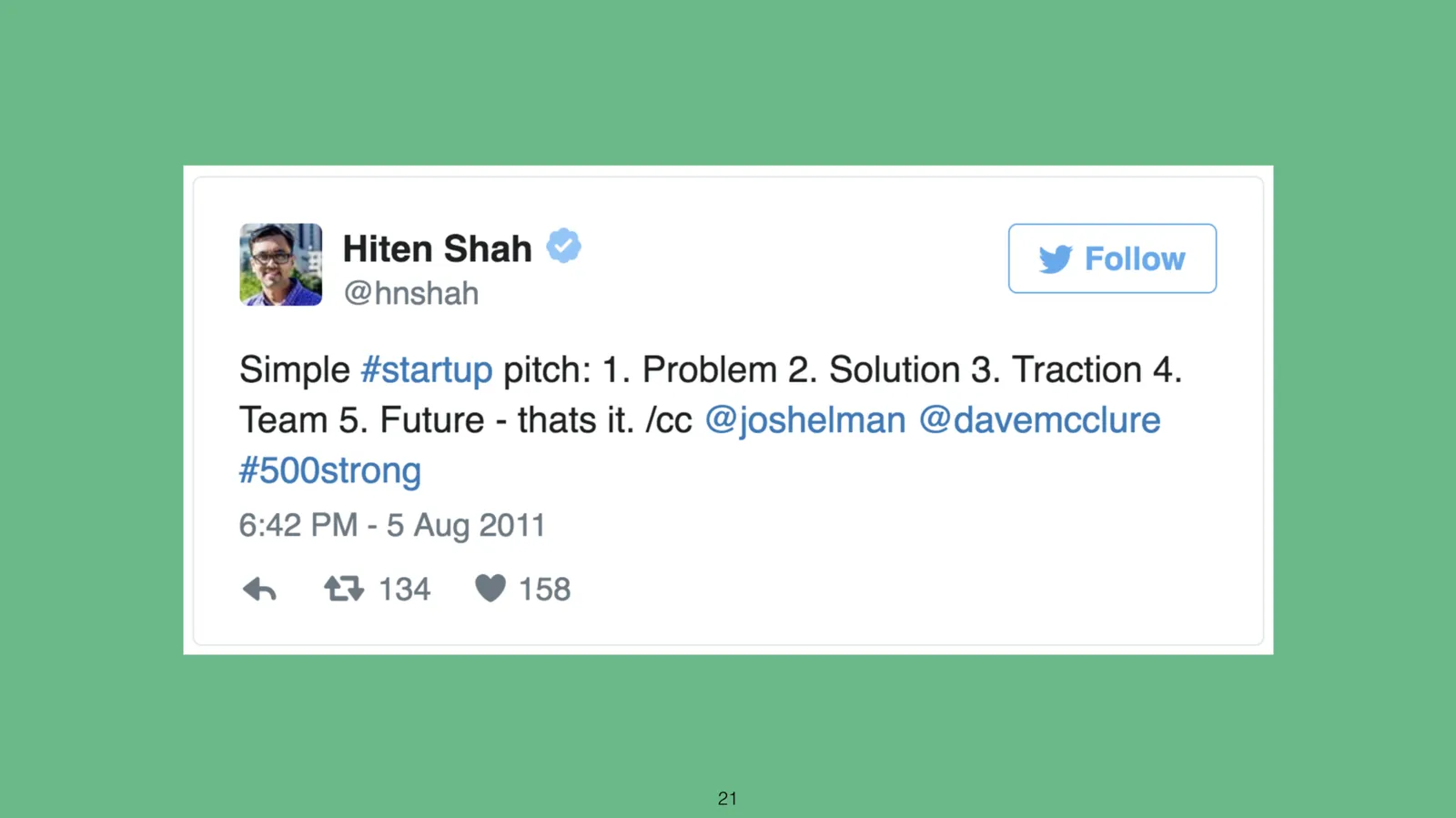
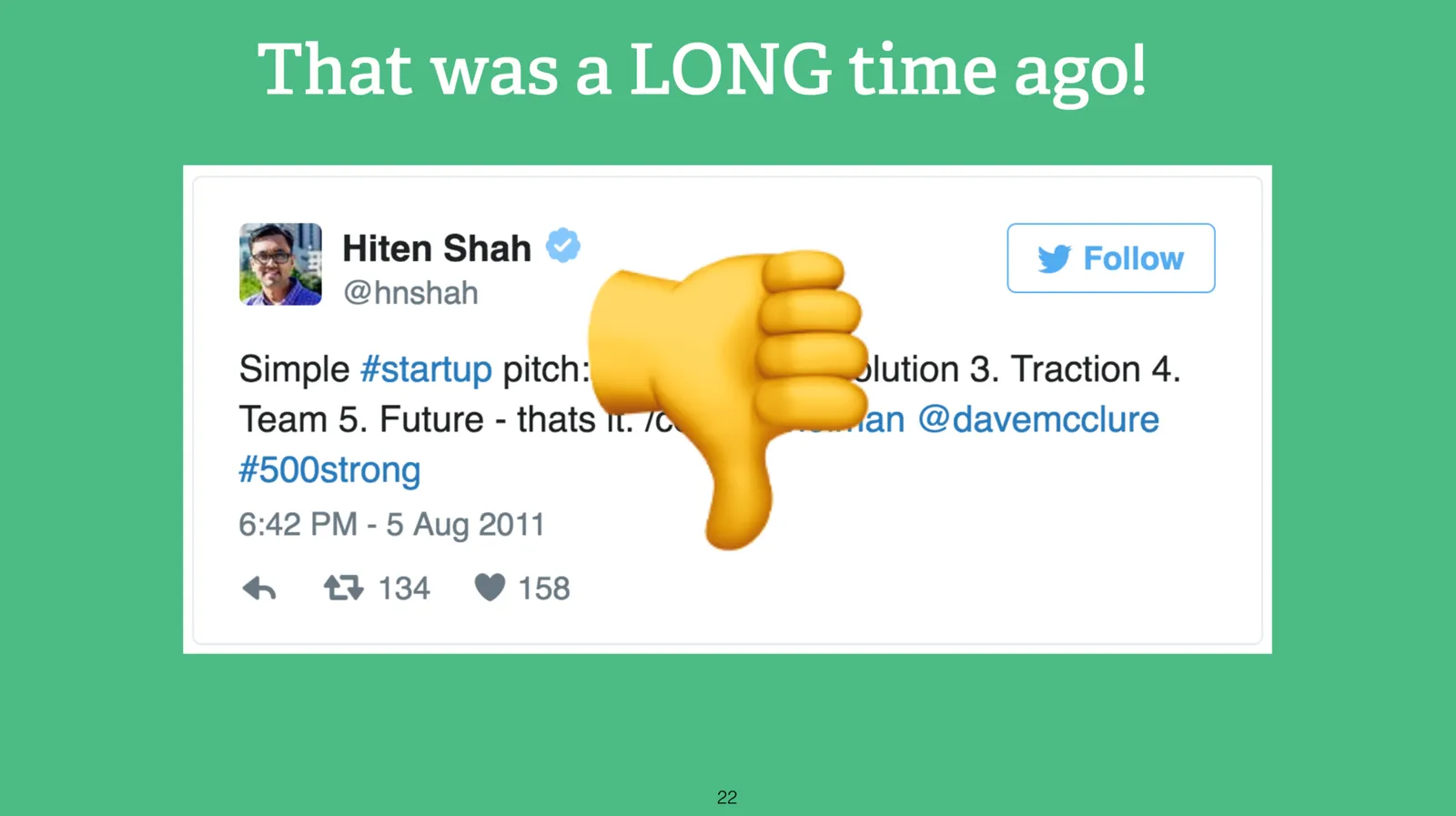
A nice collection of startup pitch deck wisdom by Hiten Shah and Marie Prokopets:

·Data visualization

How to make a source of change waterfall chart (Apple quarterly results)

In between the election news: waterfall charts….

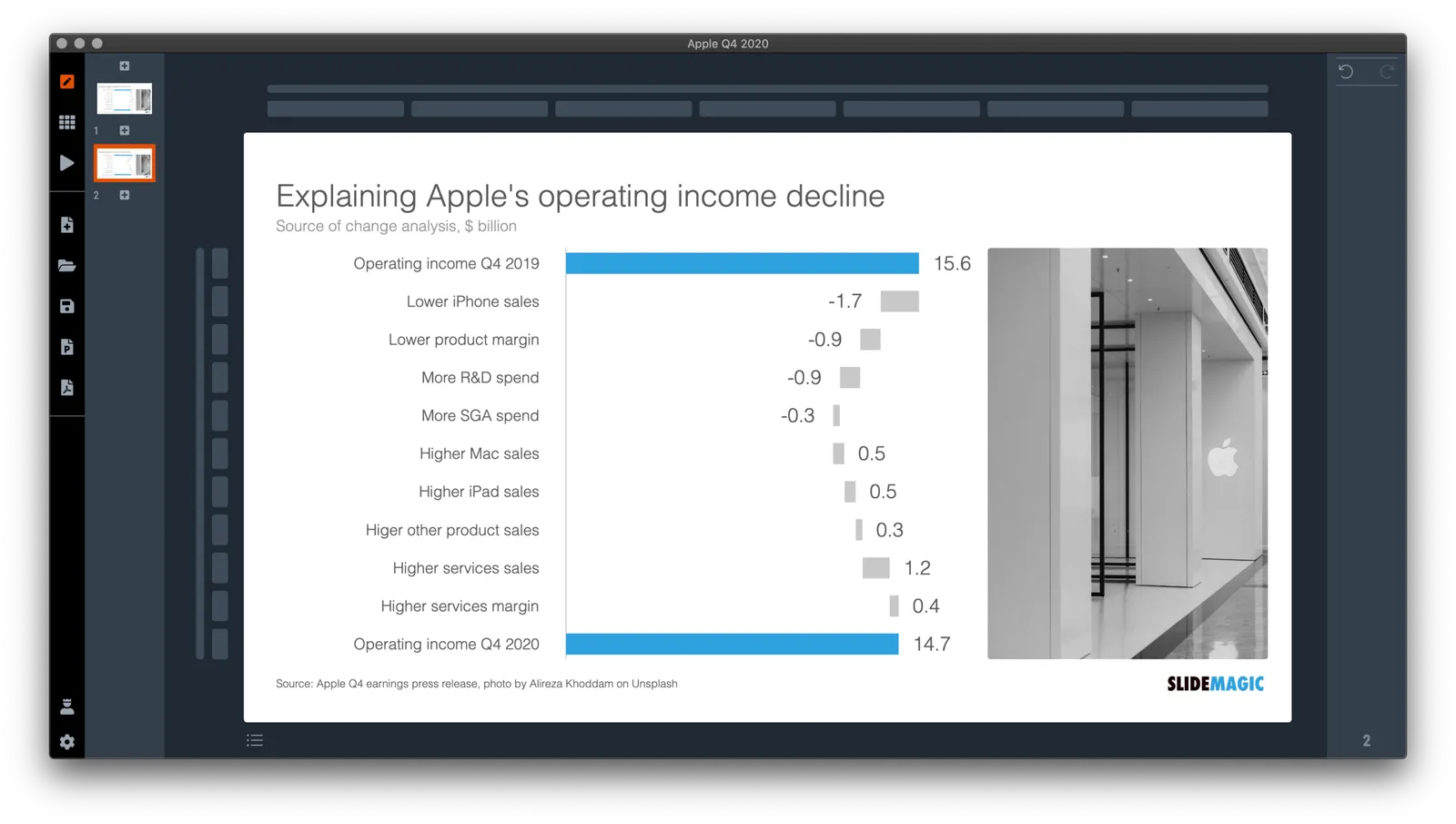
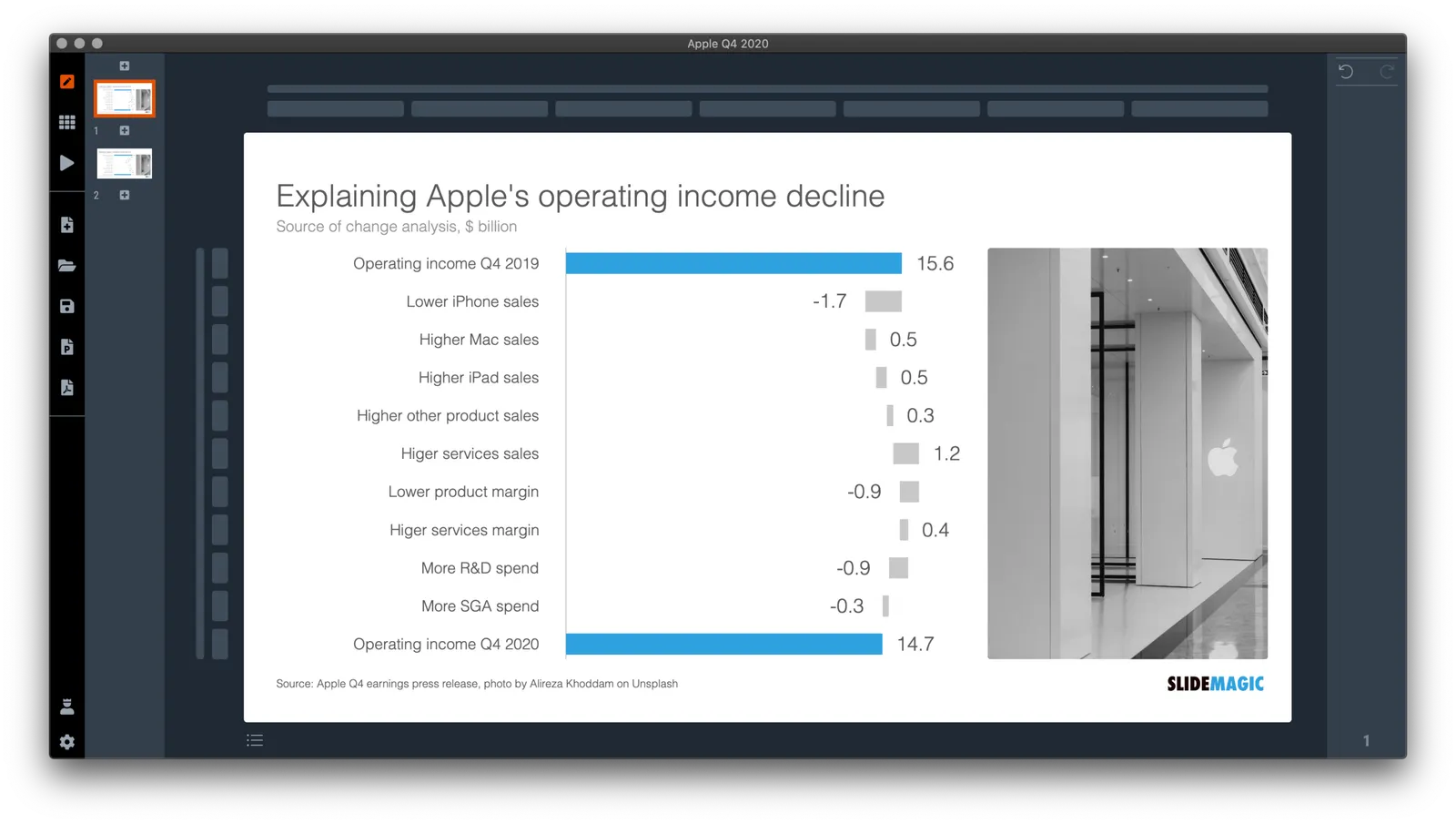
Waterfall charts are a great tool to explain the difference between 2 scenarios. In SlideMagic, they are really easy to create. Below is one I put together quickly with data from Apple’s 2020 Q4 earnings result, and a photo I found using SlideMagic’s built-in Unsplash image search. Notice how I opted for an unusual vertical waterfall, to create more space for the axis labels.

Some people would argue that you could make the chart even clearer by breaking the axes: showing them as ‘5.6’ and ‘4.7’ for example. Yes, it would highlight the deltas better, but in general, I think manipulating axes, well, manipulates the message. The fact that the changes are relatively small to the total is part of the message.

I reshuffled the rows a bit to group the decreases and increases. That makes it more clear in one sense, but less clear in another. Your choice.

\How do you go about making such an analysis? I put my numbers in a Google Sheet that you can view yourself.

  1. Enter the data for the 2 comparable quarters in 2 columns. Add the totals as calculations rather than hard-coded numbers to check that you did not make any typos. (The blue cells are the one that I type in, the white ones are calculations).
  2. Create space between the 2 columns
  3. Pull numbers from the input that you consider drivers. You see that I deviated a bit from the way the input was presented:
Continue reading →
·Investor presentation

YC advice on pitching

YCombinator has made library of support material for startup founders available online for free. One of the results for a search on ‘pitch decks’ produces this. Some things to highlight:

“Be excited. Your pitch should not sound memorized. Intonation, cadence, and projecting help a lot”

“Actually explain what you do, and do it quickly”

“Don’t be “cute” with your points, be declarative”

“If you make a joke, telegraph it. If you’re not sure the joke will land, cut it

“Charts should be easy to understand - make one point with any graphic or chart. Don’t make people read charts - they’ll stop listening to you.”

“Line graphs are better than bar graphs when showing growth” (Not sure this is the case)

“TAM should be bottom up, not top down” (I.e., not 0.5% of $5billion)

“Coolness and legibility are not orthogonal, they’re diametrically opposed”

It is important to understand where these suggestions are coming from: very experienced investors that are focusing on very, very early startups and hence need to sit through many, many, pitches with a huge range in quality (both in terms of pitch quality and company/founder quality). That explains the feedback of make your title readable, don’t use thin fonts, make your slide clear that when I look up from answering an email on my phone, I still know what is going on, don’t be cute, tell what you actually do, etc.

Still, if you are an early stage company looking for funding, this is your audience, better give them what they want. And remember, part of your startup pitch is testing your ability to sell a product to a matching audience. Selling your company to investors, or selling your product to customers, or helping investors sell their stake in your company to another investor in the future, all require similar skills.


Continue reading →
·Investor presentation

What is the forward email?

The most effective introduction to investors is via a referral of a mutual connection. When this mutual connection is ready to put her personal credibility on the line and forward your pitch to an investor, the pitch changes. No small talk, no waffly market backgrounds, and actually, no (or very little) structure, they get straight to the point.

The forward email is likely to be something like this:

  • I know this person from ….
  • She did this in the past and delivered on all fronts
  • Here is a new idea, it is something like an X for Y
  • It looks interesting, the obvious question mark is Z, but W could be the wild card that can make the difference
  • It could fit nicely with your other investment V
  • Have a look and let me know what you think.

Maybe it is a good idea to already think about what your forward email is going to look like, before you ask someone to send it.

Photo by Matt Ridley on Unsplash

·Templates

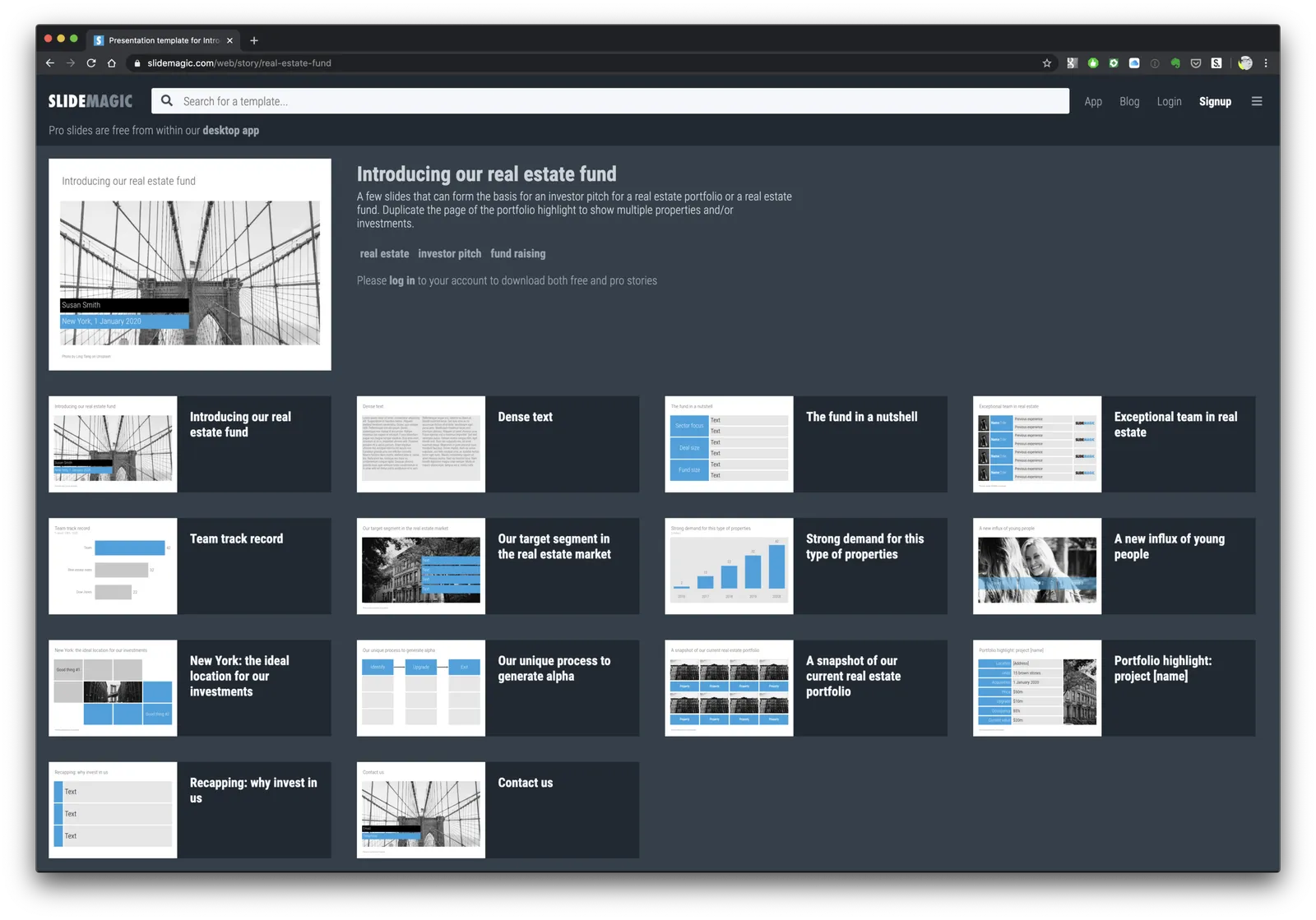
Real estate (fund) pitch presentation template

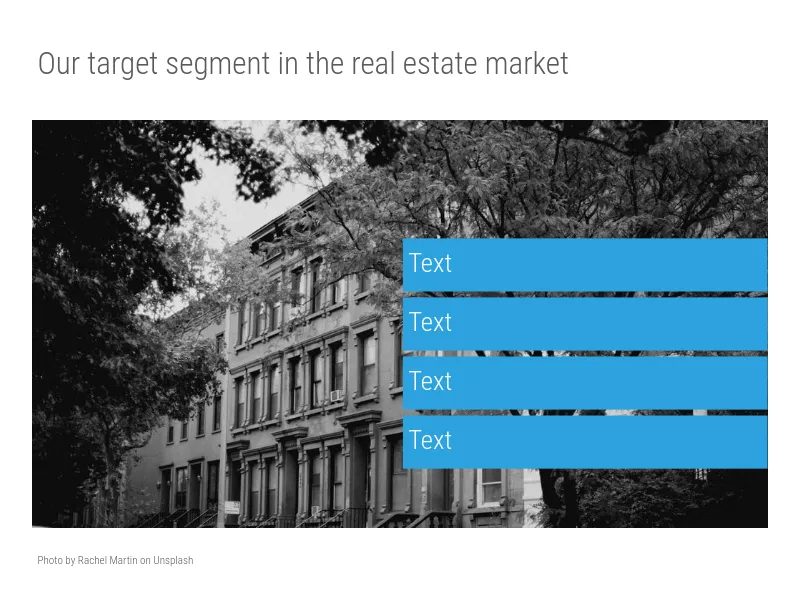
SlideMagic is very suited to make decks that promote real estate projects or funds. It is easy to manage pictures of properties and add boxes with information about square feet and returns. I have added a template for a real estate fund pitch to get you started.

Note that when searching for slide templates, you do not need to resort to keywords such as “real estate” (it will give some results now though), any layout that shows lists, or grids, or portfolios, or screenshots will do. Real estate presentations use very generic layouts.

·Investor presentation

"We are never going to invest, but how can I help you?"

If you hear this from an investor as the very first sentence she says, this could either be:

  1. A gutsy negotiation tactic to get the valuation of the shares in the B-round preferred equity shares down
  2. She will not invest in you but wants to be helpful anyway

In 99% of the cases it is scenario number 2, so launching with full energy with your pitch (page 1/50, “market developments”) might get you cut off.

In these cases, I would still clarify, ‘OK, but why?’. The answer is probably: “You are in stage x in market y, we invest only in stage w and market v, but we have a friend in common so I agreed to take the call”. No chance of scenario 1…

All is not lost though. Switch tactic immediately and find out what this investor can do for you. Useful contacts. Ideas for investors who would fit the bill. Time is probably limited (she is doing you a favour, so hold back with arguing or discussion, take notes and put all the feedback in the perspective of the person it is coming from.

The notes might actually contain something that is new to you, and you will have left a very good impression for when you guys meet again in a situation where there is a better match.

Photo by kyle smith on Unsplash