

SlideMagic Blog

Frequent updates about all things presentations since 2008. Subscribe to never miss a post.

RSS
all posts

Category Investor presentation

·Investor presentation

Startup competitions

Startup competitions are different from regular investor pitches. Your are on stage to deliver a show to a crowd, not to a VC partner group. The jury members do not have to put their money where their mouth is. I asked a recent jury member for such an event to list feedback on investor presentations from the top of her head, without too much thinking. Here is the raw result:

  • Have someone speak who masters the language. This is a back-to-back show, and if all candidates speak fluently, the one who does not will stand out negatively.
  • Personality, attitude, enthusiasm, passion are far more important than professionally crafted slides.
  • If you have to send a very junior team member to present, because the you, the CEO, has better things to do than to attend the startup competition, it is probably better not to show up at all.
  • Contradicting myself, a presentation by (recorded) video was received remarkably well.

Startup competitions might suit some startups better than others. Things that score points for a big crowd: an unusual, non-typical, entrepreneur; an impact/green/environmental/healthcare-related company objective, a market that a non-technical audience can relate to, etc. etc.

When preparing for a startup pitch event, customize your slides and story and don’t bring your standard investor pitch to the event.
·Sales presentation

In the briefcase

Here is a very common presentation scenario. You have a good relationship with a middle manager in a potential client, and she meets the CEO next week and could take “a few slides” with her in her briefcase for a 30 second pitch.

What not to do? Send your full 30 minute pitch deck that you have used in so many successful Zoom meetings before. Especially that slide with just a golf ball on a green lawn always drives your point home.

You are not presenting, your friend does, and you don’t have 30 minutes, you have 30 seconds. But this might be good news. Thirty seconds of your friend with the CEO, is a better shot than 10 minutes with a purchasing officer who you do not know.

What to do?

Take the time to explain to your friend what it is you do, and then make a “placeholder” slide that she can use to give the pitch. It is not possible to go through a slide deck in 30 seconds, so the pitch is basically a verbal one. Your placeholder should look nice, and actually not distract too much so that the CEO can keep her focus on the audio track. (Typos, calculation errors….)

You need to rely on your friend to do the pitch, but you need to compensate for the fact that you are not in the room, nor on the Zoom screen to give the CEO the opportunity to use her intuition to answer the “who are these people?” Question. A CV/bio type slide with a picture could do the trick (again a placeholder) , “hey they also went to INSEAD…”.

Continue reading →
·Story

Demo versus manual

Giving a demo of your application or web site to an investor or potential partner is different from teaching a new user how to use it by herself.

For the user:

  • Where do all the buttons sit
  • How to log in
  • How to update settings
  • Where to find your account details
  • How to create a project from scratch
  • Etc.

For the investor / partner:

  • What does the app do?
  • Show me a walk through of a “story” or use case
  • Have a project ready to show
  • Look, there is actually a piece of software that is working…
  • Etc.

In presentations, you are most likely to deal with scenario 2. Do all the prep work (logging in etc.), and design a very clear script of what you want to show, cutting out any tangents and other delays. Keep it short and focused. Rehearse your walk through, and as a backup, have a series of consecutive screenshots ready just in case Murphy’s law kicks in.

·Sales presentation

Nagging does not sell

Seth “stole” my thunder… A blog post about how nagging and insisting without introducing new information or ideas is not going to get you anywhere has been sitting in my mental pipeline for a while. Some examples.

  • People here in the Middle East can be very defensive, and this happened a few times in presentations I attended here around Tel Aviv. After your presentation you get a question, the presenter answers it. The question gets asked again, but it was not really answered. The presenter is not really listening, and more or less repeats the same answer, this time a bit louder. This pattern might repeat itself a few times without a resolution
  • As a startup CEO, I get tons of “spam” emails with subject lines and opening sentences that sound like spam. That first email does not trigger a response from me, but it gets followed up by pretty much the same email, with the same subject line in bold
  • The investor is not going to invest in you, because she does not invest in medical diagnostics companies, and you are a medical diagnostics company. Trying to convince her that she should invest in these companies will get you nowhere. Either move one, or give the pitch of your company a different spin, away from that particular field.

Parents might succumb to repeated pressure and buy calm in the house, pretty much everyone else will just ignore you.

Photo by Dan Burton on Unsplash

·Culture

Pitching to VCs outside of your home country

Mostly thanks to COVID-19, the venture capital industry is going global. Which means that VCs are increasingly willing to invest across borders. Some implications for investor pitches.

VCs get the confidence to invest further away partly because of increased specialisation. They know exactly what sort of deals to look for, have a very deep understanding of technology in that particular field, and as a result can size up opportunities easily, even at long distance.

[P.S. Something similar happened in my bespoke presentation design business, where I specialised in a very specific type of presentation which is highly similar across borders, and usually have very similar type of clients. This was both important in terms of deciding whether you can do the project, winning a pitch for a project, and making the call whether this unknown client in a different country would eventually pay my fees].

Even more than before, as a startup, you need to do your homework and select potential investors carefully. The upside of this extra work is that if your company fits a specific investor profile, you are very likely to make it through the first investor screen, people will actually look at your deck. “Hmmm, these guys are not from Palo Alto” is no longer relevant. The cost of a brief Zoom call to check you out in person is much lower than a “coffee chat”, so you might score that one as well if the field is relevant.

For a highly knowledgeable investor with an office 5 time zones away, that first deck might have to be more specific than a nice mysterious teaser inviting her to schedule a phone call. You can cut slides with general industry background, but probably need to add data that investors in a specific technology segment are expecting to see (experience from looking at hundreds of other companies in your specific sector).

Continue reading →
·Investor presentation

The audience is always right

Sometimes, you can be so absorbed in your own story that your forget to put in the obvious in your pitch deck.

Yesterday I overheard a healthcare VC reviewing a pitch deck for a new diagnostic tool. Pages and pages about the impressive team, the excellent trial results and robust data, until what the tool actually was diagnosing was revealed on page 15.

An investor who is scrolling through a deck to find an answer to an obvious question is not paying much attention to other information that is put on the slides.

Maybe in this case, this answer was actually written somewhere in page 1 of the deck, but remember that when it comes to presentations, the audience is always right.

Photo by Girl with red hat on Unsplash

·Investor presentation

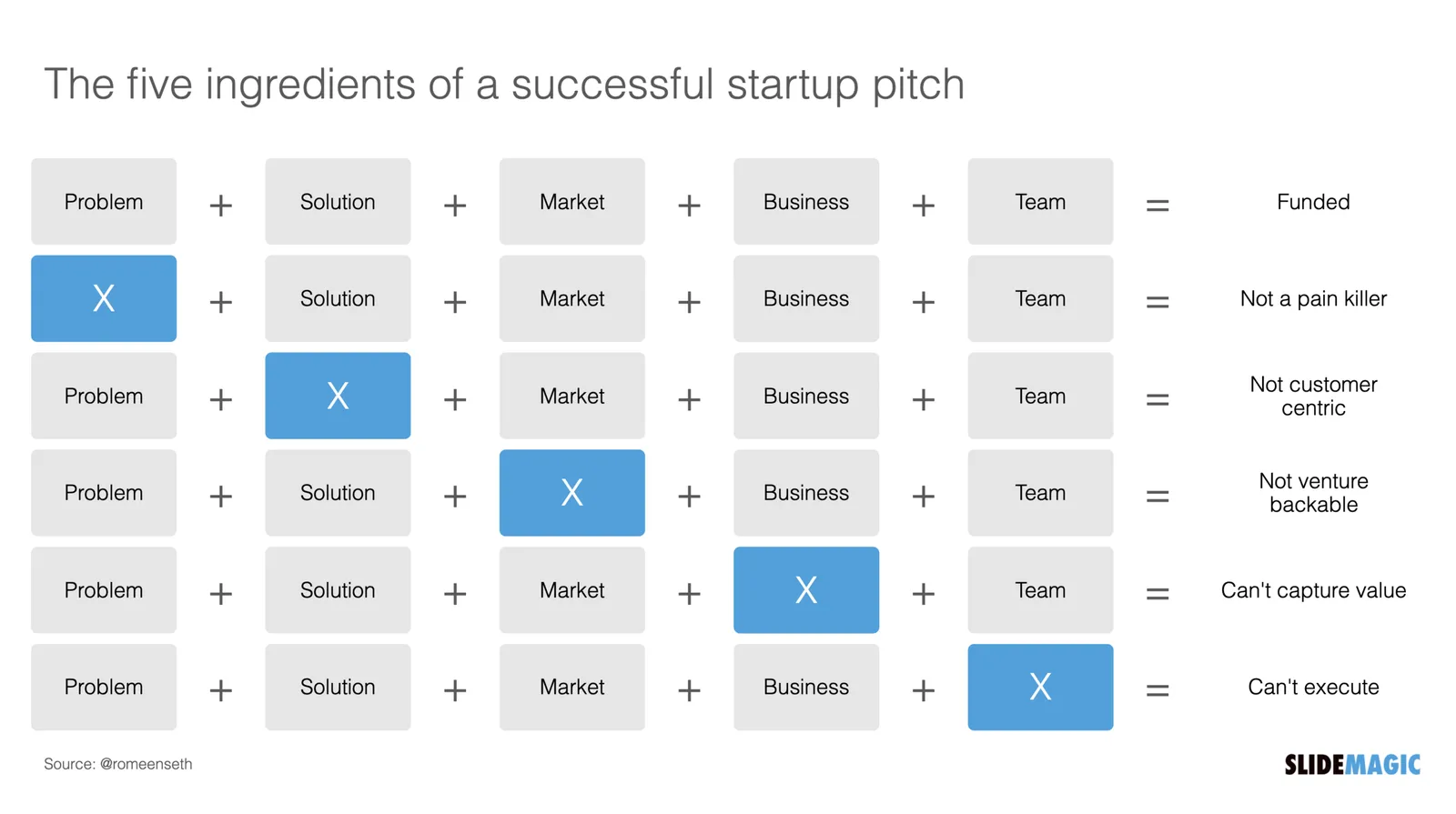
The five ingredients of a successful startup pitch

I added the slide used in this tweet to the SlideMagic library. In SlideMagic it is super easy to quickly create a grid with lots of boxes. There is a lot of redundant information on the slide, but the repetition on the other hand serves a purpose here.

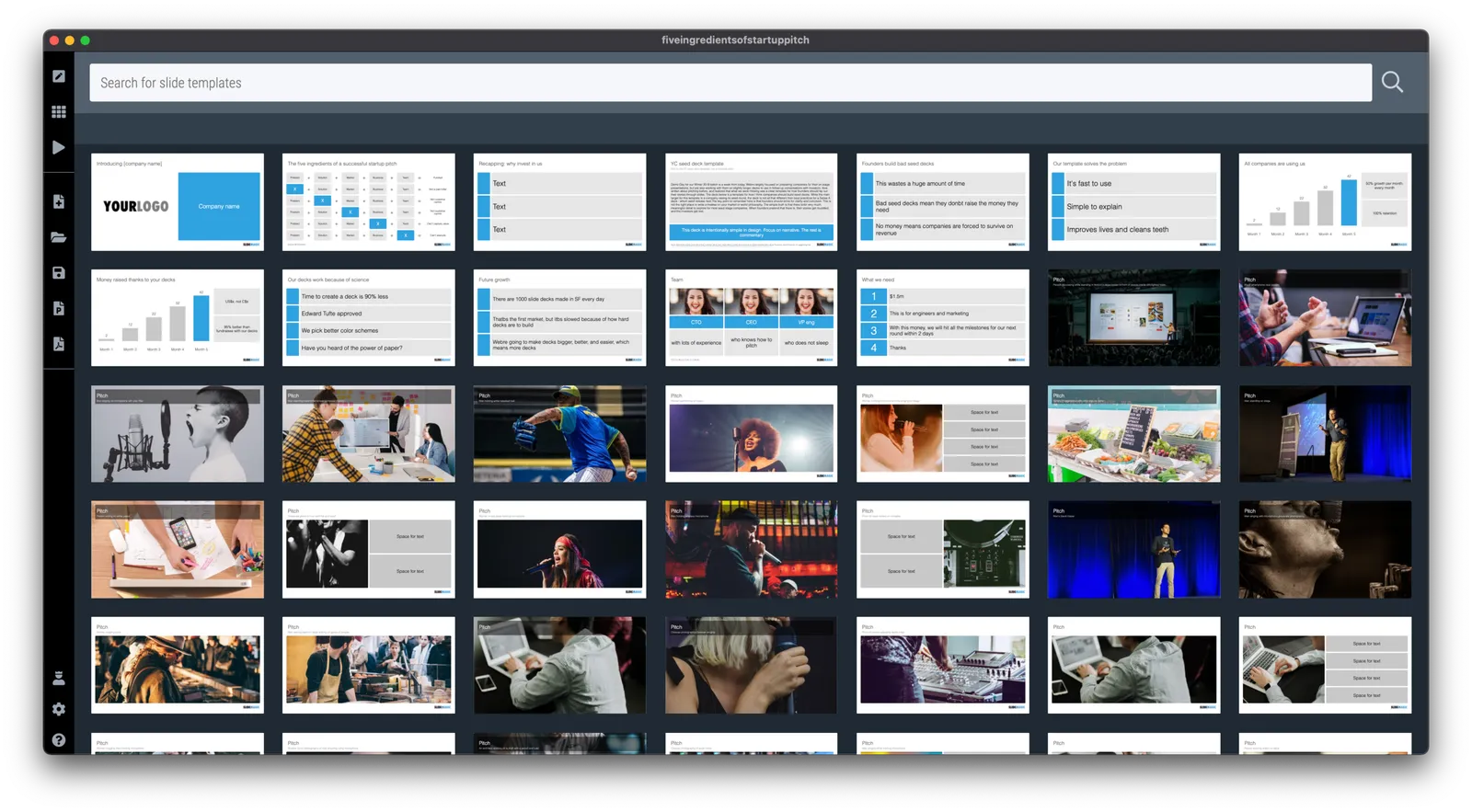
Search for “pitch” in the SlideMagic app and it will pop up for you to use (alongside some other investor and musical pitch related slides).

·Investor presentation

Live demo in presentations, should you?

It is tempting to show a live demo of your product in your pitch presentation: look, we have a real product, this is not just “slideware”.

There are downsides too though. Murphy’s law, if a technical issue could happen, it will happen, especially in important pitch presentations. Demoing a product involves all kind of time consuming steps that are not really adding to your pitch: log-in screens, clicking through various settings pages, loading dummy data. If you have only 20 minutes, each and every minute is very valuable. Fifteen minutes of demo might be too much.

So, what to do?

  • Include a series of relevant screen shots in your pitch deck that show the key features of the product. The objective is not proof of technology, just educating the audience what it is that you actually try to build. Choose the screens wisely and put them in the right sequence. Add arrows and markups to make things clear if needed. (App screens are not presentation slides).
  • If possible, have a live demo of your product running on your machine, and in that first 20 minute pitch, simply click through a few screens. The objective is not to use it to explain what you are trying to build, but proof that there is actual technology. “Look, here it is!”
  • If the audience is interested, schedule a second meeting that is entirely dedicated to demoing your product, leaving sufficient time for solving technical glitches.

Photo by Rhett Noonan on Unsplash

·Investor presentation

Everything to the front page

So you got some feedback on your pitch deck: “You need to ‘hit them hard’ with your strongest points early in the presentation”

Ok, bring this to the front, bring that to the front, this the front as well. Hmmm, now we have a lot of pages at the front, maybe summarize all of these messages on the first page, then we get to all of them really early.

The result: a dense, boring bullet point page. And it will take you 20 minutes to go through it, since it contains the entire presentation.

Most investment ideas have very few ideas that are truly distinctive, or better phrased: ideas that do not sound like all the other pitches an investor listens to. Be very honest and selective. Often, you might have to deal with an “elephant in the room” early in the presentation. Addressing competition from Google if you are building an internet search engine on page 27 is not a smart idea.

Photo by Georgi Kalaydzhiev on Unsplash

·Investor presentation

To share or not to share?

Every potential investor will probably reply with “sure” to the question if she is interested in a copy of the pitch deck. But what should you share? Some of your slides could be highly confidential, others might be too detailed. It is impossible to give a conclusive answer to this question, but here are some points to consider, given a number of possible investor profiles.

  • Investor profile: angel investor who invests as a hobby and loves networking and being involved in the buzz of the startup world. She is incredibly friendly and wants to be helpful, but you don’t know her that well. She was asking fairly high level questions and you had to give her a 101 on the industry you are working in. Maybe a short summary deck with non-confidential information will do. She probably does not have a deep technological understanding of your niche, and is likely to forward material to many of her friends to see if they can help you as well.
  • Investor profile: junior analyst at a specialized VC firm who keeps on asking about very detailed financial growth benchmarks. She is begging you to provide all the ammunition you can find to convince her boss. No, they don’t sign NDAs. You probably have to provide the details as it sounds like an all-or-nothing shot with a highly relevant investor.
  • Investor profile: you happen to sit next to her at a post-COVID dinner party and find out she is actually an investor with a potential fit. The setting was not right for an in-depth pitch. Maybe here you should send a very short “business card” presentation, slides that look great, give a brief explanation of the idea, plus additional background on you as an entrepreneur. The objective is not to land the investment, but to get an opportunity to do that proper pitch.
  • Investor profile: someone who makes it pretty clear that the possibility of investment is close to zero: wrong industry, wrong stage, wrong geography. Saying that she is interested in the deck is her being polite. Maybe better not to send anything at all.
Continue reading →