SlideMagic Blog

Frequent updates about all things presentations since 2008. Subscribe to never miss a post.

RSS
·Investor presentation

It makes sense, but it does not

I have been in many of these types of presentations:

Some of the reasons why the overall conclusion of a presentation does not make sense, while the individual slides do:

  • Maybe the people, the organisation, and its culture is not the right environment to make a plan happen. Who is going to do it?
  • The probability curve: on average, normally speaking, the strategy makes sense. But what if things start deviating from the average. What is the potential downside and could it be catastrophic to the compony?
  • The self-fulfilling prophecy. Yes, the deck has 50 slides, discussing 50 different aspects of the idea, but when you look at it, they all depend on ver few (maybe even one) assumption about the market outlook, a valuation of a company, etc. That assumption could be wrong.

Unlike for big companies, for tiny startups the opposite could be true. The slides might not all make sense, but the team is fantastic, the downside is not that big, and an angel investor is willing to bet on that one big assumption.

Photo by dylan nolte on Unsplash
·Software

Slidemagic 1.0 templates merged into 2.0

I am working hard to get rid of the Shopify template store with its shopping carts that are great for buying t-shirts, but not convenient for downloading presentation templates.

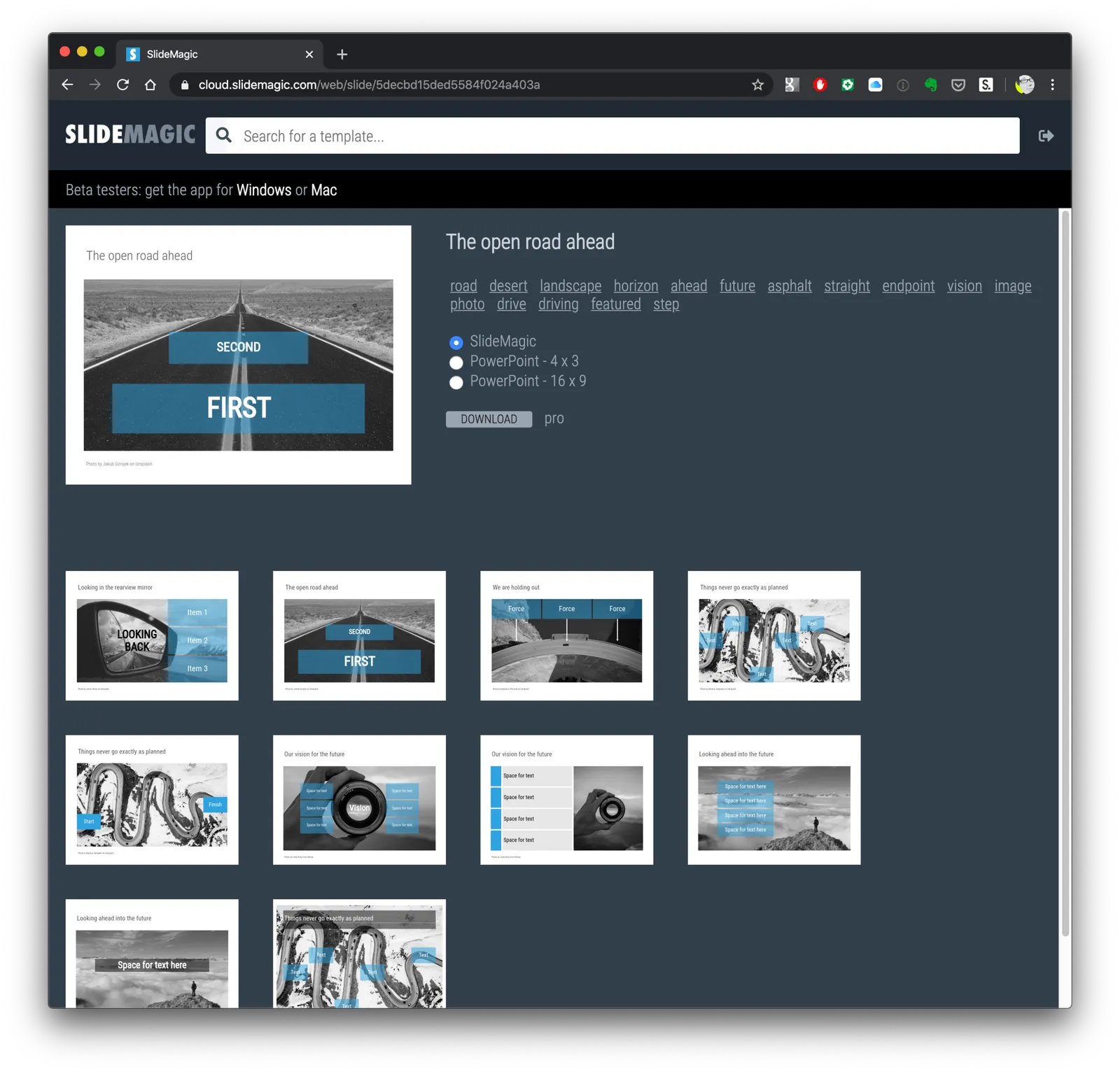
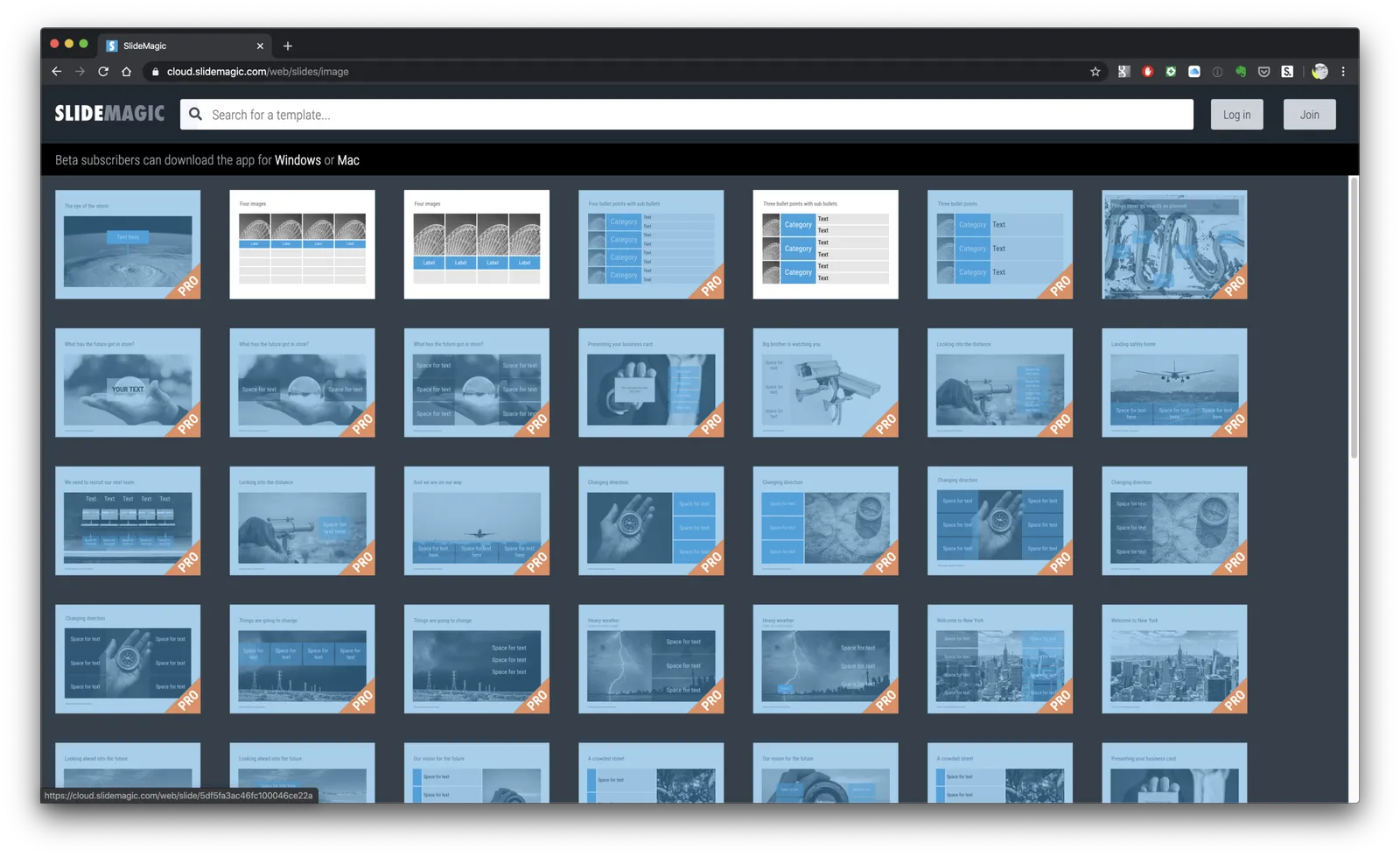
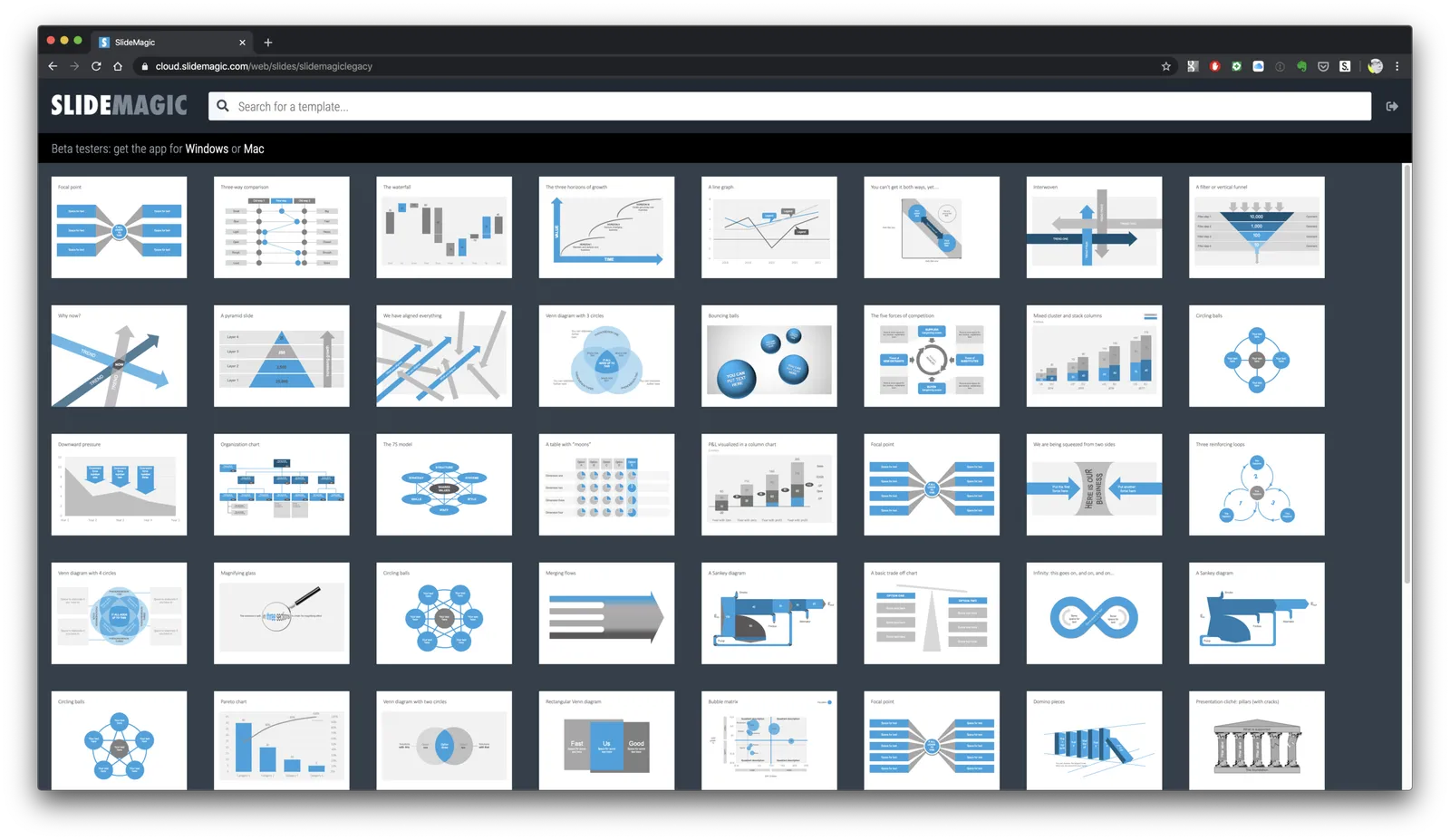
As a first step, I have now merged most of the slides of the Shopify store into the SlideMagic 2.0 database. Beta testers who go to the web site, see the templates alongside the new ones generated by the app without noticing the difference.

For 80% of the slides, I could easily convert them to .magic (the boxy ones). These slides appear in the template store with both a .magic and .ppt download option (the .ppt conversion is generated by my software, rather than the manual adjustments for screen size etc.). For the other 20%, I have uploaded the .ppt file without a .magic option. If you are just after .ppt downloads (hopefully you will change your mind at some time), you can use the template store without noticing the difference.

Users that access the slide database from within the SlideMagic app will not see the PowerPoint-only options.

So, hopefully I can retire the Shopify site soon, and I will migrate the subscribers to the new site. And, this exercise gave me some insights into what shapes I should add to SlideMagic, and what shapes are actually not required at all.

This is all a bit of a ramble by a product manager who is trying to justify and integrate past product decisions :-) What it means in practice:

  • You signed up for the SlideMagic template store in the past: you can access the same templates, but also new ones
  • You signed up for the new SlideMagic 2.0 app: you will have access to a great set of templates that are super easy to customise and don’t even miss the PowerPoint-only ones. (And, all your work can be converted to PowerPoint at the press of a button)
Continue reading →

Beta: related slides

For sites such Amazon or Netflix, ‘related products’ searches have become reliable and useful. On my Shopify platform it was very difficult to implement a link to “related slides”. Now that I have acquired the required coding skills, I looked around at other out-of-the-box search solutions (even with the help of some suggestions by blog readers), but I have not found something that could work for me in SlideMagic 2.0.

I think a good search algorithm is absolutely crucial for a slide template engine. Simplistic tag searches are not useful. “Here is another slide about "‘strategy’). You need to take into account how a slide looks, what message it should carry, what audience it is relevant for, etc. etc. And then in addition, bring in how popular a slide is.

I am breaking my head on finding a good way to index slides and make them accessible in search, both on the web interface, but more importantly inside the desktop app.

Today, I completed a very first version to get the basics working. Still far from perfect, but already better than the Shopify site. Next up is a refinement of the tags, the tagging structure, and the user interface. And of course: getting the performance right.

This has not been incorporated in the desktop app yet, I am using the web site as a playground for ideas at the moment.

Work in progress.

Any Office add-in experts out there?

I am trying to create an add-in that brings the SlideMagic 2.0 template store right into PowerPoint: search for slides, “click”, and the layout appears in your document. I thought that new Office APIs would make this really easy. I have a web server already up and running, the only thing is to move to the task pane at the right of the PowerPoint screen.

Googling around, the tricky bit seems to be the final step: inserting the slide template into the user’s presentation. The PowerPoint version of the Office API seems to be really limited. The furthest I can push it is to open a brand new presentation inside PowerPoint with the selected template(s) in it, the user then needs to copy them across as a final step.

Maybe one of my readers can point me to a solution? (Or maybe encourage Microsoft to expose this feature in their API, it will open up a whole raft of possibly very useful PowerPoint plug ins I think).

Obviously, I can dive into the world of hardcore manipulating of XML/PPTX files, but I am not sure whether that investment in time and effort is worth it.

Photo by Randy Laybourne on Unsplash

Boxifying...

The philosophy behind SlideMagic is to save making everyday presentations:

  • A bank of useful templates (still small, but growing rapidly now)
  • A clever search algorithm
  • A proprietary UI to make obvious changes to slides at lightning speed (with the option to convert to PowerPoint)
  • A simple framework to make all slides look uniform and consistent with corporate branding

But there is one other important component: simplifying (call it “boxifying”?) layouts.

Shapes and layouts that are great for drawing on paper or a whiteboard, are harder to get right and look good on a computer, think circles, arrows, curved lines. Professional designers know how to space text out evenly, add white space, line up the 7 levels perfectly on a circle at even distances. For the rest of us, this is a lot harder, or maybe even impossible. Not everyone has that eye for design, you know your slide looks bad, but you somehow cannot pin down why.

Another problem with these “sketch shapes” is that they are not ver efficient to hold text. Try adding long words in a circle shape and you run into problems. (The Japanese figured out a way to create square water melons so more of them would fit in a fridge).

And maybe you have that eye for design, then you still need to invest all that time to get your shapes and layouts right. Time that is worth it if you are designing your annual sales team kick off keynote address, time that is definitely not worth it when bashing out the quarterly numbers for a quick review meeting with the team.

Continue reading →

200+ template file now in 16:9

The Shopify platform is cumbersome for digital downloads, having to put slides through a shopping cart all the time. I am working on a better solution: integrating the “old” template store into the SlideMagic 2.0 platform.

In the mean time, I now have converted the file with 200+ templates from 4:3 into 16:9 format as well, you can find it here. Subscribers can download it for free.

·Software

"Good with computers"

Being “good with computers” had different implications when it comes to presentation design over the years. From my experience as a management consultant:

  • Pre 1995: professional graphics designers produced your slides, you could simply sketch ideas on a piece of paper. As a junior analyst you marvelled at how senior partners seem to be shaking new frameworks out of their pencil with zero effort
  • 2000: if you demonstrated that you understood PowerPoint, you were instantly designated the entire team’s graphics designer, but only during out of office hours (18:00 to 09:00, and weekends)
  • 2005: Everyone starts to produce their own charts, and being proficient in PowerPoint could actually give you an edge. Including images, even videos, complex data charts.
  • Today: technical proficiency is no longer required, as more and more people understand that the best slides are really simple slides.

Photo by Museums Victoria on Unsplash

Clearer, not prettier

As technology progresses, visual “stuff” is usually the first that gets added, because, well, we can

  • Huge wings on cars in the 1950s
  • Drop shadows and gradients in Windows XP
  • Realistic textures on iPhone screens
  • LED displays and indicators on consumer electronics
  • Animations and effects in PowerPoint
  • Highly sophisticated frameworks dreamed up by management consultants
  • Massive BI management dashboards

But after a while, we start to understand how technology really can make things clearer and more useful, and the initial “because we can” features get eliminated.

The way people communicate in companies is going through a similar transition. Long, formal memos, are replaced by email, informal slack messages with a “Dear Sirs” greeting.

Presentations need to go through a similar transformation. I am working on it.

Photo by NeONBRAND on Unsplash

Template store 2.0

It is slow, it does not have many templates yet, it does not look that pretty, it is optimised for Chrome only at the moment, but it is a major personal achievement: I can create slide templates in the SlideMagic desktop app super fast, bulk upload them, manage their search tags, convert the .magic file to thumb images, store everything in a database, allow people to search, download .magic files, .pptx conversions, and manage pro (beta) and non-pro subscribers.

The objective of this web-based template server is to give potential SlideMagic users a taste of what is possible with the app, and serve people who are not willing to use a non-PowerPont user interface to manipulate charts (their loss :-)).

This effort was not a strategic grand plan: I needed a good search engine for myself to optimize tags of slides in the database quickly, and saw that it was very easy to expose that functionality to all SlideMagic users.

Check it out: https://cloud.slidemagic.com, and let me know of any bugs, or major glitches. I am keeping the number of beta testers ver low, since there are obvious bugs that I still need to iron out.

In the near future, I hope to roll the current template store that is hosted on Shopify into my own platform, bug that requires completing the payment platform and upping things to production-grade technology that is expected by paying customers.

The next technology challenge will be go back into the world of databases (which I left behind in 1992), and see how we can make searching of templates smarter (and faster).

Continue reading →

We only have the first half of the year

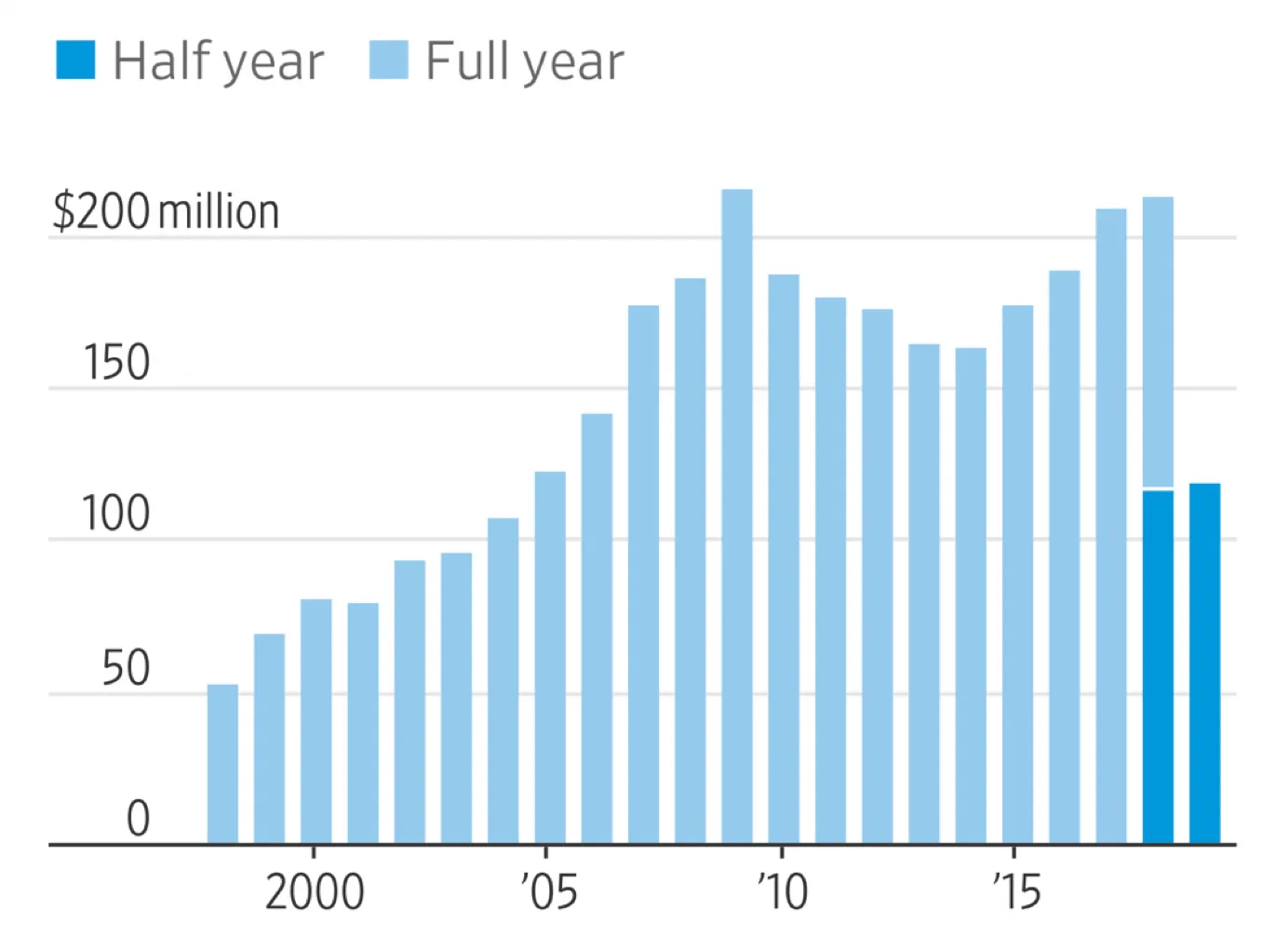
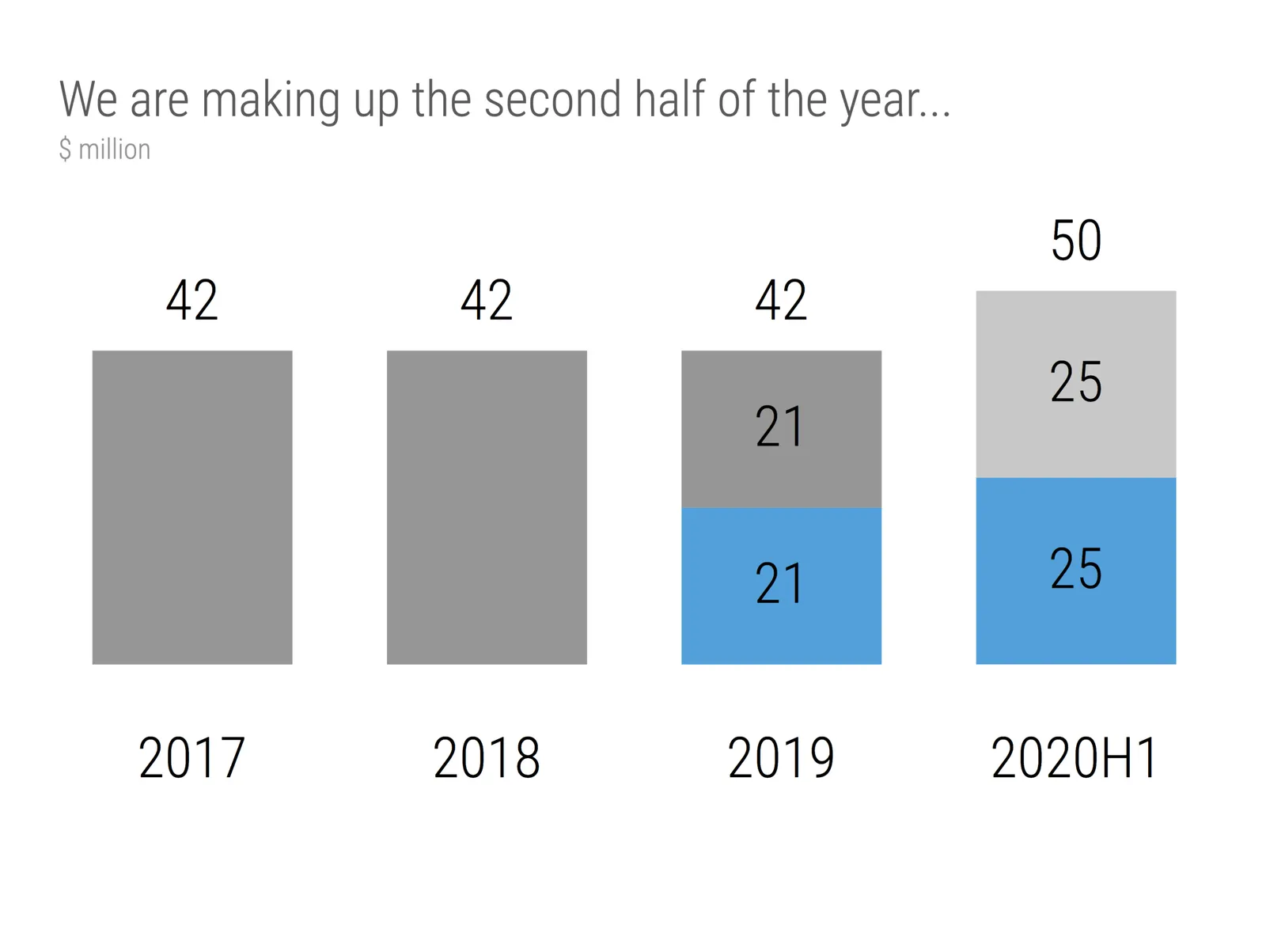
This chart that was published in the WSJ shows a good way to highlight financial data when you only have the first half of the current year available. You create a stack chart that only appears for this, and last year. For this year, you only show H1 data in the matching color.

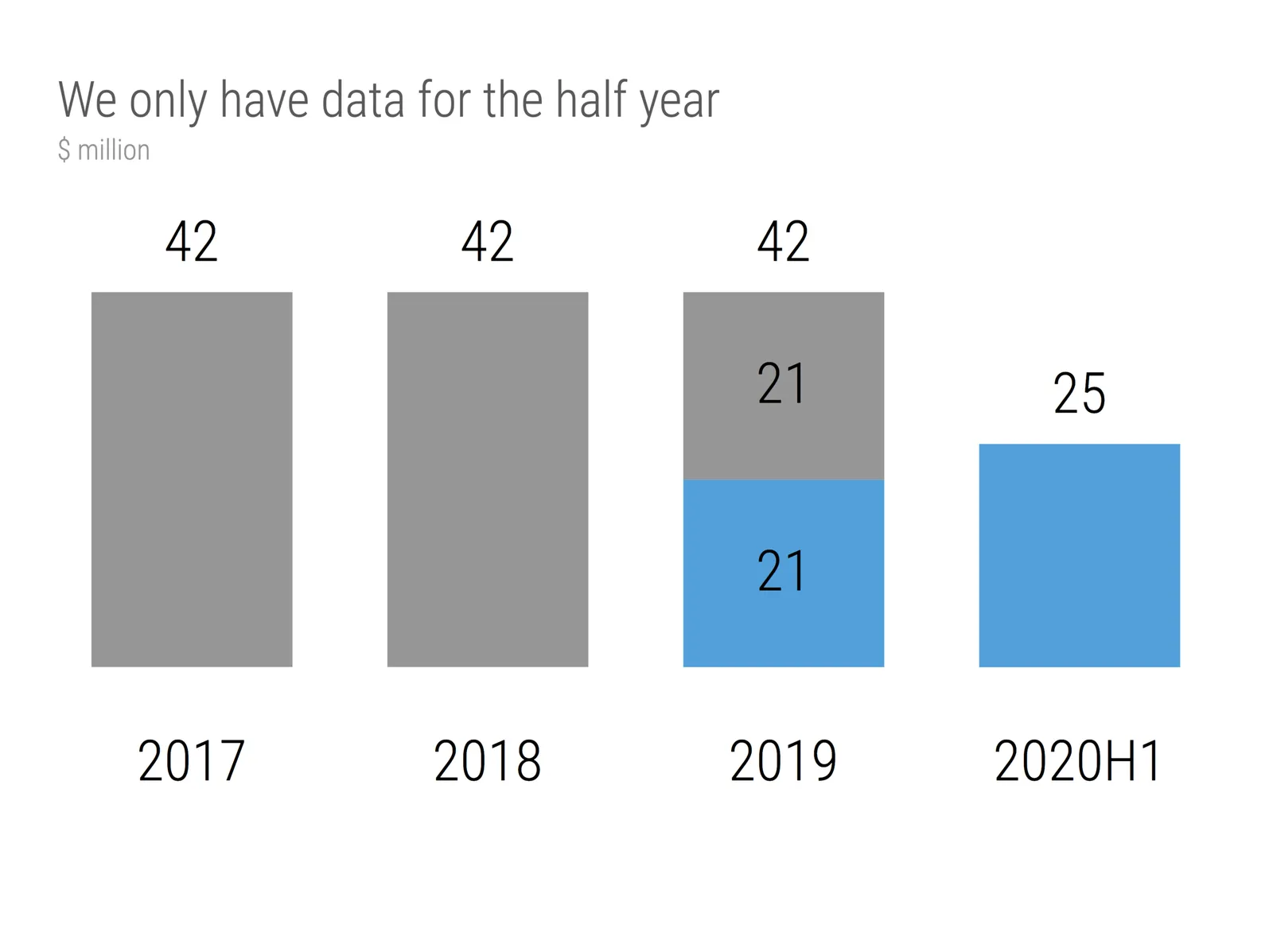
I have add a template to the SlideMagic 2.0 database with a setup for this type of chart. It is extremely easy to add more years to the data history.

Some of my bespoke design clients were very eager to push things further, why not add an extrapolation for the H2 data, assuming similar growth? Well you can, but you should realize that your chart just became a totally different one: it no longer reports what happened, instead you are putting your name on the line for delivering the H2 numbers.

Photo by Mark Boss on Unsplash