SlideMagic Blog

Frequent updates about all things presentations since 2008. Subscribe to never miss a post.

RSS
all posts

Category Presentation design

·Delivery

Aide memoire

Many speakers use bullet points to remind themselves what story to tell the audience next. Turn back to audience, say “Uh, and also…” Read out bullet point. Turn back to the audience. Then, improvise (often a very engaging) story. These people actually do not need slides at all. The story is in their head, they just need to be prompted to get the flow going. Two solutions:

  1. Use simple speaker cards instead, and forget about slides all together
  2. Create highly visual prompts: a picture, a slide with just one word on it and use presenter view to avoid having to turn your back on the audience
·Delivery

Do not overdo it

A VC complained a about a Prezi presentation today: a combination of motion sickness and impatience (using 30 slides to make a totally obvious point that could be made in 1).

There is nothing wrong with Prezi if it is used right:

  • Use zooming effects to support your story: zoom in on a technical diagram for example, hop in and out of a time sequence, focus on parts of your product, highlight different areas of a map. Zooming for the sake of zooming is not helping anyone.
  • If you are in a small meeting, leverage the non-linear navigation to have a good interactive discussion. Random story sequence shifts for a big audience makes everyone miss the plot.

Everyone knows that 30 slides with 1 message is better than 1 slide with 30 bullet points. However, obvious points can still be made in 1 slide. I see a lot of presentations on Slideshare that use one spectacular photograph after another to [click] make [click] a [click] totally [click] obvious point (especially social media and/or mobile cliches).

·Keynote

Romanticising without apologies

After you told a story, try to avoid downplaying it: “Well, maybe I romanticised things a bit”, it is like a cold bucket of water for the audience. Decide the level of romanticising beforehand, and then stick to your choice without apologising and/or blushing.

·Delivery

The nose is a lie detector

When people make big statements in a presentation they get a bit nervous (“we are the cheapest solution in the market”) and often cannot suppress the urge to touch their nose to get rid of that subtle itchy feeling. Train yourself to be strong and do not touch your face when making big claims.

·Keynote

PowerPoint for iPad review

Yesterday, Microsoft finally released a full version of Office for iPad, including PowerPoint. Unlike a previous release for iPhone, this version allows you to create and edit documents.

I blogged before about the strategic mistake of Microsoft restricting its Office products for its own operating systems, and I think the recent change in CEO might have something to do with the sudden release of the iPad app which was rumoured to have been ready for a long time.

So what do I think? First of all, the design looks great. It is a good blend of the iOS environment with Microsoft-specific UI elements (ribbon). The app works fast/snappy and is intuitive to use.

The best thing is that finally PowerPoint will look normal when opening them on an iPad. Fonts work, no need for PDF-ing, or using specific apps such as SlideShark. This takes an important uncertainty out of business meetings. I had many instances where I needed to pull out a deck quickly and unexpectedly, and if an iPad is the only devices you have on you, you keep on apologising for the horrible look of your slides.

And I think this will be the main use of PowerPoint for iPad: showing presentations plus the occasional last minute text edit, or slide show re-order. Serious slide design work is not possible, first of all due to the small screen that is not comfortable to work on for a long time, and secondly because critical functions are missing when compared to the desktop app.


Continue reading →
·PowerPoint

PowerPoint for iPad - app store link

PowerPoint for iPad is out, find it here in the app store.

·Delivery

From 90 to 100 percent

Sometimes I work with really good presenters that already have a really good presentation. How to get from 90 to 100%?

My approach would be to sit in the audience of a real live presentation, or watch an entire presentation from start to finish on video. Then, create a series of slides that exactly mimic the story. Take out slides that do not really add anything and are just a prompt for the presenter to tell a story. Add black slides to switch off the projector all together. Use very simple graphics and words to support a story. Be a movie director and look at each frame of presenter and slide together.

·McKinsey

You are not presenting slides

Back in the old days at McKinsey, my first project manager explained to me that I was supposed to “present the slide ” (Exhibit in McKinsey speak) to the client. This involved taking the audience (a small conference room) through all steps of the analysis.

And also we found… And then we found… And also we analysed… And also the team discovered…

Presenting a slide is probably still useful in internal team meetings among management consultants or scientists, but in most story-driven business presentations slides are there to support you in a subordinate role rather than claiming the lead role. The slides run in the background, as you tell your own story.

·Art

Presenter backgrounds

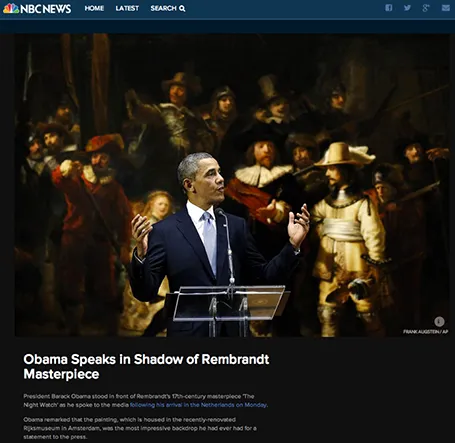
The Obama press conference yesterday in front of Rembrandt’s The Night Watch is an example of how a nice presenter background can make a big visual impact. The dark painting background looks great in close up photos, although less interesting from a distance.

Conference organisers should think beyond the curtain, blank wall, or list of sponsor logos.

·Gadgets

Two screens

There are two adjustments in my IT setup that hugely increased my productivity: 1) move to a huge monitor, 2) add another monitor making a total of 3 screens: 2 big ones, 1 small one.

In this article, it is argued that 2 screens actually reduce productivity. I agree if you use the second one to check on your email, facebook, and Twitter streams. If you use the second screen for a different version of your presentation with comments, or the directory with the images you are using, a multi screen set up is a life saver.

Employees in large companies find it difficult to be productive, and when you look at people sitting in large open plan offices staring at tiny lap top screens, you understand why.