
SlideMagic Blog

Frequent updates about all things presentations since 2008. Subscribe to never miss a post.

RSS
all posts

Category PowerPoint

·Keynote

Trying out Medium

Medium is a new publishing platform and I gave it a try with a first post on how bad design habits from the 1990s still cause dammage today (overhead transparencies, word processors).

Medium allows you to create collections and I started one about presentation design, pitching ideas, and public speaking under the name “Seeing is believing”. Feel free to contribute.

Although I like the clean design and focus on writing of Medium, it is too early for me to give up the good old Blogger platform, with many of you reading my posts via RSS and email updates.

·Keynote

A bit of detail can help

The objective of a technology sales presentation is to convince your potential client of how great your product is, and how poor the competition.

Assumption: the above is actually true, which makes designing a presentation a lot easier.

One approach is to list all the benefits, and in a few more charts show that the competition does not have them (most of the times, without naming names explicitly). This story does not stick very well, a feature list that seem unrelated.

Better is to dive in a bit into the detail. Often technical products have one specific innovation, one characteristic of the architecture, one design approach that triggers all of the goodness mentioned above. Now that the customer understands this (and Einstein said that you can explain anything to everyone - even a 6 year old), it becomes a lot easier for her to understand the full picture.

·Investor presentation

Investor investor presentations

Yes, most venture capital (VC) and private equity (PE) investors need to rais money themselves, usually from institutional investors (large insurance companies and asset managers).

When pitching, these investors often make the same mistakes the companies pitching to them make.  The most common one: a story that is not very differentiated. Careful deal selection, deep involvement with your portfolio companies, really working with management. Institutional investors get pitched all the time by VC/PE funds that say exactly the same thing.

The best VC/PE investor pitches are those that tell a story about a really distinctive type of investor, where everything reinforces each other: the backgrounds of the investment team, the deals you picked, the exit track record. Some funds have great access to deal flow in the telecom industry, some funds are really good in bidding for privatizations, some are really good in turnarounds, some have a really deep understanding of bio molecular structures,  some have a unique skill in stitching together innovative financing structures. It is very rare that all of the above work for one fund.

·Delivery

Presentation lessons from TED

Chris Anderson is the curator of TED and has written an article with some excellent suggestion on how to give a presentation of TED-like quality. Some of the points discussed in the article:

  • Plan your story: beginning, middle, end
  • No jargon, keep things conversational, cut back on the ego, show that you are vulnerable
  • People do not relate to descriptions of organisations/institutions
  • Do not try to cover too much ground, you need to go into some level of detail to keep things interesting
  • Let the audience draw conclusions themselves, not everything has to be spoon-fed
  • Really, really, memorize your talk in order to be spontaneous. Sort-of memorising is the worst, you are not your improvising self, but the words do not flow either with frequent memory pauses giving away that you are playing off a script
  • When rehearsing, think what feedback you need to take in, and what not. Usually, experienced speakers give the most useful feedback
  • Stay relatively stationary on stage, emphasise with arm gestures, keep eye contact with a few people in the audience
  • Use slides only if you have to make a point that needs visual backup
  • When using video: keep it short, and think twice before including a sound track
  • Final advice: be yourself
·Delivery

The 1-1 institutional IR meeting

I am starting to work with the CEO of a very large company to design a presentation for 1-on-1 meetings with institutional investors. I am thinking of a presentation designed for iPad, or even a loose stack of slide print outs that can be randomly selected as the need comes up in the meeting.

The big story of the company can probably be explained verbally in a conversation, these slides that are typically included in a presentation for a big audience can be left out. But then, equity analysts are likely to have detailed questions that require factual backup slides that are denser in design than the ones you would typically use for a large audience investor update.

An interesting project.

·PowerPoint

DIY shapes

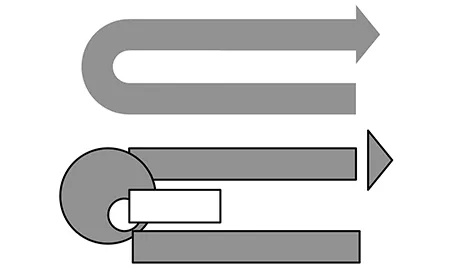
It is hard to get an arrow to point exactly right in PowerPoint. If the standard shapes fail, why not construct your own out of small individual bits. You can group the shape together, or create a new custom shape with one of the shape boolean functions (Windows instructions here, on a Mac: select 2 shapes, right click, go in the grouping menu).

·Delivery

Just a confidence booster?

Often, I see that the slide deck is just a confidence booster for the presenter of a new story. Having those beautifully designed slides behind you makes sure you will not s**w up. Over time, you become more and more confident in delivering the story, your slides get bolder and more minimalist, until finally, you do not need them anymore.

But, without that slide deck on day 1, you would not have gotten to that level of story telling…

·Keynote

Flowboard - presentations on iPad

Flowboard is a presentation design app for iPad. In the TechCrunch video below, the company CEO gives a quick demo of the product.

I am curious to hear your feedback on designing presentations on a tablet in a new app (using an iPad to display them is a no brainer). I can see the advantages of mobility, the touch interface, but on the other there are drawbacks: screen size, lack of navigation precision, incompatible file formats, and file management problems.

·Investor presentation

VC presentation parody

This cartoon of Nikola Tesla (who do you say?) pitching VCs highlights many of the dynamics that are happening in VC pitch meetings (unfortunately).

Two comments to this though:

  1. While entrepreneurs have no shortage of ideas to make a parody about VCs, I think VCs might have equally rich material to make fun of entrepreneurs pitching.
  2. But more importantly, anticipate this sort of VC behaviour. In this video the entrepreneur did not manage to get across what it is that he is actually doing early enough, and as a result the investor focused more on their email. VCs probably make up their mind whether something is worth listening to in the first few minutes of your pitch, partly maybe because they are arrogant, but also partly because it is the only way to deal with thousands of ideas being thrown your way. Get that elevator pitch ready, and the objective of the elevator pitch is not to land the investment, but to get the attention for the next 20 minutes.
·Data visualization

Put things in perspective

I just returned from a camping and hiking trip in Israel’s southern desert (the Negev) and came home with some beautiful pictures.

It is very hard to capture the sheer size of a landscape in a photo, and one trick to do this is the make sure to have an object in your frame that the viewer knows the size of. In the example below you see that the perspective greatly diminishes when I Photoshop my friends out.

The same is true with data in presentations. Putting the stunning image with the word “53 million” on it does not put the size of the number in perspective. Relate it to something instead.