SlideMagic Blog

Frequent updates about all things presentations since 2008. Subscribe to never miss a post.

RSS
all posts

Search results for “competition”

·Concepts

Blue ocean strategy in a presentation

Most investor or sales presentation have some sort of slide about the competitive environment. (Here are earlier blog posts about how to present the competition). Usually, people use tables, or 2x2 / 3x3 matrices to show how they are different.

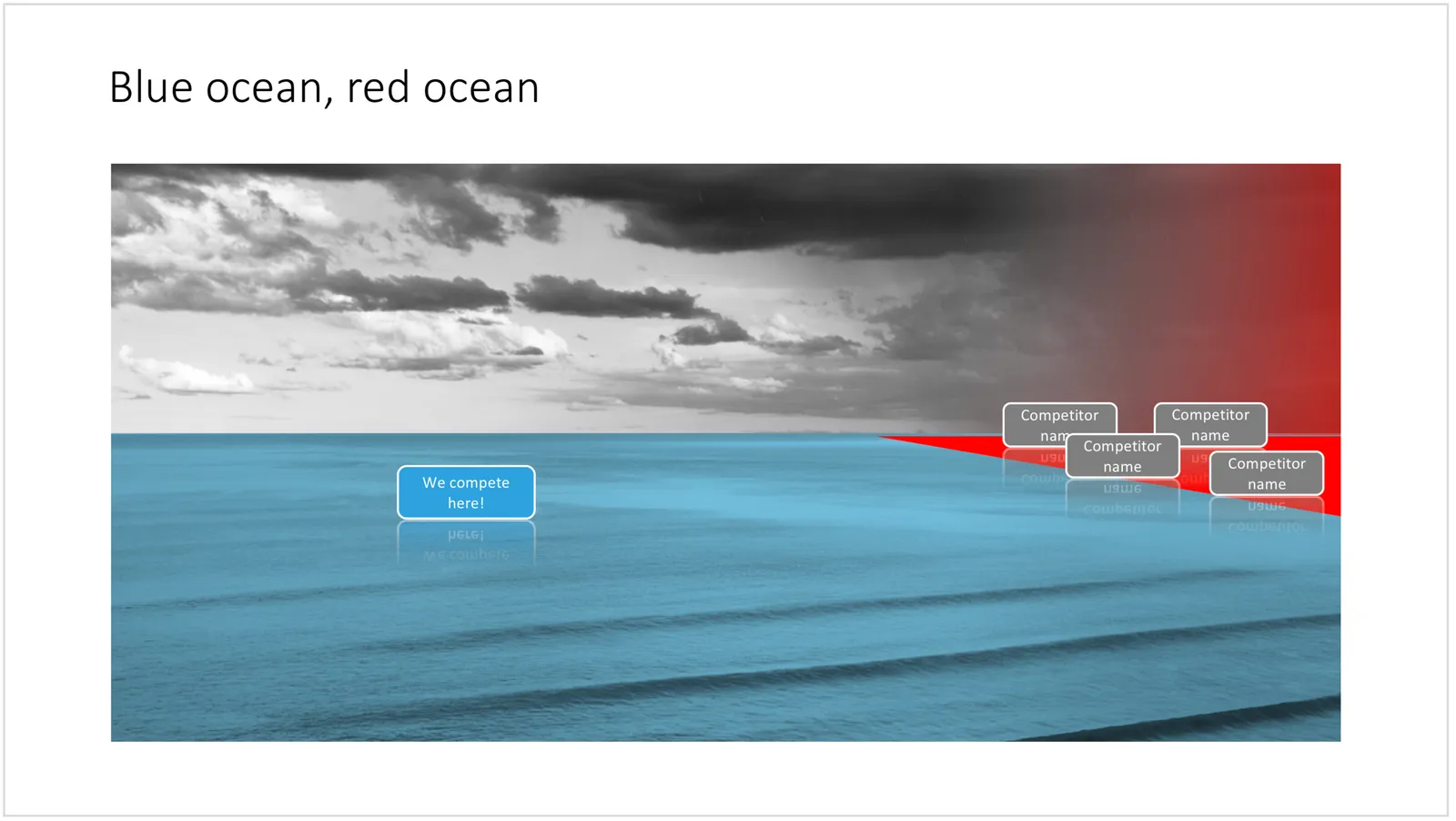
The chart below might a completely different take on the subject. The Blue Ocean strategy concept developed by INSEAD argues that is often better to define an entirely new market rather than battling with all the existing companies that go after well-established market segments. You can download the slide here.

 Visualise the competition using

Visualise the competition using “Blue Ocean Strategy” in a presentation

Cover image by Ishan @seefromthesky on Unsplash

·Creativity

Finding inspiration via search

A very significant part of my efforts to get my template store up and running goes in its search engine. I am surprised myself how well it works. My bespoke client work is the test case for it, and whenever I start out on a new slide, I give the search engine a go, and voila, most of the times a suitable lay out pops up.

Business presentations are a bit like business English: you actually don’t need a big vocabulary of layouts (“words”) to make a decent deck.

You can use the search engine to you advantage without shelling out a dollar to buy a slide. Simply search for a concept, and maybe you can “borrow” the design that comes up, or the search results remind you of slides you designed before.

Here are some examples of how you can use the search engine:

  • Look for a business concept, anything to do with talking about the competition
  • Find specific well known strategy frameworks: 7S, Porter forces, etc.
  • Search for a specific layout: Venn diagrams, 2x2 matrices
  • You need a slide to visualise 4 things: look for the number four
  • And you can always try your luck with using SlideMagic as a stock image engine (try Stormtrooper), images on SlideMagic are free to re-use

I am monitoring the search terms people use closely. If a key concept is missing, I will add the slide, if a keyword does not match a suitable slide, I will fix that. At the moment, I am constraint by the search engine in the eCommerce platform that powers my site, which means that I need to work with keyword tagging of slides. As SlideMagic grows, I envision migrating to a custom search engine that can offer higher levels of intelligence. Ultimately, this will be the real differentiation of the site: coming up with the right slide layout on request.

Continue reading →
·Investor presentation

We only have 5 minutes...

Looking back at more than 10 years of presentation design work, I noticed that my best decks are often the ones that were designed for very short time slots, usually pitch competitions where a speaker would have 5-10 minutes to give it all.

Why?

  • These requests would often come after the client and I completed the “regular” presentation: I went through the process of getting to know the company in-depth, but, and this is important, I had given the content some rest, and when coming back to something after a couple of weeks, you often get an even better perspective on how to tell the story
  • The all-or-nothing 5 minutes makes the client more confident to take visual risks: bolder, simpler slides
  • The client would rehearse more (it is easy to run through a 5 minute story twenty times) and as a result would stumble on imperfect story flows more often

So maybe there is a natural evolution in presentations:

  1. The internal strategy/board deck where you lay out your company’s ideas and make strategic decisions (management consultants stop here)
  2. An attempt at a bullet point story line for a pitch (most pitch presentations stop here)
  3. The properly designed company pitch deck (my projects often stop here)
  4. The “let’s give it one more go deck”

Photo by Mitchell Hollander on Unsplash

·Story

When the problem is not the story

All my clients want that presentation that uses story telling and captivating images to hook its audience emotionally and gets them to sign an investment check right here, right now.

But sometimes that beautiful story is not the issue. Ideas can be pretty simple to describe, the market size easily understood, what is left is the concern that company can actually make it happen.

Business models, cost structures, go-to-market routes, hiring plans, product releases, all “boring stuff” that pretty much only can be captured in McKinsey-style tables. Ah, that annoying presentation designer who keeps on pointing out inconsistencies between the slides.

These cases also highlight why certain companies can do incredibly well in big audience pitch competitions, but fail to raise money from professional investors scrutinizing the details in small conference rooms.

·Story

Is it OK to be "negative"?

People say that in marketing, it is bad to be negative, trashing the competition’s product and/or business. I can see how that makes sense in public advertising. Being the angry company who keeps on kicking others will not help build your brand in the long term.

In closed room sales and investor pitches, I think it is a bit different. You don’t have much time, and the audience across the table might not know the market very well. Stressing your positives and hoping that they will fill in the comparison to the competition might not be enough.

The tone of a presentation does not have to be negative, the differentiation versus the competition should be made very clear. In most cases, there is a positive way to spin this story. Both models have a reason to exist: your product works great for this segment, the other product will work better in that segment.

Even in the consumer market, people are looking for the head on comparisons, even if they are absent in advertising. Product reviews by trusted sources, and online comments by honest consumers, trolls, and competitors impersonating as a reviewer will inform the buying decisions.

For corporate buyers or investors, this back channel to get the real story does not really exist, and/or they do not have the time to find it, so being a bit more explicit might not be that bad.

·Story

Too many things in your head

When you are deep into your own story, your mind has hard-wired all aspects of it in one complex mesh network. Everything is related to everything, everything is connected. The upside: you are the expert and know what you are doing. The downside: it is extremely hard for you to explain your idea to someone who comes in cold, without the bits of information, and without the connections between them.

After I return to my office after a client briefing, I usually open a blank piece of paper, take a pencil, and jot down the big ideas I heard in the meeting, after I have given the brain to calm down in the 30 minute journey back. No worry about story lines, no worry about structure, no judgement about what is detail and what is a big message, and no going back to my meeting notes.

These thoughts often become the core building blocks of the presentation. These are the points that I want others to remember when leaving a meeting.

Many people get to this point, they figure out the key messages of a presentation but make the mistake of communicating them in an overly simplistic, or minimalistic way. Just writing “the competition is not flexible” as a big, minimalist statement in a nice designer font is not going to make it stick. Many times, proven/showing these high level messages actually requires going into some depth.

So, a good presentation does not dumb down content. It unravels the wool ball in your head and creates a sequential line of ideas that can ultimately form the basis for a wool ball in the minds of your audience.


Persistence

If you have to say for the 3rd time in a presentation “be patient, we will get to that in slide 42”, it might be time to switch to the topic of page 42, even if you only got to slide 5.

Your persistence gave you points as CEO for not giving up easily, but you also lost some because of lack of flexibility as a person to work with and give feedback to. Or worse, the investor think that you will continue to drive down the planned road even if circumstances have changed and require a change of plan.

Afterwards, think again about the order of your slides, maybe slide 42 needs to come up earlier. Maybe it addresses an “elephant in the room”, big question. For example it is unusual to put the competition analysis on slide 1 of your presentation, but for example, If you are planning to build a website where people can search the internet, you might have to.

Obviously, going of script works only in small settings, switching the flow of a major keynote address in front of 100s of people is a bit harder to do.

·Investor presentation

"22 reasons I won't fund you"

This is an interesting representation from the investor perspective by Jason Lemkin why he does (not) want to fund you. Some are relevant to presentations (my words):

  • Integrity: gaming metrics, locker room jokes
  • Exit strategy slide shows that you are not committed (not sure all investors will agree)
  • Pooh-poohing competition (better to show that you understand them, rather than hiding their existence)
  • Looooong industry background sections before getting to the point, the first decision point at minute 5, if you survived that one, the second one comes in at minute 20
  • Document formats that are hard to open

Image via WikiPedia

·Story

Generic investor pitch presentation flow

Here is a story flow that I end up using often for investor pitches of my clients:

  • Good idea
    • Once, there was a situation
    • Something changes/changed
    • This creates an opportunity/problem
    • It’s not easy to solve it
    • Enter [company]
    • It’s clever
    • It’s different from the competition and alternatives
  • Good business
    • Market: lots of (potential) users
    • Market: lots of dollars
    • Profitable: Unit economics work, company economics work (when company reaches scale)
  • Good startup business
    • Product/feature pipeline is doable
    • Sales & marketing strategy is doable
  • Good company
    • Team knows what they are doing
    • Traction shows that things are gaining momentum
  • Good deal (often not covered in a presentation)
    • Board configuration
    • Deal terms
·Delivery

Panels = entertainment

Another good video by VC Mark Suster about how to speak when invited on a panel:

  • Entertain
  • Be energetic
  • Be short and to the point (people don’t remember who long you spoke, but what you said)
  • Say something different than the person before you
  • If the moderator asks the wrong question, answer a different one

I would also add that pitch competitions are a form of entertainment. A pitch for such an event is completely different from a pitch to the partner group of a VC.

And most of the time, pitch competitions are far more entertaining than panels. In a pitch competition, the presenter is on the line, sharp. People in panels usually do not prepare and can hide behind the others on stage, making them a lot less interesting to watch.