

SlideMagic Blog

Frequent updates about all things presentations since 2008. Subscribe to never miss a post.

RSS
all posts

Category VC/investor pitch

·Data visualization

Explaining your business model

Most investor pitches I see claim year 5 revenues of $50m to $100m, so putting in just that piece of information is not going to convince investors, you just sound like everyone else. What you need to make believable is why you are going to hit that target. Showing an incredibly complicated Excel model (”look, we did our homework”) is not going to get you there either. So the top line number is not convincing, nor is the detailed model, what works? The napkin.

When a modeling economics, I usually go brought a cycle. Start with a very simple calculation that gets to a ballpark answer, and is easy to follow and verify. Then, go I to incredible detail in an Excel model, understanding why I do, or do not get close to my initial ballpark. After the rock solid model is finished and bug free, it is time to simplify down to the level, of that very first ballpark number.

Simplification is not simple. You need to pick which drivers of your business are the most important, you need to decide which factors to show, which ones to hide. Your challenge is to stay close to values that are linked to everyday reality, not accounting. Messages per user per month, price per message instead of $m depreciation.

With all this preparation, you are now able to let your potential investor write her own ballpark or napkin calculation of the company’s potential. You provide her with the basic framework, what are the 6 numbers you need to multiply in order to get to your $75m in year 5. She might not agree with all the numbers, but you gave her a framework to which to apply her own estimates. Getting the point estimate right is not important, agreeing on the order of magnitude, and the way how to get there, is.
Continue reading →
·Investor presentation

Pitching your startup

A nice and short video with tips for pitching your startup to investors on #startupstories. The lessons from entrepreneurs are useful, but pay special attention to what the investors have to say, they are your audience.

·Delivery

Common pitfalls in IPO presentations

I was asked to mention common pitfalls in IPO presentations the other day. Here are some of my thoughts in random order

  • Using an internal strategy deck as the basis for your presentation, rather than starting from scratch. Internal presentations are targeted at insiders, IPO presentations are meant for people who do not suffer from the Curse of Knowledge.
  • Talking management speak, full of buzzwords. Institutional investors are sifting through investor pitches and data all day long, they are trained to cut out the noise. If you provide a lot of noise and padding, they automatically think there is no real substance to talk about.
  • Over-structuring, repeating, repeating again. In a short investor pitch tell a story, do not try to get investors to remember key facts by drilling it in their heads.
  • A generic investment thesis. Very high-level bullet points that could apply to just about any company: growth, profitability, etc. Diluting the core of what is special about your company with many, many other positives that are valid, but not that important. Like in marketing: too many benefits, no benefits.
  • Avoiding the elephant in the room. institutional investors probably are pretty well informed about your company, and the key questions they have (often shared with journalists and bloggers) are pretty clear. Your presentation should address those, maybe not explicitly (here are our weaknesses), but implicitly. These questions are the only thing that people are worried about.
  • Avoid the long-term growth options. There are legal restrictions to what extent management can provide business forecasts in an IPO filing, but that does not mean that you cannot educate investors on how you can think about valuing your business. Give a framework on what value components could be there for the long-term.
  • Focus only on the company, not on trends in broader society. Sometimes the key driver behind the success of a company is a fundamental shift on how people are operating, how things are changing in the world. Your IPO is an opportunity for an investor to invest in that trend. If that is the main driver, discuss it.
  • Confusing financial data. A 30 minute pitch is not enough time to go over the financial data in full detail. Still, there is no reason why you should confuse things instead. Give a good overall picture of the components of your company. Show how the revenue model is working. Show how the cost structure works.
  • Forget the front line. Management talks about a company in terms of top line revenue, overall market share, but the real action is in the front lines. Give customer case examples, they are often a much more powerful illustration of the attractiveness of a business than top line figures.
  • Recording your presentation in front of a camera, without an audience. Unless you are a professional TV host, people find it difficult to look natural in front of a camera. Invite a small audience when you are video-ing your tape. If that is not possible, maybe tape some images of people on some chairs in the studio/conference room so you can imagine talking to the people who are listening/watching you later.

Facebook IPO video

Facebook published its IPO video, you can watch it here. Some observations (in random order).

First of all, this video is so much more professional than the ones we saw before (Zynga, Groupon). Gone are the executives presenting their slides in slightly uncomfortable positions, and instead we see a streamlined performance of relaxed-looking people.

The videos work great to present the senior team, and to highlight case studies of selected clients (both huge corporations, and small businesses). Video is less good to present some of the extraordinary facts about Facebook. Making the point that Facebook is the American Idol final, times 2, but then every day for advertisers could be made stronger on a visual. But the video is loaded with these extraordinary statistics that could have been emphasized more, maybe at the expense of some of the product feature explanations (time line, news feed, etc.)

The video is also modest about putting Facebook in the development of the Internet. They could have claimed that Facebook is redefining the net, by putting a social layer on top of it. The video focusses most of the time on what Facebook is today. The investor wants to know what Facebook could be. The payment business for example, only comes out in minute 28 of the presentation. The legal council probably advised against speculating too much about the future of the company in an IPO presentation.

The financial section of the presentation is too short. Stats fly over the screen, and at no single point do you get a complete financial picture of Facebook. Growth, cost, margins. profits, cash flow. The designers of the video probably thought that the objective is to get people interested enough for them to seek out the detailed financial statements themselves.

Continue reading →

Too good to be true

The other day I watched a startup CEO pitch, and his story sounded too good: “There are huge exits in my industry, a few IPOs, everyone uses this technology now, 5 similar companies in the world do really well and one is worth $1b”

“We started out 6 months ago and already have a great technology.”

While he convinced me that this is probably an attractive sector of the technology market to invest in, he also did not answer the elephant in the room question, “Are you arriving too late at the party?”

·Investor presentation

So what do you do?

This tweet by Michael Arrington says it all: investors are human, take it slowly and answer the very first thing what is on their mind: what is it that you are actually doing. You might have been working on this startup for months now, an investor hears about it for the very first time. You suffer from the Curse of Knowledge, and remember, an audience who is guessing what you do in the back of the mind is not paying attention to all the other things you want to say.

Just read an entire investor presentation, twice, carefully. No idea what this company wants to build or sell.Maybe sensors. We’ll see. — Michael Arrington (@arrington) March 21, 2012

Michael tried reading the deck twice, most investors will not do that.

·Investor presentation

Do not dilute your pitch

Usually, a pitch starts really great. When asked, out comes a short and to-the-point story about what you are about. Then we add more info on this, more info on that, until we have diluted our story so much that it sounds pretty much like any other company or fund in your market.

Use the fact that everyone in your industry is creating noise about why the market is so bit, how it is growing so fast. Trigger a recall of this information in the mind of your audience through simple charts. Focus the majority of the time and slides on that unusual story about why you are different than all the others.

Maybe it is good to record that very first pitch on video so you can go back to it in the middle of the design process. Part of the value of a professional presentation designer is sticking to the story that came across in the briefing.

·Concepts

Rigorous deal selection

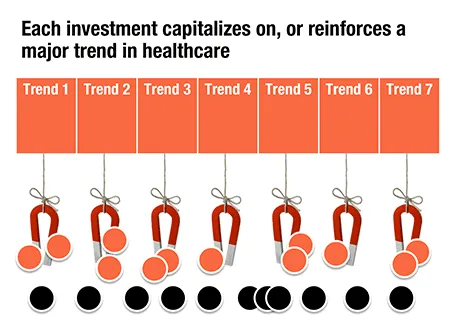
A U.S.-based healthcare-focussed venture capital fund only invests in a company if it pushes forward on of seven trends in healthcare. The page below tries to visualize that.

The point here is only about the rigorous selection, the trends themselves get explained on separate slides, and the portfolio companies get discussed somewhere else in the presentation. After the presentation, institutional investors should remember that the fund is very picky in investing their money, “remember that magnet slide?”

·Data visualization

You put in that P&L manually?

When people receive my analyst or investor presentations and they see a few years of P&L data entered manually one-by-one, they always ask me whether after all these years I have not found a more efficient way to do it. I have not.

While I punch in the numbers manually (which takes about 15 minutes by the way), I can do a lot of things in parallel:

  • Round up numbers
  • Shorten labels
  • Collapse labels and combine rows
  • Check whether everything adds up

A data table is worth that extra attention, instead of an Excel data dump, you get a visual that makes sense.

·Investor presentation

Pick your battles when pitching

Arguing until the bitter end about small facts, when the VC thinks she right because she has a reliable source (in her opinion) is not a good idea. You might be right, BUT you will not convince her, you will do no good to your credibility, and you raise doubts about how the future CEO-Board Member relationship is going to pan out.

Better focus that energy in disagreements that are really worth arguing about. Pick your battles.