

SlideMagic Blog

Frequent updates about all things presentations since 2008. Subscribe to never miss a post.

RSS
all posts

Category Keynote

·Delivery

Passion

VC Mark Suster reconfirmed how important in-between-the-lines-body-language is when pitching investors.

If I had to put a number on it I’d say 1 in 20 pitches – maybe 1 in 30 – are by an entrepreneur who comes across as truly passionate about her project. Y […]

The other 29 pitches consistent of many smart people who “think they have an angle on making a buck” which I know is an unfair over-characterization of the situation but you can genuinely tell when somebody isn’t “all in.” 

I am not sure about the 1 in 30 ratio, but I have seen similar dynamics when clients approach me to upgrade their investor presentation. When you are a professional manager-for-hire that makes a career in big firms, your affinity with the product is usually not that super important, you manage people and deliver the goods. When you are the CEO of a startup raising its first round, it matters a lot.

If the CEO herself cannot portray the required passion for the product, maybe it is wise to include the person on the team who can. I have seen many successful combinations of a CEO who is focussed on a execution and a “product guy” obsessed with the technology, but slightly disconnected from the harsh reality of budgets and timelines. Still, if you need to rely on this combination you definitely lost some points with VCs that you need to make up for in other areas.
·Keynote

Two ways to keep it short

Option 1: lots and lots of benefits, but each one is described in just one, really short bullet point (i.e.: “A flexible solution”) Option 2: Only 3 benefits, but each is described with rich and elaborate stories

The same amount of words, but guess which option will be remembered best. Too many benefits equals no benefits.

·Keynote

Making the story bigger

In projects, I typically help out with 2 things:

  1. Making things look pretty
  2. Lifting the story, making it bigger

I rarely do major surgery in fixing the flow of a story (this is where all time was spent when writing McKinsey documents). In a short 20 minute pitch the sequence of the messages is usually more or less right. What I see often though is that people do not pitch their story big enough, they take out the big picture of how their solution can really change things in a fundamental way. For you, the expert, it is obvious, for the outsider it is not.

·Creativity

Scribling

I keep on looking for a good electronic solution for note taking, doodling, and scribbling. None of them are perfect. A new option has been added recently.

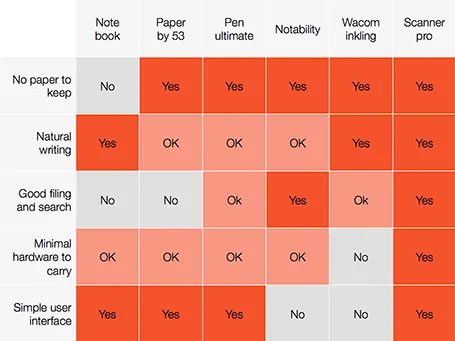
A good note taking solution needs to combine a number of things:

  1. No paper to keep
  2. Natural writing interface
  3. Good filing and search
  4. Minimal hardware to carry
  5. A simple user interface

See my highly sophisticated analysis below.

The new option is a smartphone-based scanner. Scanner Pro is a brilliant app. It takes photos, and lets you easily crop the image. You can keep the image as a photograph or flatten it to bold, fax black and white. Then upload the scan to Dropbox or Google Drive where you can store and search things.

So the best note taking might be scribbling on a piece of paper, scanning it, and throwing away the paper.

PS: earlier review of the Inkling, Penultimate,Paper and styli (?) for iPad.

·Delivery

How the Fed learned to talk

An interesting piece in the NYT: how the Federal Reserve is moving to communication as the core of its strategy to steer the US economy.

More, and more bastions of corporate waffling are being torn down as journalists, analysts, bloggers, and the audience itself becomes more ruthless in cutting to the chase of what is actually being said.

Historically, there were probably two reasons for people to waffle:

  1. Status: lawyers, politicians, doctors, scientists, priests, CEOs used their jargons to re-emphasize their authority towards us, the ignorant masses.
  2. Cover up: if you get an unexpected question, waffling is the default strategy to gain time

Reason 2 is probably here to stay. Reason 1 is no longer an excuse.

·Investor presentation

Raising seed money

This is a pretty informative deck about pitching investors for seed money by **Steve Schlafman**a VC at RRE.

Raising Seed Capital from Steve Schlafman

Thank you Paola Bonomo.

·Colors

Fix the PPT for Mac colour bug

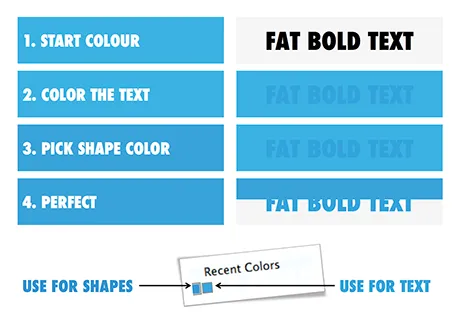
The colour rendering bug in Microsoft PowerPoint 2011 for Mac is highly annoying. Here is fiddly a trick to get around it. You basically need to goal-seek the text colour into something you like.

  1. Pick a colour you like, draw a shape and fill it with the colour
  2. Write some text in a big bold font and set it to the same colour: PowerPoint will render it incorrectly
  3. Here is the fiddly part: repeat steps 1-3 until you are happy with the TEXT COLOUR.
  4. Now, use the Apple colour picker to strip the colour of the text

Save your colour template with 1 accent colour for text, and one accent colour for shapes. In your drop down menu they will look different, on screen they will look the same.

Note 1: I tested the PowerPoint RGB colours as well in Photoshop and Illustrator, and it turns out that PowerPoint renders the shape colours incorrectly, the text is correct.

Note 2: There is a more analytical way to get your desired colour than simply trial and error. You can analyse the RGB codes of the background colour and the text colour. So, set the shape colour to something that you would like. Write down the RGB codes. Colour the text with that colour, and pick its colour with the colour picker. Write down the text RGB codes. Analyse the difference between the two colours and create a third colour by adding/subtracting the R, G, and B differences between the colours. This will be your text colour that renders the same as the desired shape colour. It all sounds more complicated than it is.

Continue reading →
·Keynote

A real person

When you write a presentation, it can be helpful to have a real person in mind that you need to convince. With real I do not mean the actual sales prospect you are going to pitch to next week, but someone who you know better, personally.

The hard-nosed venture capitalist, the hipster designer, the over-loaded IT manager, the stylish marcom lady, the social media expert, the alpha-male sales director, the super-bright hedge fund manager, the Israeli wheeler-dealer, the geeky startup founder, etc. I have a cast of characters who always travel with me and are always willing to receive a mental pitch.

·Investor presentation

You vs the competition

In a startup pitch try not to define yourself early on through an explicit competitive positioning. Early in the presentation, you can mention how current solutions fall short, and you do something clever to fix that. But only later should you introduce the actual names of the competitors.

·Keynote

Document standards

Here is an article from the Guardian, discussing how the UK government is thinking of getting rid of Microsoft Office in favour of open source software. The arguments 1) cost saving, 2) making it easier to share documents.

The article highlights an inevitable trend: the reduced importance of Microsoft Office as the standard for enterprise document creation. But I do not think that some open piece of software will replace Microsoft Office. Unfortunately, we will see increased fragmentation of document creation apps that - I think - will convert their output to PDF files for reading on any computing platform (including mobile phones).

I think that the majority of senior managers at the moment use PowerPoint to view presentations that subordinates send to them, but very few actually edit them themselves.