

SlideMagic Blog

Frequent updates about all things presentations since 2008. Subscribe to never miss a post.

RSS
all posts

Category Investor presentation

Too good to be true

The other day I watched a startup CEO pitch, and his story sounded too good: “There are huge exits in my industry, a few IPOs, everyone uses this technology now, 5 similar companies in the world do really well and one is worth $1b”

“We started out 6 months ago and already have a great technology.”

While he convinced me that this is probably an attractive sector of the technology market to invest in, he also did not answer the elephant in the room question, “Are you arriving too late at the party?”
·Investor presentation

So what do you do?

This tweet by Michael Arrington says it all: investors are human, take it slowly and answer the very first thing what is on their mind: what is it that you are actually doing. You might have been working on this startup for months now, an investor hears about it for the very first time. You suffer from the Curse of Knowledge, and remember, an audience who is guessing what you do in the back of the mind is not paying attention to all the other things you want to say.

Just read an entire investor presentation, twice, carefully. No idea what this company wants to build or sell.Maybe sensors. We’ll see. — Michael Arrington (@arrington) March 21, 2012

Michael tried reading the deck twice, most investors will not do that.

·Investor presentation

Do not dilute your pitch

Usually, a pitch starts really great. When asked, out comes a short and to-the-point story about what you are about. Then we add more info on this, more info on that, until we have diluted our story so much that it sounds pretty much like any other company or fund in your market.

Use the fact that everyone in your industry is creating noise about why the market is so bit, how it is growing so fast. Trigger a recall of this information in the mind of your audience through simple charts. Focus the majority of the time and slides on that unusual story about why you are different than all the others.

Maybe it is good to record that very first pitch on video so you can go back to it in the middle of the design process. Part of the value of a professional presentation designer is sticking to the story that came across in the briefing.

·Concepts

Rigorous deal selection

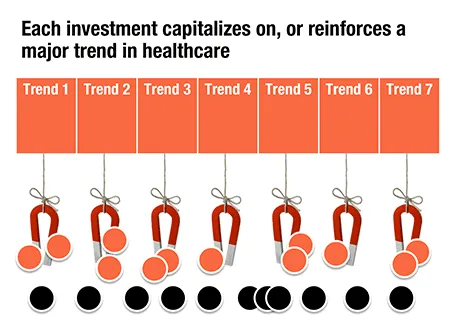
A U.S.-based healthcare-focussed venture capital fund only invests in a company if it pushes forward on of seven trends in healthcare. The page below tries to visualize that.

The point here is only about the rigorous selection, the trends themselves get explained on separate slides, and the portfolio companies get discussed somewhere else in the presentation. After the presentation, institutional investors should remember that the fund is very picky in investing their money, “remember that magnet slide?”

·Data visualization

You put in that P&L manually?

When people receive my analyst or investor presentations and they see a few years of P&L data entered manually one-by-one, they always ask me whether after all these years I have not found a more efficient way to do it. I have not.

While I punch in the numbers manually (which takes about 15 minutes by the way), I can do a lot of things in parallel:

  • Round up numbers
  • Shorten labels
  • Collapse labels and combine rows
  • Check whether everything adds up

A data table is worth that extra attention, instead of an Excel data dump, you get a visual that makes sense.

·Investor presentation

Pick your battles when pitching

Arguing until the bitter end about small facts, when the VC thinks she right because she has a reliable source (in her opinion) is not a good idea. You might be right, BUT you will not convince her, you will do no good to your credibility, and you raise doubts about how the future CEO-Board Member relationship is going to pan out.

Better focus that energy in disagreements that are really worth arguing about. Pick your battles.

·Investor presentation

Presenting a mobile demo

Passing a device with your demo app around the audience is not enough, even for a small group of people:

  1. Screens are small and do not make a big impression
  2. People do not know what to do in order to see the best of the app

So the point of passing the device around is mainly to prove that your app exists. It should be supported by very large screen shots on the projector screen that tell the story behind the app, with the right sequence of features. Preferably with different levels of zoom: a user holding the device, the opening screen with the device around it, and then zooming even further to parts of the screen.

·Investor presentation

A shift in my design work

A few years ago, the main purpose of my presentation design work was to arm people with a powerful set of slides for a live stand up presentation. Usually, the meeting would be set up after an initial telephone or in-person conversation, and the audience would see the slides for the first time.

More and more, I see my visuals being used to get to that meeting in the first place. The “cold” email attachment. Presentation slides become a short 3 minute commercial for an idea. The distribution is not in print, not on TV, but through an emailed document or URL. The actual presentation is more about figuring out the people behind the idea, not the idea itself.

There is general presentation format, or universal PowerPoint document. PowerPoint can even be used to write text documents. The 3 minute commercial is yet another one to add to the long list.

·Investor presentation

Different investors, different pitch

You can be very efficient when pitching to a professional VC and leave the 101 stuff out of your deck. She will have read all the relevant blogs, she is likely to be a power technology user, she sees 1,000s of deals each year, no need to teach her about the market environment anymore.

One, it is a waste of your scarce pitch time, two it shows that you do not have an ability to seize up your audience, which might tell her something about your skills as a manager and sales person.

If you are pitching to a less experienced angel investor, it is a different story, These people require more background and more time. But remember, there are highly seasoned angel investors as well.

·Investor presentation

The early-stage VC pitch deck

Ryan Spoon of Polaris Ventures wrote this guest post on TechCrunch about designing a VC pitch presentation for early-stage startups. Most of his guidelines are valid. I have a few comments on some. It is interesting to take a step back and read between the lines how a VC is analyzing a presentation. Ryan does not say everything explicitly.

How to Create an Early Stage Pitch Deck