SlideMagic Blog

Frequent updates about all things presentations since 2008. Subscribe to never miss a post.

RSS
all posts

Category Investor presentation

·Investor presentation

Talking is the best briefing

A story line skeleton is hardly ever the best briefing for a presentation. It is useful for an analyst who has the fill in the missing pieces of data, not to convey a powerful sales or investor message.

The better approach is to set back and talk things over, that’s when big ideas come out.

Image from WikiPedia

·Investor presentation

Make up the financials?

It is impossible to predict the financials of a business that does not exist yet correctly. And therefore, every financial prediction you see in a startup pitch is made up. Is there any point in doing it? I think you should.

Numbers are a powerful way to check your story for consistency. You cannot sell to more than 6b people on earth, if you are tripling an existing market, are all constraints you should think about. If takes more variable cost to make something than the price you charge, something is wrong. If you want to sell to 10 large Fortune 500 customers, but you only have one sales person in the office, something might not be right. If you plan to hire 300 people next year, that means 1 a day, how are you doing so far?

The key is to translate top level numbers to things you can touch. Sales are customers x products per customer x a price they pay for it. Sales costs are sales people. Etc. etc.

People are not be convinced by the $100m sales in year 5 because your spreadsheet says so. They will believe that you are someone who know what she is doing when the logic behind the $100m stacks up.

Art: Victor Dubreuil, Money to Burn, 1893

·Investor presentation

Sales versus investor presentations

CEOs are used to doing the company’s product sales pitch. When they look for investors or acquirers for their company, it is temping to just press play and do that same sales pitch again. But they can be very different stories.

An investor needs to hear the sales pitch. It makes her believe that the company makes products that people want to buy. Also, it shows that the company CEO is actually good at selling (or not). But investors needs more: strategy, financials, margins, funding requirements, and a more explicit comparison versus the competition than you would put in the sales deck.

Potential acquirers might not be interested at all in the sales pitch. Maybe they are considering to buy the company for a very specific asset they need. (Technology, people, distribution). Acquirers need a very specific, tailored presentation. To make it, you need to put yourself in their shoes and resist the temptation to hit “play” and run the sales pitch.

Image from WikiPedia

·Investor presentation

"It takes too much time to get to the solution"

Clients say they get this feedback after giving a pitch. The initial reaction to this would be:

  • Cut slides from the deck
  • Take the specifics out of your text, make it shorter and more high level
  • Combine multiple slides into one

The danger of this is that you end up with a few slides of highly generic and dense bullet points.  Remember:

  • Slide count does not equal time spent presenting them
  • Smacking someone with the solution in their face instantly takes away the opportunity to lead them by the hand in an interesting story that covers the problem you are trying to solve.
  • The best way to sell the solution is to sell the problem

Here is what I do:

  • Create a super short intro slide that explains the audience what you solve and what you do. So they can stop guessing about the point you are trying to get to.
  • Now, lead people through a sequence of visual slides that highlight the problem, slowing down sufficiently to make sure that the audience “feels” the issue. “Production cost is too high” is too generic. Why is it so expensive, and why could no one do it cheaper until today?
  • Then, present your solution and use the framework of the problem you set up in the previous section to mirror your product against markets that are out there in the market today

Image by David Felstead on Flickr

·Investor presentation

Teach them how to think about you

This debate on the Fred Wilson blog whether you should look at Twitter in terms of monthly active users who log in, or (the much larger number of) people who view/get exposed to tweets is an important lesson in investor presentation design: sometimes you need to educate your audience how to think about you.

Investors like benchmarks that they can compare quickly across stocks, like features of car: EPS, CAC, churn, MAU, eye balls, beta, EV/EBITDA. If your company does not fit the traditional pattern you need to make sure your audience understands it.

Image from WikiPedia

·Investor presentation

Explaining complex things

If your technology is very complex, you have 2 challenges:

  1. Still explain the principle of the technology in a simple way
  2. Show that the incredible complexity is an asset that is hard for competitors to copy

Don’t mix the two. If you cannot resist and make the explanation of the basic idea behind your technology complex, people won’t get it. If you oversimplify things and hide the complexity, people will think that this is something obvious and not worth investing in.

You need to separate (sets of) slides.

Image by Panayotis on Flickr.

·Investor presentation

Should you care about a good investor pitch?

Here is a question I was asked to answer on Quora:

“I heard a famous silicon valley investor saying that “the investors and the VCs are able to see if there is something going on through a bad pitch”. That being said, why should the entrepreneur care about having a good pitch?”

Here is my answer:

  1. Not all investors are like that
  2. Seeing through a bad pitch is especially hard when you are cold emailing someone a deck without explanation, Q&A
  3. You probably also need to the pitch to recruit people, strategic partners, maybe even customers
  4. Building on 3, settling for mediocre is not a good way to start creating an exciting company culture for the years to come
  5. The pitch is likely to be the basis for other marketing collaterals: web sites, brochures, etc. etc.

Image by Wystan on Flickr

·Sales presentation

Keep the CEO in the loop

Investor presentations usually start with the CFO (who naturally puts a finance spin on the story), then the Marketing Director adds product positioning, the Sales Director puts in a highly detailed benefit analysis: the result 3 presentations.

Why is it so important to have the CEO involved early in the process? She is the only one who has a view on the story that cuts across finance, marketing, sales. An equity investor audience is different from a client, is different from a tech conference, is different from a traditional bank that provides loans. More importantly, she is likely to have to make the pitch herself, and so she better is in sync with the slides.

You cannot delegate the investor pitch design, or give the super high level input “you know the story, pitch that we are more flexible”. Time to roll up the sleeves.

Art: Gustave Caillebotte, The Floor Scrapers, 1876

·Concepts

How to present pros and cons

A question came in on Twitter the other day:

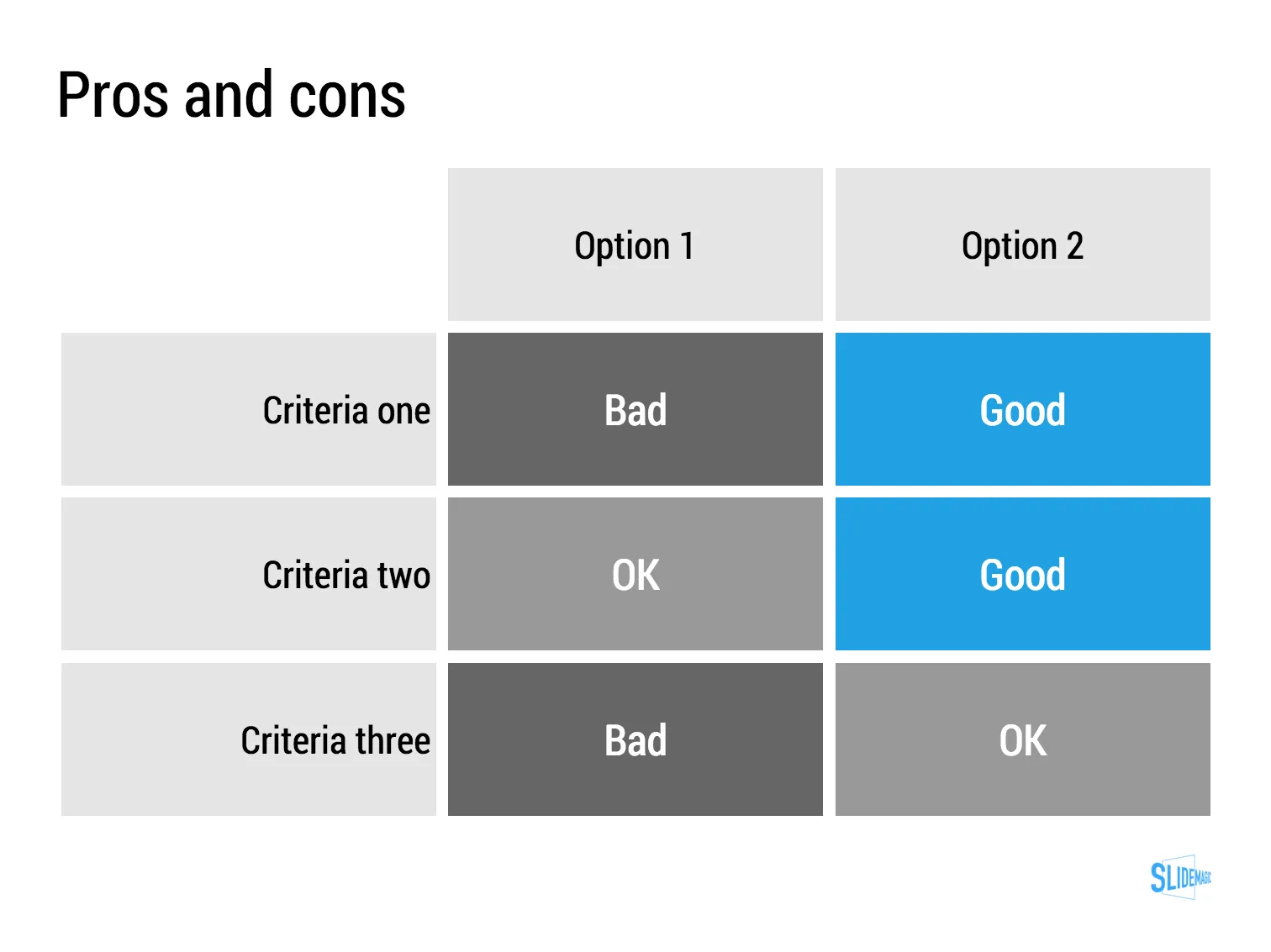
My answer is: a simple table, like this one I prepared quickly in my presentation app SlideMagic (you can clone it to your own SlideMagic account in the presentation template file that contains on the slides I have used on this blog).

The difference between a good pro/con slide and a bad one is not the design in itself, it is how your present the argument. A presentation slide is a tool to get a decision, it is not a laundry list of pros and cons that you evaluated in your analysis. Put your analysis aside, and design from a blank sheet of paper:

  • Group similar arguments together, if an argument is sort of the same, combine them
  • Sort the rows in the table in such a way that things visually line up. For example you start with rows where both options are “good” (all blues), then do the "OK/good"s, then the "OK/OK"s. etc.
  • Isolated and focus those arguments that are going to drive the decision and/or are controversial. "Option 1 is cheaper, option 2 is faster but the what will make the difference is whether we think [criterion 3] is important.
  • Cut words rigorously until you have a page that is still meaningful but does not look cluttered.

Art: weighing of the heart versus the feather of truth

·Investor presentation

The impatient audience

When I am reading I switch in different modes:

  • Losing yourself in a novel and forgetting the time
  • Digging through an article to find the acquisition price that was paid for a company
  • After having failed to resist the click bait title, looking for the answer to the question it raised
  • Absorbing every background aspect of the making of a certain music album

“Newspaper” journalists often get this wrong. They think they are writing for a person sipping a glass of wine and sitting in front of a burning wood fire, while most often they are not.

Hardly any business presentation is digested in the lounge chair. The audience:

  • Has no time
  • Is constantly distracted by calls, emails, messages
  • Thinks that they know it all already and tries to put your idea in a box that is familiar
  • Is clicking down and clicking down and wondering when they get to the point already

The captive TED Talk audience is in the lounge chair sipping wine. The venture capitalist is scrolling down your slides on her mobile while wondering whether the elevator button “1” or “0” will get you to the lobby.

BTW: Happy 2016 to everyone!

Art: Edouard Manet, Young Woman Reclining in Spanish Costume, 1862-1863