

SlideMagic Blog

Frequent updates about all things presentations since 2008. Subscribe to never miss a post.

RSS
all posts

Category Delivery

·Delivery

My presentation training in 1996

In the middle of the house and office declutter exercise, I found my credit card-sized reminder of things I should work on which I wrote after a communication training at McKinsey, back in 1996 when I just returned from INSEAD:
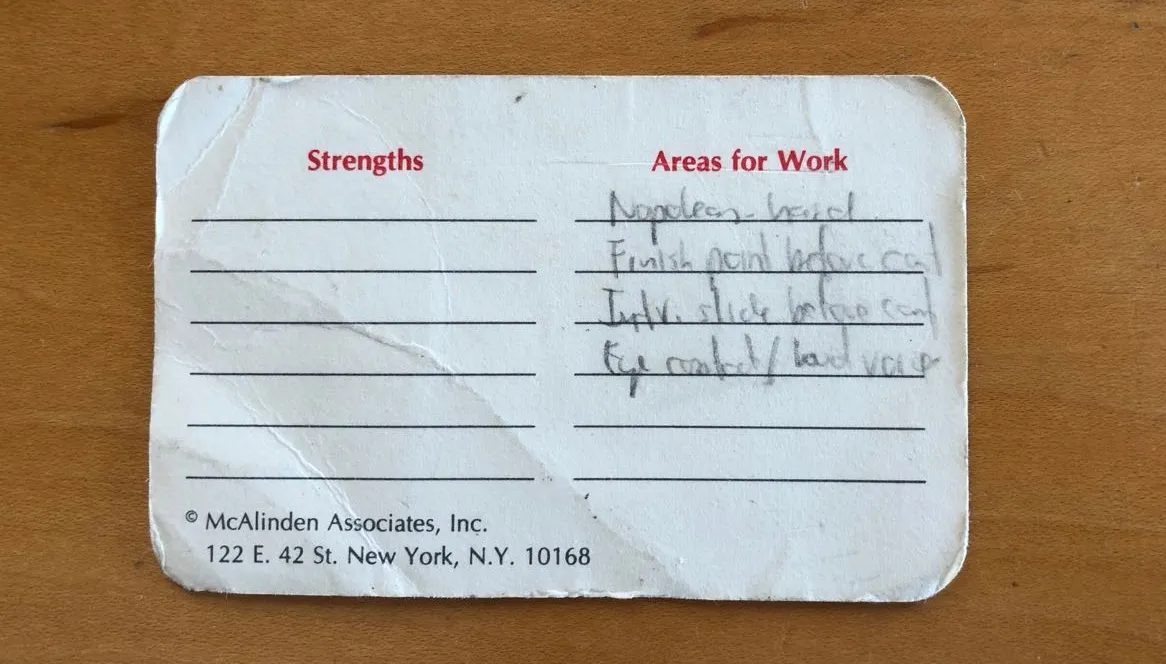
  1. Avoid the “Napoleon hand”, I seemed to have difficulty finding a natural position for my right hand
  2. Finish a point completely before jumping into the next slide / topic
  3. Introduce a slide before putting it up (McKinsey data slides can be overwhelming)
  4. Maintain eye contact with the audience
  5. Use a loud (maybe confident?) voice

I think I had a few strengths as well, but did not bother to write them down (I hope :-) ).

That little card might survive the declutter tornado.

Cover image by Margarida CSilva on Unsplash

·Delivery

Pitching your voice lower?

In a recent blog post, Nick Morgan advises to pitch your voice lower when presenting. When we are nervous, we tighten our vocal chords, which results in a high “shrieky” voice that radiates lack of confidence.

I see many people do this even in smaller meetings, and especially some women are dropping their voice pitch dramatically to come across stronger in a male/testosterone-loaded world. In many cases this sounds very artificial.

 Part of the exercise of lowering your voice is probably not related to your voice at all, it gives you something to focus on that simply calms you down. When you are in your mental low voice mode, you feel more confident.

I would treat lowering your pitch as a last resort, and hopefully other stress reduction techniques (including having tremendous confidence in your story) enable you to keep your own natural voice.

Image via WikiPedia

·Delivery

How to practice?

If you have a few hours left to prepare for your presentation, they are better spent rehearsing than fine tuning the design of your slides.

How to practice? I prefer to run through a presentation as if it were the real thing. No stopping, no stepping back, no rephrasing. Present it once start to finish, think what went well and what went wrong, and do it all over again.

In this way, you get used to the feeling of being on the spot, and that extra mental challenge will help you prepare better for your presentation.

·Story

The stumble chart

I am in the business of designing presentations that I hardly ever need to deliver myself. Now and then I come up with this brilliant visualization/analogy that simply does not stick with the client.

First she asks what it means. I explain. “OK”.  In the next call: “remind how that chart works again?”. I follow up with a passionate explanation. During rehearsals: “So, here we have an [um] great example”, and the energy in the pitch grinds to a halt.

Time to take the chart out.

·Delivery

Getting stuck on page 1

Often, presenters get stuck on page 1. The long list of bullet points which are supposed to summarize the story becomes speaker notes to deliver the entire presentation verbally without the visuals.

Well, that is great right? A captivating story standing on its own with out the need for slides. Things are usually not that perfect. Instead of a captivating story, the presenters reads out the summary bullets, adds some “uhms”, hints a bit at the key points but stays at a generic level, saying that the real story will follow. After 15 minutes, the actual presentation starts, which the audience has already heard, more or less. And then, when the presenter reaches the final summary slide, the whole things gets repeated again in 10 minutes.

When presenting live, it is best to consider your first slide a teaser slide, not a summary slide. Hint at what is about to come, but resist the temptation to spend too much time on it. Instead, run the presentation using the visuals.

For presentation documents that are meant for reading a summery page is appropriate (not a teaser page), and in that case I would actually add more text in a smaller font for someone to get the full essence of a story in 1 page, just in case she does not click through to the end.

·Delivery

Behind the projection screen

I watched an opera a few days ago in Tel Aviv, where the singers were performing behind a perforated projection screen, and in front of another regulator projection screen, which created a very interesting stage backdrop. Here is an idea for a presentation set up: put the presenter literally inside the slide.

In the image below, you can see the 2 screens. The battlefield background is a regular projection, the barrels in front are semi transparent. I googled for another demonstration of this stage setup:

·Delivery

Paul Ryan's PowerPoint

This is unusual, a politician doing a PowerPoint in front of the press. You can see his full presentation here.

Here are a few observations:

  • The slide design is actually OK: consistent, good use of color, balanced, not a spectacular TED talk, but still a lot better than your average corporate bullet point deck
  • The screen is too small
  • He is a pretty good and confident presenter
  • Het gets the start wrong. A super technical summary slide with what they are going to do, without having presented the logic of why they want to do it. I think most people switch of in the first minute (See some reactions here).
  • Later on, things get better. But it is almost as if the slides are holding him back. First he presents a statistic or a quote, turning towards the slide, then he steps away from the screen and explains what it actually means. And it is here where he does a pretty good job.

I watched about 10 minutes of the presentation. The key change I would have made, is to change the framing of the presentation. Leaving my own political views aside, if I were trying to make the case for a script, it would: "Hey, from the outside Obamacare looks pretty good, because of 1, 2, 3. BUT, people are missing a few problems 1, 2, 3,. Our plan offers the best alternative. And here is all the technical, legal stuff we are going to do to make it happen.

·Investor presentation

Too informal

From multiple VCs I have heard this scenario:

Highly confident entrepreneur walks in the conference room, sits casually next to the VC rather opposite the table, leans back relaxed in the chair, rocking back and forth, savoring his coffee, suggests to do a different style of pitch, life is too short for boring pitch decks, let’s just have a more intimate and informal chat about the tech world at large and the entrepreneur’s specific venture in particular, the entrepreneur-investor relationship is all about dialogue, conversation, and exchange of ideas…

“Multiple VCs”, means 2 VCs, and both of them were women. (No, it was not the same entrepreneur).

This approach might be a bit too informal to work. Have your traditional pitch deck ready, and make things less formal if you sense the right dynamic in the meeting.

·Delivery

Slides = training script

This quote applies to telephone sales people, but it is relevant to presentations as well.

When a presentation is still fresh, the presenter clings on to her slides which contains the flow of her presentation. Good presenters get away from stage 0 (reading the slides aloud) and can fake spontaneity by really knowing them by heart. The next level up though is feeling so free and immersed in them that you can almost leave them out al together.

A bit like a guitarist, play the song, memorize the scale and improvise, and in the end, just flow with the music.

·Investor presentation

Executive Summary?

Back in the 1990s, “Executive Summary” pages were summaries that you put in front of a strategy consulting document. They were meant for senior management / decision makers. There was almost something offensive about them, reminding you of your junior position in the hierarchy. Senior managers can skip the detail that you have been sweating on for months and get straight to the point.

The good thing about these summaries was that you actually had to think what it is you wanted the senior management to do, and you had to frame your argument in the best possible way. Writing these summaries often caused major shifts in the recommendations of the project.

Clients ask me frequently about an Executive Summary of a presentation. This time, it is about a summary document that they can email to someone ahead of a presentation, or in most cases, a document that should convince the recipient to agree to a presentation.

I think the classic Executive Summary memo is not the most engaging way to get people excited about your project. There are a number of differences between your need for a summary, and the Executive Summary of the strategy review that is addressed to the CEO of your company.

The CEO is probably very interested in the recommendations (what price should I pay for the acquisition target), and is fully aware of the broad context of the project. She just needs the underlying logic to complete her own understanding of the situation. And, she probably knows you, and can pick up the phone quickly to clarify something that is not clear.

Continue reading →