SlideMagic Blog

Frequent updates about all things presentations since 2008. Subscribe to never miss a post.

RSS
all posts

Category Gadgets

·Gadgets

Trackpad only

A while ago I wrote this post comparing a Logitech Mouse, the Magic Mouse, and a track pad. Nine months later, I have switched complete to a track pad, which is not only much better for navigating the Mac Lion OSX, but I also find it highly accurate for drawing shapes and general slide design work.

The key thing that I had to learn was to move things around not by using the old PC method: click the track pad and hold it pressed down while moving your finger, but work with 2 fingers: one presses the track pad down, the other one moves the object. Once you get the hang of that, your movements are as precise as with a mouse.

My pile of obsolete hardware is getting bigger.

·Books

Apple iBooks and presentations

Two main take-aways from the announcement by Apple yesterday about the new platform to design and publish interactive books for the iPad:

  1. It removes the excuse that the lizard brain inside me used so far to stop me from writing a book: the thousands of dollars and months in training I would have to invest to port an InDesign document to a working iPad app. Here you go, I committed publicly.
  2. This platform can be fantastic to write investor and sales pitch documents for one-on-one meetings or sending to a prospect before you meet face-to-face. The standard for the boring text “Executive Summary” just got raised in such a way that people might actually start to read them.

·Gadgets

MacBook with 2 external screens

The new Apple 27" Thunderbolt display enables you to connect 2 giant external displays to a laptop, something that has not been possible until now without additional hardware.

Large screen real estate has its advantages. It is easier to design presentation slides when you have a large workspace in front of you. Extra space also enables you to open multiple windows, for example a PDF file with comments on the previous version of your presentation, or an Excel file with the data that need to go into your pie chart.

Now, 27" is a lot of space (2550x1440 pixels) and for most ordinary people, one screen will do. A presentation designer might actually need two (putting her in the same category as financial traders, air traffic controllers and social media addicts). I like to design on a clean and calm canvas. All the small windows with bits of information distract me. So I use that second screen as my messy desktop, literally pushing bits, pieces, and windows aside when I do not need them, preserving my pristine and uncluttered design environment in front of me.
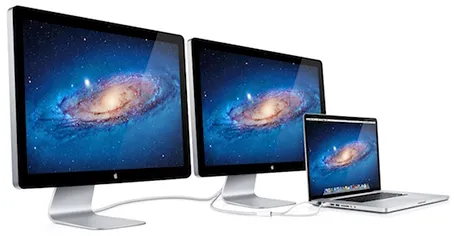
Now some technical details. An Apple Thunderbolt screen can only be connected to a recent MacBook laptop that actually has a Thunderbolt port. But more importantly, the dual screen configuration only works on the most recent 15" and 17" MacBook pros, not on the 13" MacBook Pro, and not on the MacBook Air. (This might actually be an argument for getting a MacBook Pro over a MacBook Air) at the time of writing, October 2011).


Continue reading →
·Gadgets

First sketches with the Wacom Inkling

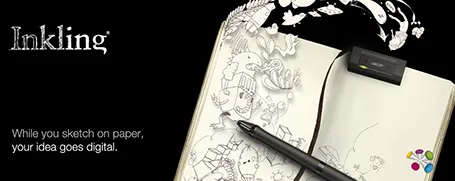
The Wacom Inkling Digital Sketch Pen (affiliate link) is a tool that lets you draw with a regular pen after which a sketch can be transferred to Photoshop or Illustrator for further editing. No, it does more than a regular scanner. First of all, it allows you to draw in layers and preserve them in the editing software. Secondly, the hardware is so small that you can take it any where you want.

My box arrived yesterday in the mail and the experience confirms what I have seen so far in the promotion video (my sketching skills have some way to go though). The product comes in a box the size of a regular pencil case. The pen and the receiver fit in nicely. Clip the receiver at the top of the page, and start sketching. It is as simple as that. One button opens a new file/page, another button adds another layer. The software is easy to install and works great.

The only drawback for me is that sketching has to happen with a ball point. I prefer a soft tip pen, or best of all a thick pencil to draw. There might be technical reasons why Wacom stuck to a ballpoint for sketching, but hopefully they will release a pencil-based scanner in the near future.

·Gadgets

Software developers, please fix this

More and more applications will be a platform to deliver presentations, which means more and more applications need to do the following things:

  1. Have a good full screen mode
  2. Respond to Logitech and Apple remote controls
  3. Support dual monitors including slide preview mode, where you can see the upcoming slide on your laptop screen (not on the screen the audience is watching)

Adobe Acrobat does not have preview mode, and does not respond to an Apple remote. Apple Preview only seems to have slide shows with automated page transitions. OK, Preview might not be intended for running presentations, but Adobe at least should build in features that make Acrobat a good alternative to PowerPoint and Keynote for presenting slides.

Tablet devices would be another category. It is easy now to hook up an iPad to an HD screen. Again, presenting slides should be thought of as a required application.

·Gadgets

Wacom Inkling

I still have not found the perfect device to transfer sketches to a computer. Drawing with the mouse does not work. I do not like using drawing pads that do not allow you to see what you just drew on the same surface, and the very large touch screens are very expense and so heavy that they are impossible to carry around. And carrying around is crucial for creative sketching. Ideas always come up when you are not at your desk.

So, that is why I am excited about the Wacom Inkling that was announced today. A sensor tracks the movements of a regular pen on normal paper and stores them. Once you connect the sensor to a computer, sketches are transferred.

I see 2 benefits for presentation design:

  1. Enabling me to include cartoon-type drawings in my presentations. The key here is the option to use layers. Sketch a character roughly on a piece of paper. Press a button to open a new layer, and trace a more precise drawing over the rough one. Repeat the process of necessary. The top layer can now be of decent quality, and transfered as a vector to your computer. Great.
  2. An archive for sketches that can be filed and searched on a computer.

The big question: does it actually work? I took the risk and ordered one and will report back.

·Gadgets

Using your laptop monitor as a 2nd monitor

Computer screens have gotten bigger and bigger, and I suspect that most users will use the extra screen real estate to keep multiple windows open on their desktop. One for email, one for Twitter, one for PowerPoint, one for Skype. Designers do not have this luxury to spread everything out in front of them, they need a big calm design environment with minimal distraction. My PowerPoint or Keynote screen is always set to the maximum.

I used to work with a laptop in clam shell mode in my office: the laptop is closed, and a big external monitor is used as a display. For copying and pasting, inserting Excel charts in PowerPoint, I was constantly moving windows around. Until yesterday, as I looked at the closed laptop screen.

So now I created a dual monitor screen set up. My slide design application is up full screen on the large monitor, and my laptop screen is used as a collection bin for all kind of bits. It has been a liberation. My 17" laptop actually is big enough for the little side apps that I am running in that screen. Great.

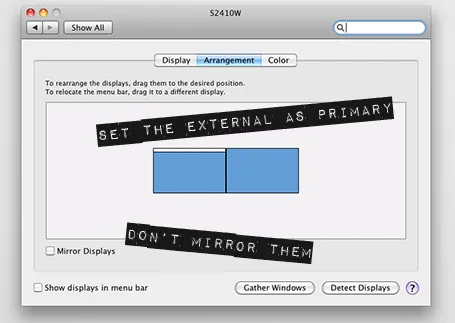
If you are on a Mac, here is how to do it:

·Gadgets

Magic Mouse versus Logitec MX mouse versus Magic Trackpad

I have experimenting with various input devices over the past month.

  • The Logitech MX mouse: a leftover from my old PC. Large to fill the palm of your hand completely, this device has worked for me very well over the past years. If there is one drawback it is the materials it is made off. This fake-velvet plastic actually wears off after long use, making the piece of hardware that you touch all day, every day of the year look and feel dirty.
  • The Apple Magic Mouse. I actually had to get used to this device for a few days. Unlike the Logitech mouse, it is small. You move it with your thumb and index finger. The surface is made of glass enabling you to manipulate the cursor and zoom just like you can do on a track pad. I love the clean material (glass), no more sticky plastic on your fingers. Sometimes though, the scrolling can be a bit unpredictable in PowerPoint, oops I just went 2 pages up.
  • The Apple Magic Trackpad is a standalone version of the trackpad that is usually found in laptops. It has a nice large surface, and nice click. For a casual computer user, this would be the one I recommend. For the professional designer (me included), I still prefer a mouse to manipulate and drag shapes across the screen.

After a month, I end up working with the Magic Mouse most of the time. I still need to find a solution for that unpredictable scrolling somehow.

·Design

Dropbox beats YouSendIt / Google Docs / Office Live

PowerPoint designers are struggling with big file sizes that consume storage and make it hard to email documents. I have discussed solutions such as YouSendIt and Google Docs before (here). Recently, I switched to Dropbox:

  • Seamless integration with all my devices (desktop, laptop, mobile phone, tablet)
  • Seamless integration with these devices’ operating system (you do not notice it is there)
  • Two solutions in one: 1) sharing big files 2) always access to your own files
  • Nice extra 3) a service that keeps history of your files so you can roll back a version in case a file got corrupted or you made a horrible design mistake.
  • Minimalist design interface

The Dropbox pitch to venture capitalists from 2007 pretty much still holds.

YouSendIt requires sign in all the time, and all the advertising and branding does not look very professional. Google Docs is still hard to integrate with Microsoft Office. Office Live does not integrate fully with the Windows operating system. It also suffers from feature overload: I do not always want to create a full virtual team room with calenders and contact lists, just sharing files is enough.

If you sign up with this link for your free 2GB account, you get 250MB of bonus space (disclosure: and I get another 500MB). You see, they know how to market as well. The regular link is here.

The last word probably has not been said about this subject, I wonder whether the conclusion still will be the same in January 2012.

·Design

Going analogue with mechanical pencils

Most of my charts start with a pencil sketch. I burn literally through piles of paper when designing a presentation (a good use of those 1-sided print outs you do not need anymore). So what are my favorite pencils?

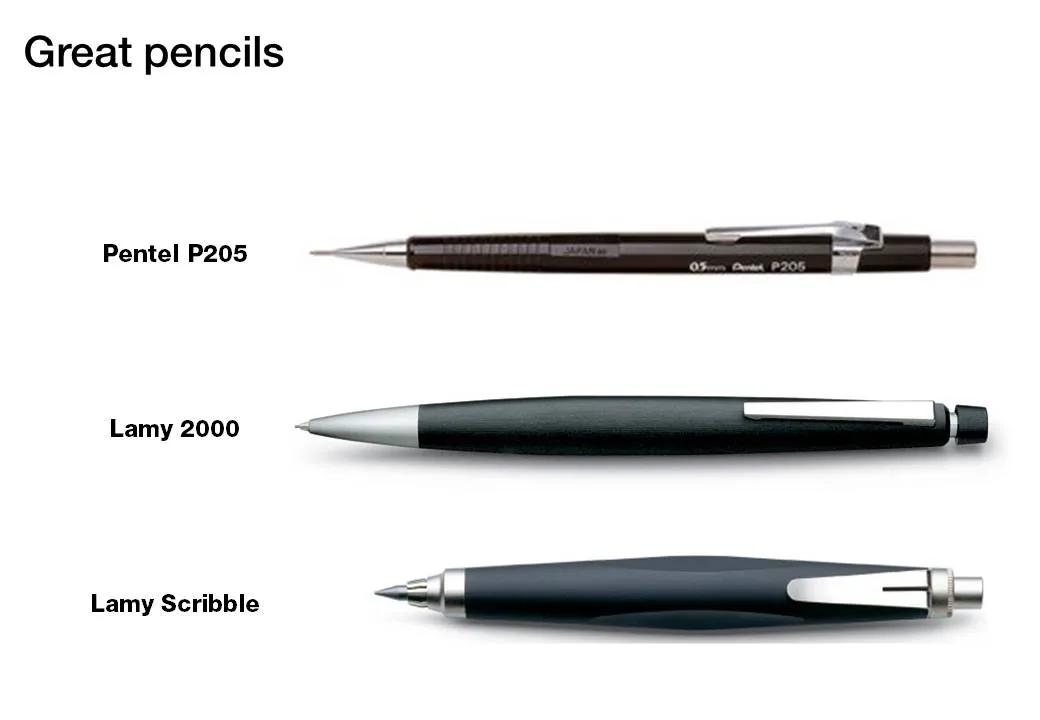
When I started at McKinsey, the Pentel P205 was my initial favorite. Per pencil, it is actually very cheap. That was exactly the problem, people considered it cheap enough to borrow it all the time. I kept on buying new ones.

I experimented with various much more expensive pencils only to discover that these are actually pieces of jewelry rather than sketching instruments. Beautiful to look at, but not very useful. Check out the site of Joon Pens in New York to see some examples.

Recently I discovered Lamy pencils as the perfect in-between. Two pencils are my favorite. First there is the classic Lamy 2000. Designed at the end of the sixties, and still in production pretty much unchanged. A beautiful minimalist look, very light and a nice, almost wood-like feel. People say that over time the mat finish will wear off at those spots where you hold the pencil though.

I use a 0.7mm pencil for regular writing. But when it comes to sketching a wider pencil is much better. The Lamy Scribble comes in a version with a 3.15mm fill. It has a very nice grip and is beautiful to let your creativity go.

(All links to Amazon are affiliate links).