SlideMagic Blog

Frequent updates about all things presentations since 2008. Subscribe to never miss a post.

RSS
all posts

Category Delivery

·Delivery

Video without the audio

Short videos can fit really well into a presentation. The audio track can be a problem.

  1. Bombastic loud music can feel out of tone, especially if the sound was not set up correctly (too loud, too soft)
  2. A spoken voice over might feel out of tone with your overall presentation
  3. It is hard to edit/change video audio, maybe your message has changed over the past month, the voice over of your video has not

A good option can be to run a silent video, where you the presenter, gives live commentary in a voice the audience already has gotten used to, perfectly blended into your overall story.

·Delivery

"I need a conference presentation"

You have a sales presentation that - despite the fact that it is loaded with bullet points - has been very successful in 1-on-1 meetings with customers. Now you have an invitation to speak at a conference for an audience of more than 100 people for a maximum of 20 minutes. What next? Here is a recipe.

  1. Trim down the content. In the conference audience are competitors, analysts, journalists, all kind of people that might not be suitable to receive the ins and outs you would discuss with a prospective customer. Remember, the object of a conference presentation is not to close a deal, it is to tease people into calling/emailing you to set up a first meeting.
  2. Flatten the story. Take out overview/summary slides, and spread them out: one slide covers one bullet. We want a story, not a structured table of contents of a business school text book.
  3. Beef up the “problem” section of your presentation to let the audience connect with the issue you are trying to solve. The problem might be totally obvious to you, and 60% of the audience, the other 39% is not there yet.
  4. Avoid repetition. If you talk early on in the presentation how highly accurate your product is, group that together with the a slide in the back that shows test data confirming accuracy.
  5. Find big bold visuals that support your points (one point per slide). Stretch images to a full page size, and cut text.
  6. Take out any live demos or demonstrations
  7. Use your videos (if you have them), BUT only if you can integrate them seamlessly in your presentation flow. Embed it and test it 300 times to make sure there are no technical glitches. Think where you want to insert the videos. Videos are excellent wake up calls, anticipate where in your story the audience runs the risk of getting bored.
  8. Practice, practice, practice, until you can deliver the whole talk in 15-17 out of the allocated 20 minutes.
Continue reading →
·Delivery

Who are you?

I am in the process of beefing up my software skills (Logic Pro X, nothing to do with presentations), and am spending a lot of time watching screen shot movies. I am just wondering why in these training sessions, the face of the presenter is not shown? OK, the screen real estate needs to be as big as possible, and a constant “talking head” on your screen distracts, but maybe a small introduction, at the beginning of a lesson?

This could be an idea for presentations that are used in cold email approaches: put a very short, very short, intro video of yourself on page 1 (to keep file size emailable and not take away the attention from the slides that follow).

·Delivery

Passion

VC Mark Suster reconfirmed how important in-between-the-lines-body-language is when pitching investors.

If I had to put a number on it I’d say 1 in 20 pitches – maybe 1 in 30 – are by an entrepreneur who comes across as truly passionate about her project. Y […]

The other 29 pitches consistent of many smart people who “think they have an angle on making a buck” which I know is an unfair over-characterization of the situation but you can genuinely tell when somebody isn’t “all in.” 

I am not sure about the 1 in 30 ratio, but I have seen similar dynamics when clients approach me to upgrade their investor presentation. When you are a professional manager-for-hire that makes a career in big firms, your affinity with the product is usually not that super important, you manage people and deliver the goods. When you are the CEO of a startup raising its first round, it matters a lot.

If the CEO herself cannot portray the required passion for the product, maybe it is wise to include the person on the team who can. I have seen many successful combinations of a CEO who is focussed on a execution and a “product guy” obsessed with the technology, but slightly disconnected from the harsh reality of budgets and timelines. Still, if you need to rely on this combination you definitely lost some points with VCs that you need to make up for in other areas.


·Delivery

How the Fed learned to talk

An interesting piece in the NYT: how the Federal Reserve is moving to communication as the core of its strategy to steer the US economy.

More, and more bastions of corporate waffling are being torn down as journalists, analysts, bloggers, and the audience itself becomes more ruthless in cutting to the chase of what is actually being said.

Historically, there were probably two reasons for people to waffle:

  1. Status: lawyers, politicians, doctors, scientists, priests, CEOs used their jargons to re-emphasize their authority towards us, the ignorant masses.
  2. Cover up: if you get an unexpected question, waffling is the default strategy to gain time

Reason 2 is probably here to stay. Reason 1 is no longer an excuse.

·Delivery

Minority report screen

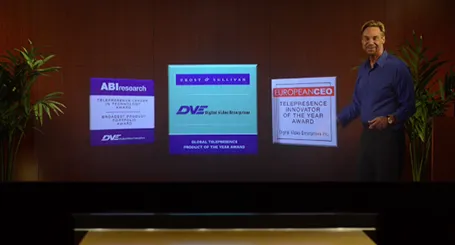
See this presentation screen by DVE Telepresence (auto-play alert), it allows you to move PowerPoint slide objects in the style of the film Minority Report. What do you think? I am afraid that more sophisticated screen technology will not turn humans into better story tellers.

What would be useful though is to have a technology that allows you to write on a transparent whiteboard in front of an audience where technology takes care of mirroring your writing, so it becomes readable by both you and the audience.

Secondly, having a camera hidden inside a screen is great for creating natural eye contact.

·Delivery

The learning pyramid

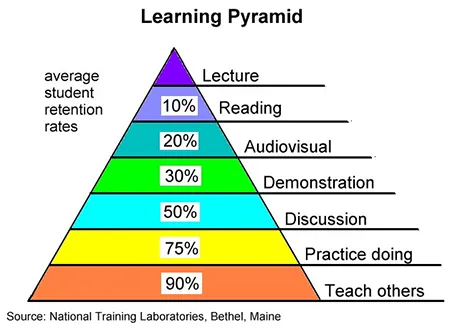
I came across this image the other day, showing retention rates of students by delivery form. A lecture is the worst, teaching others is the best. I am not sure about the accuracy of the exact percentages, but there is something to the overall hierarchy presented here. And presentations are definitely somewhere high up there.

But we can learn from this pyramid to make our presentations better.

  1. Audiovisual: This will not be a shocking new insight: use visual material in your presentation, avoid text
  2. Demonstration: Keep things highly practical, use case examples that people can relate to
  3. Discussion: Easy to do in a small setting, but harder for large audiences. In sales presentations for example, this would mean improvising your entire sales pitch on the client specific situation.

How could you get to teaching others in a presentation?

·Delivery

Presenter fatigue

Giving your presentation over and over again makes you a better story teller. You need to know your stuff inside out in order to be spontaneous. Pretty much like a musician who can only start to improvise after the basic song can be delivered on auto pilot.

But, some presenters go to the other extreme, they get bored of their own presentation. Energy levels drop, and slides get cut and reduced to generic bullet points that say it all. They say it all to the experienced presentation, they say nothing to the novice audience who hears the story for the first time.

So, how can you freshen up a presentation? Some thoughts

  • The most important one: now that you are more confident about your story, you can move toward much more daring and unconventional slides.
  • Add stories or anecdotes
  • Go for a totally new look and feel (dark background, light text)

But different slides can only do so much. In the end you have to power yourself up to tell that story the way did it the first time to your audience who hears it for the first time.

·Delivery

Slides = confidence booster

Most clients give an almost perfect verbal investor or sales pitch in our first briefing meeting. Somehow, in one on one meetings it is easy to connect with the 1-person audience, and construct a compelling story with a natural flow.

As soon as the number of people increases, something goes wrong.  Luckily we have our presentation slides projected big on the wall to remind us to get on with telling our story just like we did in the 1-on-1 meeting.

And here is the secret of the professional presentation designer: I often follow that first raw 1-on-1 pitch very closely in my story flow design. But do not tell anyone.

·Delivery

Audience perspective

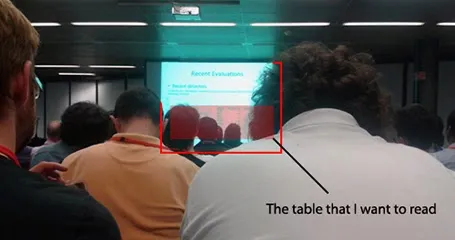
The PowerPoint or Keynote slide sorter view with the small thumb nails is a good proxy for how the audience will see your slides. But sometimes, they are even worse off as in this image by Ali Eslami.

While I would not go as far as recommending to fill the top of the slide with all the important content, it is true that this is the part of the slide that will get the most visibility. At least write the message clearly in the headline, rather than using the space for a descriptive title.