
SlideMagic Blog

Frequent updates about all things presentations since 2008. Subscribe to never miss a post.

RSS
all posts

Category Culture

·Culture

Presentations is culture

I remember doing a project for a TV broadcaster back at my days at McKinsey. Because the client was in the business of communication, it was very picky on how reports should be written and presented.

Presentations are part of your corporate culture. If they look sloppy, are full of pages with boring bullet points, contain incomprehensible diagrams, are loaded with buzzwords, it says something about the organisation that produces them, especially when you requires staff and customers to sit through them.

Maybe you invested a lot in that first meeting sales presentation, but you can’t keep it up in the decks for the 2nd, 3rd or 4th due diligence meeting. This is where you show your real face.

These follow up decks do not have to be master pieces of graphics design, they still should look decent, consistent and on-brand.

(SlideMagic is here to help).

Photo by Raphael Renter on Unsplash
·Delivery

Getting to the point

Everyone is working remotely The meeting is on an improvised video call. Less time to prepare the slide deck. People watching slides on small screens. There is less room for “escape behaviour”, request another sensitivity analysis, rephrase slide 25 to get back to it later.

The current situation might be a turning point in corporate communication. PowerPoint still holds the fact packs and the result of our analysis, built up over months, updated with the latest information. Then, there is the (virtual) meeting tomorrow where you have 5 minutes to make a point. “OK, what it all boils down to is this…”

And that’s where SlideMagic comes in: fast and simple.

Photo by Tommy Lisbin on Unsplash

·Culture

15+ years of working from home...

I have been working from my home office since 2002, and for me, the experience has been great. Well, it fits my personality (introvert who does not crave water cooler chats), and the sort of work I like to do (create, design things).

The coming weeks will give an opportunity to find out what sort of work can be done from home, and to what type of people it will appeal. There will always be people that need constant supervision and checking to stay “focused”. There will always be managers who just love to have all subordinates around ready to be called in at any time it suits her agenda. There will always be cultures that thrive on corridor chats to coordinate things.

For other situations, this might be an opportunity.

Photo by Breno Assis on Unsplash

·Investor presentation

It makes sense, but it does not

I have been in many of these types of presentations:

Some of the reasons why the overall conclusion of a presentation does not make sense, while the individual slides do:

  • Maybe the people, the organisation, and its culture is not the right environment to make a plan happen. Who is going to do it?
  • The probability curve: on average, normally speaking, the strategy makes sense. But what if things start deviating from the average. What is the potential downside and could it be catastrophic to the compony?
  • The self-fulfilling prophecy. Yes, the deck has 50 slides, discussing 50 different aspects of the idea, but when you look at it, they all depend on ver few (maybe even one) assumption about the market outlook, a valuation of a company, etc. That assumption could be wrong.

Unlike for big companies, for tiny startups the opposite could be true. The slides might not all make sense, but the team is fantastic, the downside is not that big, and an angel investor is willing to bet on that one big assumption.

Photo by dylan nolte on Unsplash

·Investor presentation

Signing NDAs?

As a professional presentation designer I deal with highly confidential information in almost every presentation I work on. Let’s look at NDAs (non disclosure agreements) from different perspectives.

As a founder, inventor, entrepreneur, you have every incentive to get people to sign an NDA before sharing confidential information. You have this fragile idea that anyone could just steal and replicate. Also, NDAs are important when applying for patents. If someone can prove that your idea was “out in the open” without NDA protection, you could lose your claim as its inventor.

Investors see thousands and thousands of deals in a year. Signing an NDA for each single one of them creates some practical problems. You would have to thoroughly check 4 pages of dense legal text for each one of them, you need to keep track of all the agreements over time in order not to forget the thousands of legal obligations you entered into over the course of 20 years. That is the reason most investors won’t sign an NDA.

Since investors hold the check book, they are in a pretty strong negotiation position versus the inventor. What to do? In most cases it is possible to explain an idea without signing an NDA. Simply leave the very specific bits out of the pitch. When the due diligence process advances, you might have a chance to get the investor to sign later on, as the probability of making an investment increases.

Even if the investor had bad intentions, it is pretty hard to copy a startup idea after glancing through an investor deck. You need to have the required technical know-how, the team, etc. etc. to make it happen. And even if you have all that, you need to put in the sweat to make it actually happen.

Continue reading →
·Creativity

Business document production workflows

Production of documents and reports inside corporations is a hugely inefficient process, because of a number of reasons:

  • Using the face-to-face meeting format to discuss small text edits
  • Do zero preparation for such a meeting, and start reading analyzing the text with the junior analyst in front of you
  • Because of this lack of preparation, completely upend the start of the presentation because critical bits are missing, without reading things to the end
  • Having too many people involved: lots of captains on the ship giving contradicting input
  • Refusal of senior managers to make tiny text edits directly into the text themselves

I remember this from my early days as a junior analyst at McKinsey. Fight 1 hour of traffic to drive to a meeting with a senior client and/or partner. Listen to small talk, get send out to make paper copies, multiple people making edits to slides with pens, make copies again, back into the car, in the office at your desk failing to read the hand writing, going back and forth via fax machines until you get it right. Technology has moved on a bit, but document editing is still pretty much the same today.

When I start to work with a new client there is usually a small adjustment process, especially when we are on different continents. Am I a junior analyst who needs paragraph by paragraph instructions? He is 7 hours ahead, but hey, I am the client and get to set the meetings. Better schedule frequent update calls to make sure he stays motivated to press on.

Continue reading →
·Culture

"Do something basic, it does not have to be great"

“I know you are busy, but this is really urgent, I we are on a very tight budget: do something really quick, it does not have to be great, pretty, beautiful”

A warning to all freelance designers don’t fall into this trap.:

  • Your client says it does not want quality, but will for sure be disappointed when she receives the work. Secretly she hoped that you would not stick to the bargain and put in the extra hours to come up with a decent product
  • Your basic, not so good, quick work, will still go out there, it will be passed on, other people will see it, and the poor quality will boomerang back to you.
  • You have crossed the “I am a quick fixer for hire” mental threshold. The mindset of the freelancer should always be, how can I be more valuable, and as a result charge more for my work, rather than less. It should be a one-way door, never go back.
  • If you accept this short term work,  you might have to drop a potentially interesting client a few days later because of it. Opportunity cost of time.
  • Clients who are willing to compromise quality are probably not the best clients to work for.

Another often used argument is “we will do the design, you just focus on the story”. Things go quiet when you actually send over a deck full of boxes and placeholders that is ready to go into the design process.

Continue reading →
·Culture

Ethics and the freelancer

Many of my clients are concerned about confidentiality when we start working for the first time together. Especially after I ask them for the company financials, cap table, and product development timeline, all essential ingredients for an investor presentation.

Some clients require signing an NDA. Unlike VCs, I sign them if they are capped in time, and do not contain non-competes. But many clients, actually don’t bother. Here is why your secrets might be safer with a 1-person freelance organization than a larger company:

  • The cost of a data breach is much higher. Even the slightest hint of an ethical issue will put me out of business. For big companies, it is a legal issue that can be dealt with in dollars. But, this is hardly ever going to be an existential issue.
  • One person firms are better at controlling information flow than large companies with lots of different departments, with lots of different subcontractors in lots of different locations.
  • Good freelancers probably have a 100% full work pipeline, and select work based on the interest or creative challenge rather than a need to fill the empty capacity of a bank of designers waiting for work downstairs. As soon as a prospective client really gets interested (wink, wink) in knowing more about the specifics of the work you did for a competitor, it is a good sign to walk out of the room.
  • A free lancer works directly with the client, so the eye-to-eye handshake is a personal contract signed with your consciousness. You are not wondering whether you violate a contract, but whether you are breaking someone’s trust.
Continue reading →
·Culture

All the slide templates you will ever need

With my presentation app SlideMagic I aim to change the communication culture in corporates. People spend too much time preparing slides. They produce documents that are unattractive to look at, and spend far too much time falling asleep in conference rooms.

The solution: splitting the communication tools: Excel and PowerPoint for logging the analysis, and a new tool 100% focused at communicating an idea and getting to a decision. A super simple visual language does not allow you to get lost in crafting complicated slides, or worse - give up all together and just use bullet points on every chart.

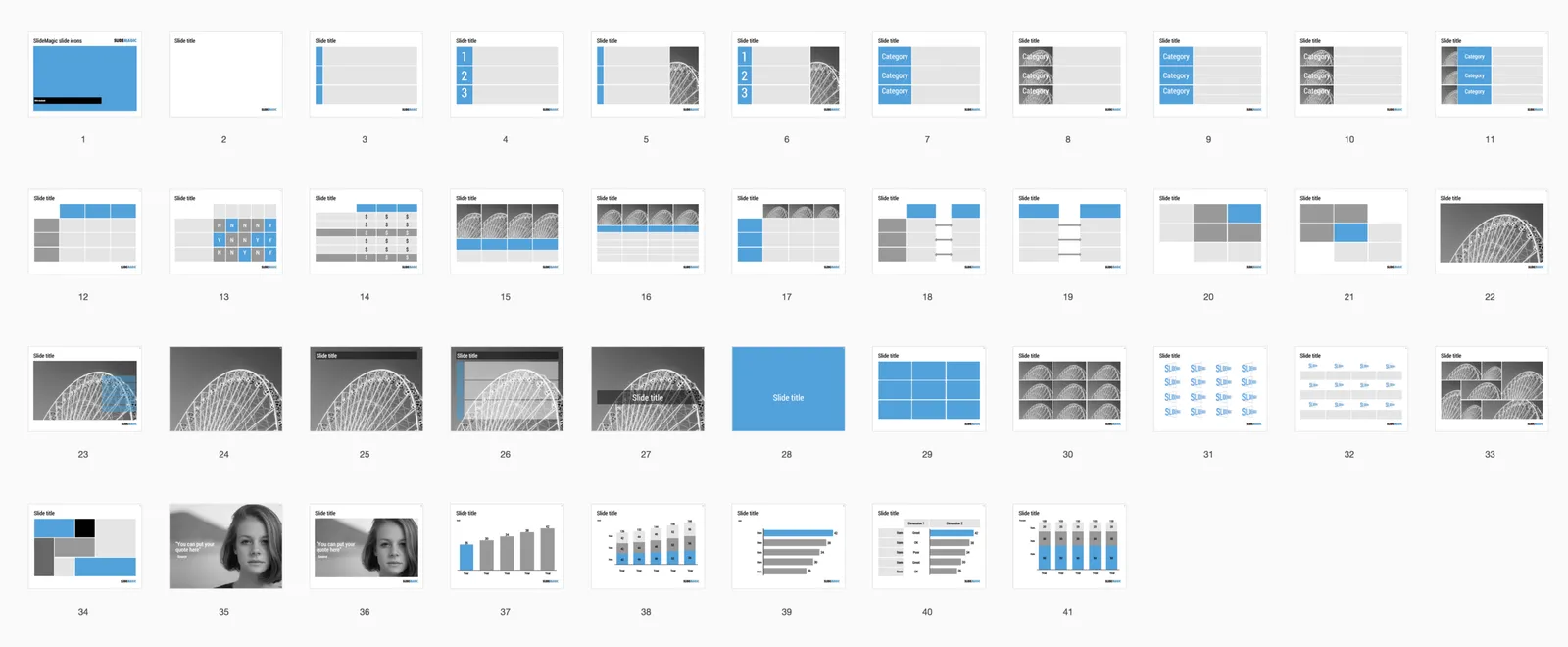
In a business presentation you need very few visual concepts:

  • Listing and organizing stuff (yes, the dreaded bullet points)
  • Comparing, contrasting, things
  • Showing growth, trends, forecasting
  • Showcasing things (products, people, clients)
  • Linking one thing to another, impact, cause/effect, from-to

When you hit “insert” in SlideMagic, you get presentation with this list of slide templates. In my opinion they can cover 99% of your business presentation needs. Think about what you want to do (listing, comparing, forecasting, showcasing, linking), pick a template and adjust row/column counts and you are done.

If you want, you clone this entire slide deck in your own SlideMagic account via this link. Let me know which concepts that I have left out you cannot live without. Maybe processes, timelines?

·Culture

Corporate speak

Professions tend to have their own language. Academia, doctors, lawyers, politicians. You need to master the language in order to be part of the club. Once you are part of it, you filter the language and extract what it actually means.

Managers in corporations have such a language as well, it is called the presentation. The key messages are hidden in bullet points, consulting frameworks, and buzzwords. Junior managers learn the craft by spending hours creating the deck and iterating them, senior managers know how to read in between the lines and get to the issue that matters quickly (the 2nd part of the proposed budget on page 35).

We got rid of formal letters and replaced them with informal emails and messages. It is time make those presentations more to the point as well.

Part of the solution is more visual slides (imagers, less text). But the most important change is a cultural one: saying what we want to achieve in a short and to the point matter.