SlideMagic Blog

Frequent updates about all things presentations since 2008. Subscribe to never miss a post.

RSS
all posts

Category Creativity

·Creativity

Scribling

I keep on looking for a good electronic solution for note taking, doodling, and scribbling. None of them are perfect. A new option has been added recently.

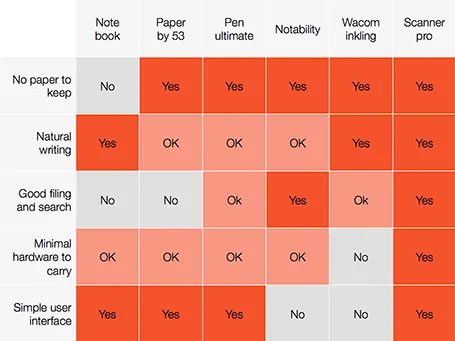
A good note taking solution needs to combine a number of things:

  1. No paper to keep
  2. Natural writing interface
  3. Good filing and search
  4. Minimal hardware to carry
  5. A simple user interface

See my highly sophisticated analysis below.

The new option is a smartphone-based scanner. Scanner Pro is a brilliant app. It takes photos, and lets you easily crop the image. You can keep the image as a photograph or flatten it to bold, fax black and white. Then upload the scan to Dropbox or Google Drive where you can store and search things.

So the best note taking might be scribbling on a piece of paper, scanning it, and throwing away the paper.

PS: earlier review of the Inkling, Penultimate,Paper and styli (?) for iPad.

·Creativity

From memory

I realised that I hardly look back at my notes from a briefing meeting when designing a presentation. The big story is designed from memory, only for facts I need to revert to my scribbles.

I guess that your brain gets used to recording stories when you design presentations for a living. When I listen to someone (more important than seeing an existing presentation) I record the information by creating a story flow in my head that is more memorable than scribbles on paper.

·Creativity

Learn to see

A child find it hard to draw realistic 3D perspectives, because her brain is still developing 3D perception. She draws a house with a front, and a side wall without that wall disappearing towards the horizon. She is not drawing what she sees, she is drawing what she thinks the house looks like. When the drawing is finished, she notices that someone is not right, but she finds it impossible to lay her hand on it what it exactly is.

The same is true for grown ups and graphics design. You see a beautifully designed page, you want to make something similar in PowerPoint and somehow, it does not come out. Why? Because you stuck to your own mental model of a PowerPoint slide (and what you think it should look like) and did not really see how the designer deployed white space, used of grey scales in text rather than blunt black, and set the space between title lines slightly tighter, and was careful not to overdo it with the colours.

Here is an exercise. Take a poster or design that you really like and literally recreate it in PowerPoint (or Keynote) until it looks exactly the same. Now apply that template to your presentation.

·Creativity

Shutting down your brain

This post by Nancy Duarte about how taking long walks inspires her, resonated with me. She describes the experience of shutting down your brain to help you focus and be more creative. Almost all pleasures in life are someway or another about cutting out noise, worries, and random thoughts out of our mind.

Ancient oriental wisdom encourages us to focus deeper on the natural experiences of enjoying what we eat, making love, meditation. Artists try to create a disconnected world through a good story or beautiful craft. More brutal, unhealthy, and/or illegal ways to reach that stage of disconnection are alcohol and other banned substances. Mass media tries to achieve that same escapism through retail therapy, (loud) music, or bone-shaking visual effects in movies. Endurance sports fanatics can even get hooked to to beta endorphins that are released as the result of heavy exercise.

Nancy choses hiking, I use mountain biking as a way to shut down the brain. It is the perfect combination of being outdoors, doing a physical workout, but also requiring your brain to focus heavily on obstacles on the trail ahead of you and being aware of the balance and flow of your body at all times. There is literally no time to think of anything else.


·Creativity

Remote-controlled slide editor

When you are designing a presentation for either your boss or a client, there is always the temptation towards the end of the project just to do the required changes and stop thinking creatively with the finish line in sight. Slowly, your original radical design idea can be diluted into a more ordinary and less powerful presentation. Resist the temptation of becoming a remote-controlled slide editor and protect your work of art.

·Creativity

High-Low-High

This describes my usual creative process. You start off with digesting a story at a high level, and things seem clear - although most of the times presented wrong. Then you dig in, start asking questions, go all the way to the very bottom of detail, and things are confusing, ambiguous and not clear. After this stage it is time to rise up again to come to a new high level story. And that high level story is most of the times a completely different one from the first version that we started off with.

A parallel can be drawn to financial analysis: you start with a napkin, build a very detailed spreadsheet, and end with an extremely simplified chart (that looks different from the napkin you started off with).

·Creativity

I did not do anything today...

I sometimes have these days where I sit at my desk thinking, sketching, being distracted, and some more pondering. It feels like nothing happened that day, until I sit down the next morning after a good night sleep I crank out the entire slide deck in under 2 hours…

·Creativity

The importance of starting

You have that big presentation coming up in a few weeks from now and you are a bit scared. It is easy to put off working on it, forgetting it, until a few days before the event. Wrong strategy.

Start the design process early on even if the brilliant ideas do not flow, then put it away for a while. Your subconscious mind will continue to grind on the presentation and you will be surprised what you can come up with later. If you start this process 48 hours before the event, this creative energy will never be released.

·Creativity

Being sick and designing

Back in my days as a management consultant, I would surrender to an illness only when I had a really big fever and stay in bed. Now, as a designer it is different.

My work no longer involves in running around, chasing things, sitting through meetings. And even the slightest disruption of your health has a direct impact on your design work and creativity. I often sense the onset of a cold before the first real symptoms such as a soar throat: not being able to focus, a simple chart that I simply cannot get right.

Well in these cases, there is always the end of the month accounting to do…

·Creativity

Pro tip: guitar in your office

I tend to work in focus bursts of 30 to 45 minutes (sorry, yes that is why I put my cell phone in a different room when you tried to call) after which my mental energy drops and my brain is looking for distraction.

I recently found the antidode to pointless facebook and Twitter browsing: put an accoustic guitar in your office, play for a few minutes, and dive back into your work. I do not miss reading about those 5 mistakes every designer makes…