

SlideMagic Blog

Frequent updates about all things presentations since 2008. Subscribe to never miss a post.

RSS
all posts

Search results for “wework”

WeWork IPO: elephant in the room?

WeWork has filed its S-1 documents to prepare for the upcoming IPO. This set of numbers is the big question for investors (quickly put together in SlideMagic 2.0):
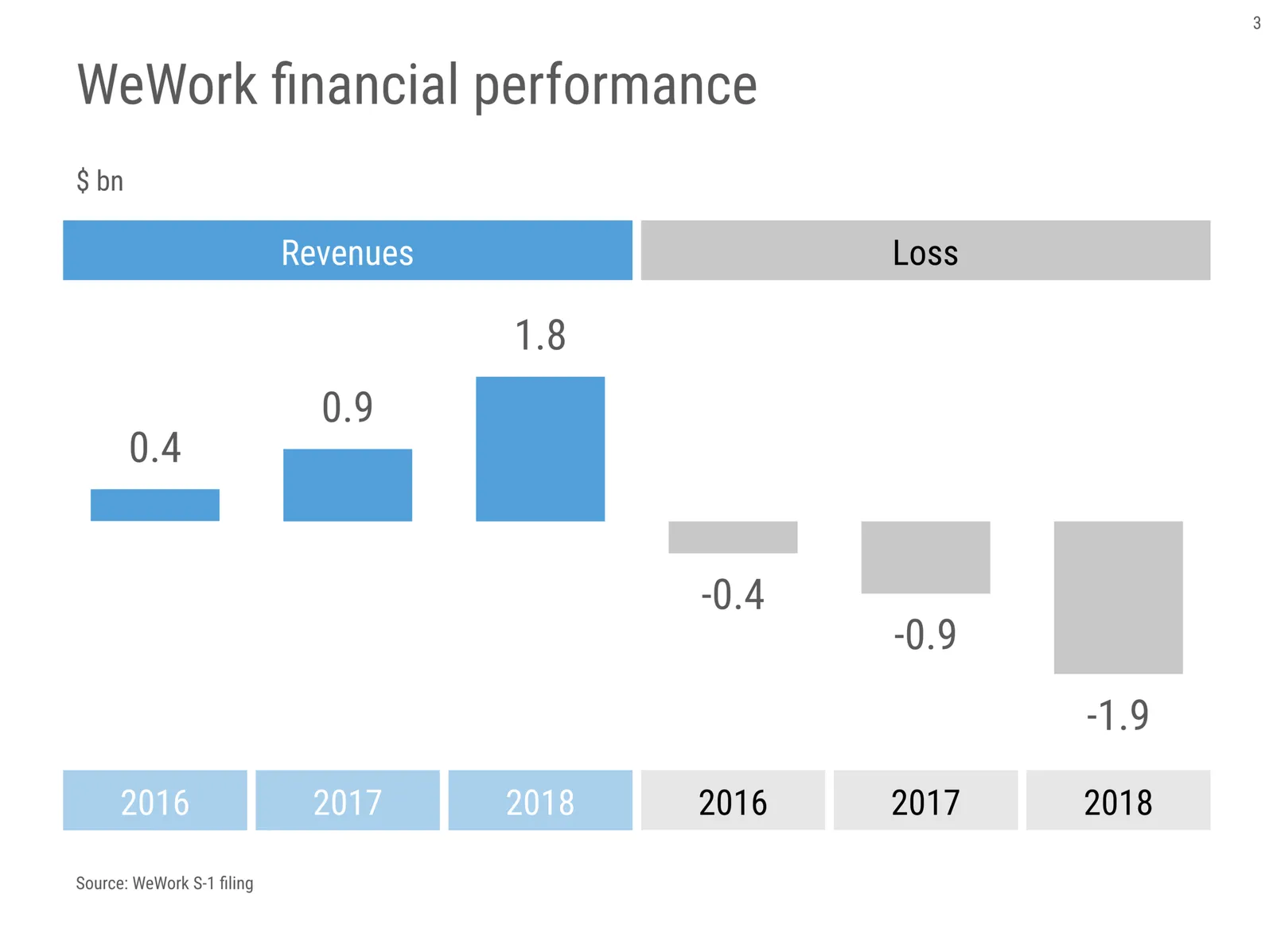
Investment analysts are all over this document: unlike Facebook, or Uber, real estate is a relatively well-understood business, so people can apply traditional valuation methods to try to make sense of a valuation. Is this a gigantic money burning operation, or the start of one of the world’s most profitable tech giants that will change how people work together?

I think WeWork needs an investor presentation that takes the questions head on.

  1. What are the economics of a single location (finding. refurbishing, filling, etc.) per square meter, and back it up with data of actual locations. The S-1 contains a graph explaining the concept, but it lacks a y-axis.
  2. Show a scenario of the current real estate business, how many locations/members would you need to get to a stable, profitable operation
  3. Then, what other options are out there to start building other businesses on top of this.

I have not run the numbers, but I suspect that stage 1. and 2. will not be enough to justify the share price, and your decision to buy into the IPO will depend on what you believe the potential of 3. is.

Photo by Eloise Ambursley on Unsplash

WeCrashed

I have been watching a few episodes of “WeCrashed”, the Apple TV+ series based on what happened to WeWork. Lots of investor pitching here, as Adam is raising money to keep his business going.

People often use this high profile entrepreneur case studies as inspiration for writing investor decks. But these were very specific types of deals. A specific entrepreneur, a specific funding and expansion strategy, a specific stage the company was in, and and very specific type of investor bet: putting in huge sums of money and hope to get your return out before the bubble pops.

Your might be a different type of entrepreneur, with a different growth strategy, in a different phase, and pitching to a different profile of investor

P.S. I wrote a few posts about WeWork on this blog before.

"Sloppy" IPO documents

A piece in the WSJ states that WeWork investors were turned off by ‘sloppy’ IPO filings.

Consistency and accuracy are the #1 requirement for any investment document. As soon as a potential investor needs to stop looking at the content of the business and start worrying about whether the numbers are correct and add up, you probably lost the deal. Trust is paramount. Investment is a leap of faith, and it is impossible to check 100% of all the data before writing the check. If you find some things that look incorrect, there might be more.

The WSJ article does not mention that there were actual errors in the report, just things missing. Details of private jets are not the most important I think, it is the data that allows you to construct how the business actually works: new location, mature location, and that multiplied by the roll out. Every investor presentation boils down to a story that ultimately gets translated into a spreadsheet by someone. You need to spoon feed the right information, without explicitly providing a finished financial model. The latter would enable investors to start “salami slicing”, turning all assumptions down and explaining you why the valuation of your business is too high using your own Excel model.

In the case of WeWork, there was clearly an “elephant in the room” question, and investors needed an answer to it, which they did not get.

·Investor presentation

Pitch one liners

TechCrunch posted a list of contestants at the latest  Y Combinator demo day, and you can learn from the one-liners that describe the company. A few words capture the essence of a pitch and instantly makes it clear what the company does, and even more importantly, teases you to find out more about a potentially interesting idea.

No buzzwords, filler words, no hype. See how the headlines use concepts that we already know, often brands of established companies. This is a quick memory short cut for a story that would have taken 30 minutes to explain to someone in 1995 who never heard of Palantir.

Voodoo Manufacturing – A robotic 3D printing factory Volt Health – An electrical stimulation medical device Terark – Making databases faster Wright Electric – Boeing for electric airplanes Speak – AI english tutor NanoNets – A machine learning API Scribe – Automating sales development representatives Breaker – Making podcasts a real business Bitrise – Automated build/test/deploy for mobile apps Fibo – Mobile work tracking for construction teams Paragon One – Career coaching from real professionals Tress – A social community for black women’s hairstyles Bicycle AI – Automated AI customer support Vize Software – Self-Serve Palantir Simple Habit – Netflix for meditation Snappr – On-demand pro photographers IQBoxy – Software that replaces human bookkeepers Beek – Book review site for Latin America Bulk MRO – Industrial supplies for India Soomgo – Thumbtack for South Korea Cartcam – Shopping app for the Snapchat generation Peer5 – P2P Serverless CDN Pit.ai – Automatically mining trading strategies SmartAlto – Software suite for commercial real estate XIX.ai – Predictive assistant that anticipates your needs Zestful – Employee activities as a subscription service Arthena – Art investing for everyone Mednet – Stack Overflow for oncologists Penny – A mobile personal finance coach Moneytis – The cheapest way to send money abroad Hogaru – Cleaning for SMBs in Latin America Bulletin – WeWork for retail space Sycamore – Onboarding drivers for on-demand jobs Aella Credit – Consumer and low-income lending platform Tolemi – Software to help cities find distressed properties Niles – Conversational wiki for business Upcall – Outbound calls as a service KidPass – One pass for “amazing activities for kids” Lively – Modern healthcare savings account (HSA) Indigo Fair – Amazon for local retailers Collectly – Stripe for medical debt collection Tetra – Automatic notes for business meetings FloydHub – Heroku for deep learning ACLU – A non-profit you might know

Continue reading →