
SlideMagic Blog

Frequent updates about all things presentations since 2008. Subscribe to never miss a post.

RSS
all posts

Category Investor presentation

·Investor presentation

Join me for a G+ Hang Out

I am glad to speak live about startup investor pitches in a Google Hangout organised by the Google Developer community in Israel. The event is this Wednesday 14:00-14:30 Israel time. I think up to 9 people can join the interactive conversation, but Google will live stream the event so other people can follow it “on mute”

Details of the event can be found here.
·Investor presentation

We are robust!

Sometimes, putting up a slide that says explicitly “We are a robust company!” might make the audience actually think the exact opposite. “Hey, so far this was a fantastic and professional presentation, I did not realize these guys are a tiny startup, that is until now…”

·Investor presentation

"Hot"

Some sectors of the technology market are “hot”, everyone wants to buy the products, all investors want to get in.

But writing that sentence explicitly in your presentation might just give the impression that you are in a bubble that is about to pop. Get the sizzling temperature of your market across without saying it directly.

·Investor presentation

VCs can also improve their pitch!

As a startup you are used to sitting in the hot seat while the VC (venture capitalist) is grilling you on your business idea, and in the process gives you some advice on how to pitch it better. True, VCs probably know best how it is to pitch to them.

But VCs themselves can improve their pitches as well. I have designed many fund raising presentations for VCs and later-stage private equity (PE) funds pitching their next fund to institutional investors and high net worth individuals. Here are some of the common mistakes in version 1.0 that comes across my desk:

  • A lot of attention to the mechanics of the fund; how the due investment process works, and how the fund is organised.
  • Very generic descriptions of what sort of companies the fund will be looking for: great product, great management, no competition, sound business model
  • (Every fund does this) a chart emphasising that the fund (unlike all other funds) will actually be really hands-on with their portfolio companies
  • A dry summary of the investments made and financial returns, forced in the same generic framework that is applied to all the portfolio companies (with completely different stories) often lacking the real story behind the investment decisions and the portfolio’s company progress over time
  • Investment banker-style, dense, bullet point slides that are meant for printing and reading, not for presenting.

Investors in VC funds have heard the exact same story from all the other funds that are pitching for their money. VC/PE funds need to really think hard and articulate their story, and how it stands out from other funds.

Continue reading →
·Investor presentation

Slides from Barcelona

Following requests, I uploaded the slides I used for my talk in Barcelona about investor presentations. They are pretty minimal, so it will be hard for those who did not attend to grasp the full meaning, sorry. (I am working on documenting its content though, watch this space) Thank you Barcelona entrepreneurs for a great event!

·Investor presentation

Too generic to sink in

Opening slide bullets:

  • Industry #1
  • 15 consecutive quarters with growth
  • 40% EBIT margin
  • Offices in 35 countries

Pretty impressive, but when you put on a slide like this the audience is unlikely to digest the numbers fully. Almost every opening slide of almost every corporate presentation has numbers that look like this (something about growth, something about margin, something about locations, we do not pay that much attention to the actual numbers).

Instead, break up the slide, show that you are bigger than IBM, show a column chart with growth in the past 15 quarters, show that competitors are struggling to achieve 5% EBIT margin, show a map with 35 dots. It takes the same time to present, but your audience will remember.

·Data visualization

Making up some numbers

In many cases it is hard to give a real example of the cost savings someone can achieve with your product or service. Data is not public, or in case of a startup, you might not have that many customers yet. “Making up some numbers” does not sound like an ethical alternative, but it is a good strategy if you stick to some simple guidelines.

  • Explicitly say that it is a hypothetical example
  • Create a highly realistic artificial customer (1 owner, 3 trucks, 1 warehouse, $x million in annual revenues, etc.)
  • And most importantly: explain how you get to your cost savings. If possible break them down into a few simple categories, and use a highly simple and transparent way to quantify them (10 instead of 35 phone calls of 30 minutes each per week equals $x)
  • Make the spreadsheet as complicated as you want, but start with a blank PowerPoint/Keynote page to explain your calculation.
  • Add everything up and see whether the cost reductions make sense as a % of the total

The main purpose of the case example is to explain how you got to the savings, not the absolute point estimate.

·Investor presentation

Over-complicating a framework

Yesterday I posted about a way to visualize a complex comparison (a hedge fund). Sometimes thought, the best things is just to simplify. “Here is a competitive landscape. These guys are bigger. These guys use a wholesale model (we are retail). These focus mainly on Asia. These market to younger consumers.” Interesting for PhD students that study your market, too much information for a first pitch to a potential investor. Aggregate things up to a simple grouping of competitors and complicate things in later discussions.

·Investor presentation

From screenshots to use case

How do you showcase your application in a 20 minute pitch? Doing a full, live demo is hardly ever an option:

  • Murphy’s Law will strike, and your Internet connection will break down, and if not, another technical issue will hit you
  • Some aspects of your app are interesting to show, others are boring and time consuming (loggin in, entering some data, etc.)
  • It is hard to stay focussed and on script in a live application, before you know you have lost yourself in an interesting feature and spent far too much time on your demo.

In a short VC pitch, doing a live demo is likely to take the energy and momentum out of our talk. The other solution is showing a bunch of screen shots. But how can we transform a series of uninspiring screen shots into an exciting use case of your product? Some steps to consider:

  • Base the whole section on a story. The best stories are real: find an actual customer, disguise everything so it is impossible to expose private information and build the entire screen shot demo on her case.
  • Alternate between regular visuals and screen shots. Use a map to show locations, use images taken in the street to give things a sense of place.
  • When using screen shots, crop out all the clutter that is irrelevant: operating system window bars, icons, browser navigations and put huge arrows or circles to focus the viewer attention to what you want to see them. Use big text to emphasise what you are doing and why it is so great (“We open an account in just one click”).
  • Throughout your story, stay consistent: the same user, the same location, the same issue she is trying to solve.
Continue reading →
·Investor presentation

Speaking in Barcelona

I will be crossing the Mediterranean Sea and talking about designing a good VC/investor pitch presentation in Barcelona. It would be great to shake hands with readers in Spain.

The event is scheduled for October 3, at 19:00. The location still has to be finalised, maybe the campus of the IESE business school, or another central Barcelona location. The presentation will be in English, and is free of charge. You can sign up for the event here.

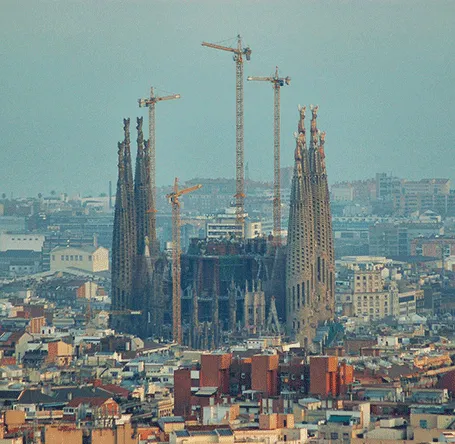
Thank you Conor Neill for connecting me to the Barcelona startup community. Thank you John  and Mel Kots for this nice and hazy picture of Gaudi’s master piece that is still under construction.