

SlideMagic Blog

Frequent updates about all things presentations since 2008. Subscribe to never miss a post.

RSS
all posts

Category Investor presentation

·Investor presentation

PR people and journalists

WebSummit was full of them. Apparently, there are 5 PR people for every journalist on earth. Each journalists in the tech world receives about 200 emails, pitches, stories per day. I listened to a panel with PR people and journalists discussing thing with each other. Here are my impressions partly driven by what they said, partly what I read between the lines.

Your product is actually not that interesting to them. Two hundred products per day, lots of copy cats (“Uber for X”). I actually think journalists don’t have time, take the time to understand a technology, and hence don’t find it interesting and/or write about it. It takes me a good 45 minutes to understand a company well, a journalist does not have that time, the reader does not have that time, and most journalists don’t have an engineering background.

Big milestones are actually not that interesting anymore. Everyone raises $100m at a $1b valuation.

Other aspects of “your story” (becomes a buzzword) are more interesting. Did you come from an unusual background, does your company have some sort of social, environmental purpose (primary, or a side effect).

Do you actually need to be in a major Silicon Valley tech publication? If your target customers are in those circles, then yes. Maybe if you need to those “featured in” logos on your web page to strengthen your pitch to SV investors, yes. But otherwise, maybe spend your time and effort somewhere else.

“Social media” is becoming crowded and busy as well. With so many people creating noise, it actually boils down to a product that people want to use and talk about to their friends. Not so much social media, more building a great product.

Continue reading →
·Investor presentation

Y Combinator on "good advice"

I set through a panel with partners from incubator/investor Y Combinator today here at WebSummit in Lisbon. The topic was about which advice is useful, which not, partly in the context of fund raising. Startup CEOs get bombarded with advice, while almost all advice sounds credible, not all the people who are given you advice (prompted, or unprompted) know what they are talking about.

As panels go, there was a lot of “noise” but these guys had a few pretty good points. Advice from these type of people might help you:

  • People that have just done something that you are about to do, try to lift yourself up to the next level. They raised series A, you are getting ready for that round as your Seed funding dries up.
  • People who have done that very recently and have “fresh” knowledge. The shelf life of advice is pretty short: technology moves on, the fund raising market develops, etc. etc.

Keep it in mind when someone critiques or praises your slides.

·Investor presentation

"They are just interested in the numbers"

One client told me the other day that a later-stage investor was interested in investing in his company, and the main interaction was with a relatively junior analyst who kept on asking questions about the numbers in the business plan, rather than probing the quality of the technology.

This can mean 2 things:

  • The best way to present to late-stage investment fund focus most of the time on presenting growth assumptions to the junior analyst
  • The company went more or less through the full due diligence of the company, they (think they) understand the main strengths and weaknesses of the technology, what is left to be done is stabilize the numbers in the valuation model.

Option 2 is probably more likely. Although they keep on asking for numbers, does not mean that the overall story and context is not important.

·Investor presentation

Triangulating market sizes

It is hard to forecast the size of a market that exists today in a few years. It is impossible to predict the size of a market for a product that does not even exist. Startups working on new products deal with this issue in every investor presentation.

My suggested solution: come at it from different directions to give a potential investor confidence that there is something there.

  • Big billion dollar point estimates from Gartner or IDC research reports, and pointing out that in the future part of that spend might be cannibalized.
  • Looking at comparable markets. For example IT security spend is roughly 10% of every IT budget. If you are working on a new product category that you think will be as indispensable as IT security, you can provide a market size range by applying a % to a future IT spend forecast.
  • Going down to company level, and point out that of the few pilot customers you have, they were willing to pay x$ per seat, x% of their IT budget, and then scale that up to the total market.
  • Bottom up: customers x product per customer x price per product
  • Etc.

In most cases your “made up” numbers which are backed up by a transparent and logical analysis will be more useful than point estimates lifted from out-of-date, out-of-context research reports.

Image from WikiPedia

·Investor presentation

Investor versus client positioning

In most big B2B enterprise sales dialogues the client understands the market, knows the key players out there, knows the issues she is trying to solve. They don’t care about margins, market sizes.

In most investor pitches, the potential investor knows the broad market segments that sound similar to the one you are operating in, knows how big they are roughly, knows major competitors. They are less interested in specific feature comparisons.

Presenting your differentiation, what makes you special, is different to each of these audiences.

Image from WikiPedia

·Investor presentation

Which clients raise money?

I see dozens and dozens of technology startups and yesterday I sat back and jotted down the similarities between my clients that manage to raise money. Disclaimer: it is not scientific, it is not conclusive, and in many cases I actually do not get updated on whether the fund raising round was successful or not.

Here are some similarities:

  • More than one exceptional team member, the company is not just carried by one strong CEO
  • Straight to the point discussions during the briefing meeting, no buzz words, no vague marketing frameworks, no empty discussions about flow in the absense of substance
  • A positive and happy working environment. Supportive feedback, respecting people’s time instead of negative comments all the time, insisting on unreasonable deadlines, making people wait a long time, calling in person meetings to communicate something that could have been done in a phone call. These are places you want to do your best
  • People are open to reposition, change things that are pretty fundamental to the company.
  • Taking advice and input form people the right way. Some people get listened to, others ignored.
  • A realistic awareness of strengths and weaknesses

OK, you need to have a good business concept. But looking back at the above points, these are companies that designers like to work with (and presumably investors want to work with them as well). There is a contagious, positive energy among them.

·Investor presentation

Where to put the team slide in the pitch deck?

Venture capitalist Mark Suster posted a quick video about this issue.

His advice:

  1. What you do (he is right, some pitches are vague about this), if you can, even without slides to make direct eye contact with the audience and establish rapport.
  2. The exec bio, to establish credibility, why you are the right person to pursue this opportunity
  3. The body of the presentation

He has a point. BUT, I would keep that bio slide super short, maybe limit it to the CEO and/or people who are presenting in the room and put the dense, detailed CV information in a slide later in the back. Grinding through lots of CVs of everyone on the team can break the momentum of the presentation (unless everyone on your team is a unique rockstar). Also not every startup has that rock star team (which probably gets you a minus from Mark anyway).

A final note, if you are presenting to Mark, there is no question, put that full bio slide on page 2. You should research every person you pitch to, and this is how he likes to see things, so that’s what you do.

·Story

Problems, problems, problems, solutions, solutions, solutions

Most product pitches go something like this:

  • Existing solutions have this problem
  • Existing solutions have this problem
  • Existing solutions have this problem
  • Existing solutions have this problem
  • Existing solutions have this problem
  • Our solution does not have this problem
  • Our solution does not have this problem
  • Our solution does not have this problem
  • Our solution does not have this problem
  • Our solution does not have this problem

The story gets repeated, which makes the whole things boring. A better option is to elaborate on the problems, but then keep the solution section relatively short. You can even show a grid of small screen shots of all your “problem” slides, with tick marks over each one of them.

·Investor presentation

Example startup pitches

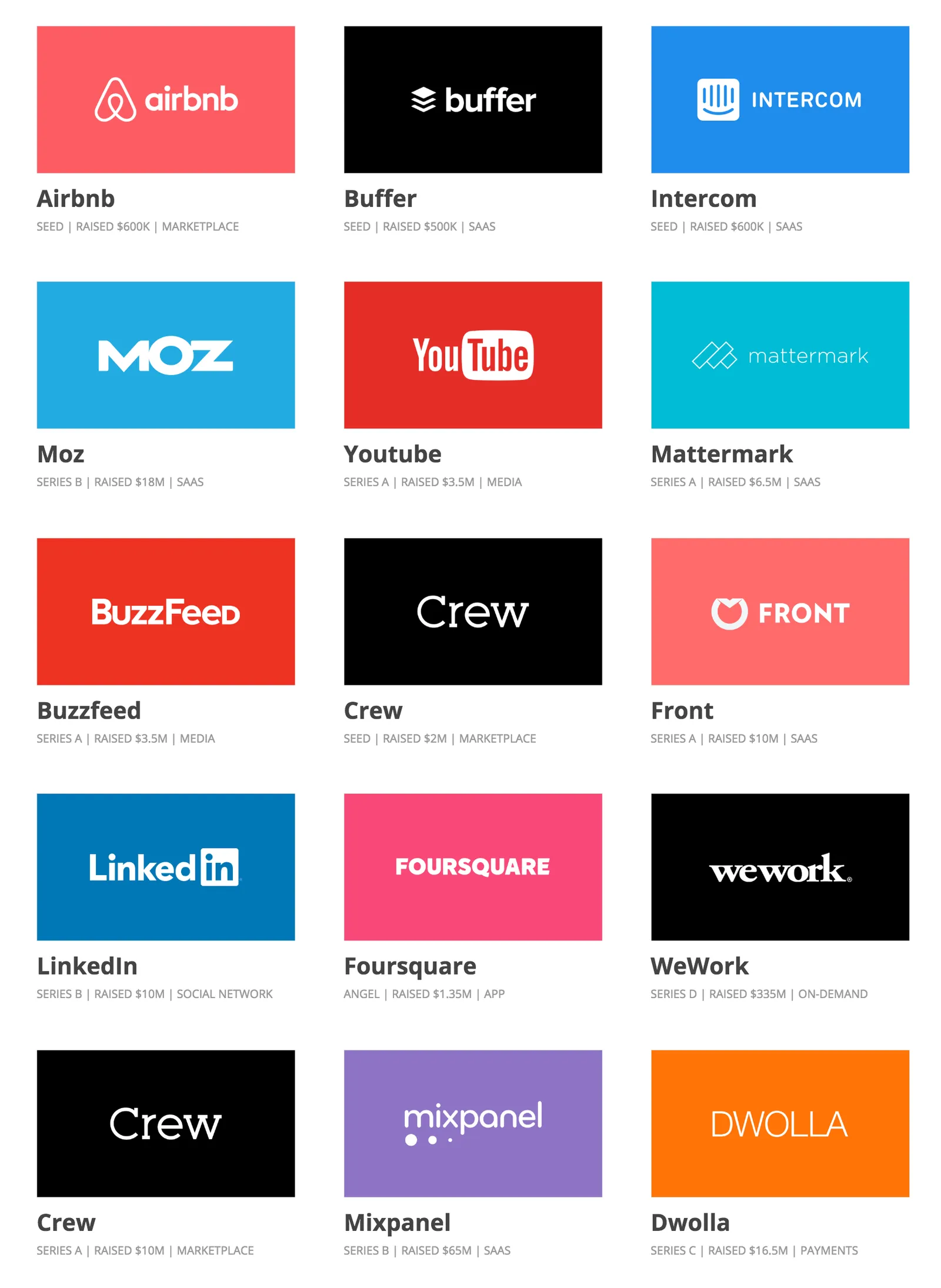
Here is a nice collection of early-stage startup pitch decks that managed to raise money successfully.

There are some common concepts in all of them:

  • Most importantly, they are actually great ideas. LinkedIn, YouTube, AirBNB now look like totally obvious concepts, but back when they started out they were not.
  • They explain clearly what the company/product actually does, often via a demo of screen shots. Many startups omit this important part of your pitch (surprisingly).
  • Often, there is a very powerful traction slide inside. If you have grown your business from nothing to millions of dollars in 6 months, investors will pay attention, and forgive you if the rest of the slides in the pitch deck are not that good.
  • All these decks are email friendly, you get the idea without the need for a presenter to explain it to you. (That is now actually the main type of presentation I design for my clients)
·Investor presentation

Full circle

Every pitch starts with an informal, but often very good, story/conversation. Then we start to complicate things with slides, templates, storylines, structures until we get to some slide deck. Then, it is often useful to step back to the very fundamental investor questions:

  1. What is it they are trying to do? (Often not clear in a presentation)
  2. Will anyone want to use it? (Rational logic, emotional gut feel)
  3. Can you make money from it? (There are many good ideas that do not deliver a profit)
  4. Can this team pull it of? (Probably most important question)
  5. (Can I construct a good deal given valuation, cap tables, Board seats, etc.)