

SlideMagic Blog

Frequent updates about all things presentations since 2008. Subscribe to never miss a post.

RSS
·AI

Codex Computer Use - control any app on your machine

Another day, another presentation AI tool. Codex Computer Use is a plugin for OpenAI’s Codex desktop app. It enables control of any app on your machine using the regular human interface: ‘seeing’ screen and making clicks. (Mac only, and not available in the EU/UK because of regulatory restrictions).

Its powers are phenomenal. SlideMagic is a quirky app with a small user base. In a few minutes I got it to insert a profit and loss table, add a year to it, and then take the last year of the table and turn that into a horizontal waterfall chart.

In PowerPoint for example, this tool will be much more useful than the Claude PowerPoint plugin, which “fights” complex PPTX file formats (a huge amount of nexted XML tags) to make simple edits like moving a box. The Codex Computer Use plugin can simple drag the box.

This feature is extremely token-hungry though, probably because of the screenshot data that gets send back to the server.

Claude Design is here, what does it mean for presentations?

I was waiting for this announcement, and Anthropic did announce a few hours ago: Claude Design. There are many demo and review videos online that show the features, I will focus on a few specific issues.

The big issue for enterprises when it comes to presentations and documents is to keep all employees “on brand”. The designer of the corporate web site gets it right, but what about the new analyst who works late at night to prepare the quarterly revenue update presentation? Claude Design does a great job here to capture fonts, colors, and style guidelines in one place.

For enterprise AI workflows and systems, context is everything. And the Claude set up makes it easy to access files, information, data, anything.

The current Claude Design application is a web app, that has not been integrated in the desktop all yet (it will probably happen soon). For presentations, its a wrapper around Claude’s ability to manipulate and create slides. At the moment, Claude Design treats presentation slides as HTML. (Unlike Claude Code/Cowork that can work directly with PPTX). As you interact with Claude Design your presentation comes out beautifully, but will have a “web site” look and feel. (Maybe that is actually a better feel than corporate PowerPoint?). Your presentation is HTML with a 16:9 aspect ratio without the resizing options.

When you are done, you can export to many formats, of which PPTX is one. Once exported, Claude Design can no longer edit the resulting PPTX file. (Obviously you can ask Claude Code/Cowork to take over from there, but that app will miss the context that you created before).

Continue reading →
·Software

None of the tools were right, so I quickly wrote one...

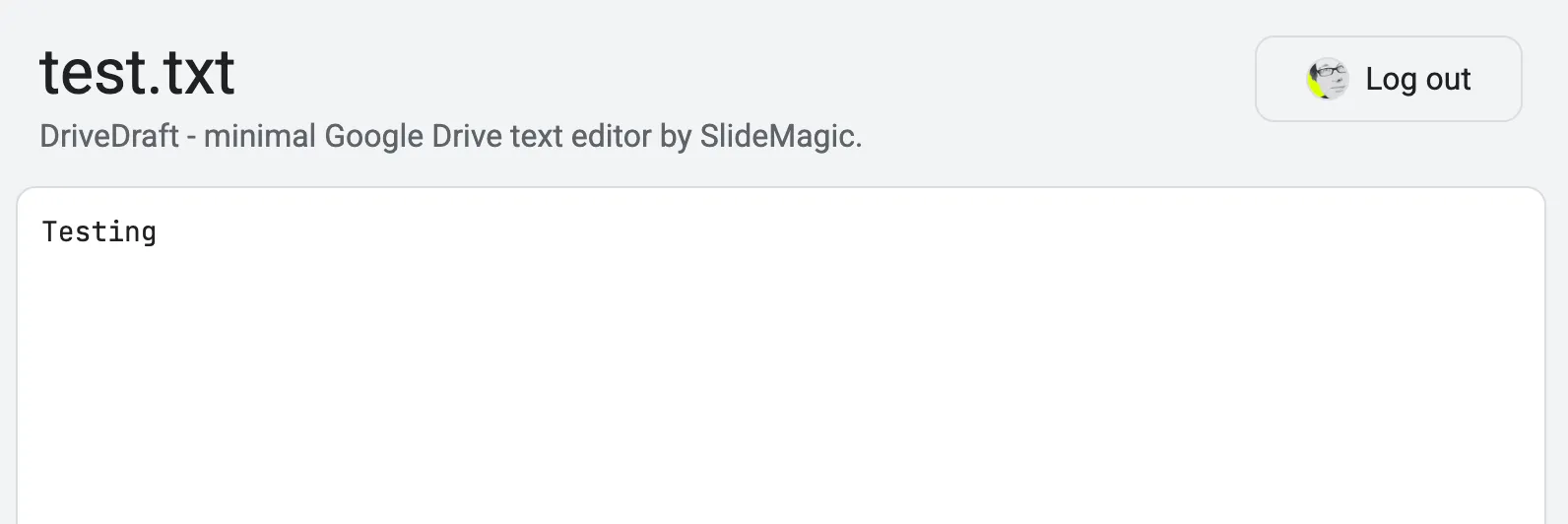
This is 2026… I needed a super basic text editor for Google Drive. If you double click a text file in Google Drive, it will convert it to a bloated Google Doc for you. You can install text editor apps, but they all come with a catch: too many features, 1990s UI design, ads, paid plans. So i used Codex to write me one… Writing the app took 10 minutes, configuring the Google Cloud Console a few hours (but now I know the drill).

I have requested Google to approve it to get rid of warnings when you install it. The primary user is me anyway, so I won’t put it out in the add-on market place.

You can try it: drivedraft.slidemagic.com. Sign in with your Google Account. Now go to Google Drive and right-click a .txt or .md file and choose ‘Open With’ DriveDraft.

·AI

PowerPoint via Whatsapp

I have been experimenting with OpenClaw, a 24/7 personal AI assistant. It is an open source project that was created over the past month, created almost by accident as a hobby project by a developer. Late last year, developers discovered that using an AI coding tool for non-coding applications really works, especially if you can give it access to local files (rather than chatting). Next step: keep the AI agent running 24/7. Next step, find a way to let the AI agent keep some context about you. (Context memory is a big issue in AI, it fills up at some time, so storing bits of context for future reference enables persistent awareness). Next step, implement recurring instructions. Next, make the AI assistant available from any channel, including Whatsapp. This, combined with full system access, creates an incredibly powerful AI assistant (that can also be incredibly destructive). “It’s 2AM, I have a 12 hour to do list and full shell access, lovin’ it”. What can possibly go wrong.

So it requires some technical knowledge to run this thing in a vaguely responsible way. I put it on AWS EC2 in a completely isolated virtual network, with an access tunnel that only I control, plus a number of prompt injection filters running on yet another server. (OpenClaw’s founder has joined OpenAI exactly for that reason, to get the financial resources to fix the complexity and security issues)

Working with it, enables me to get a feel for the future. Direct instructions to applications (code editors, presentation design software, spreadsheets, food takout apps) will become increasingly irrelevant.

Continue reading →
·AI

AI images are the new stock images

People are starting to develop a pretty good sense of whether an image “smells like AI”. The audience will notice when you use them just as visual fillers like you used to use stock images. (“Life-style conscious gen-z person working from the local cafe”).

Completely obvious AI renderings are comparable to clip art of the earlly 2000s. Hyper realistic AI images are similar to stock images, “something is off here”.

Apply the same approach to AI images as you did to stock images.

·AI

"Files are so back"

The past decade with spend a lot of energy moving all our files into the cloud, and accessing them through a browser-based application. That is going to reverse in the era of AI.

A good old desktop folder is the perfect context for an AI agent. All information in one place. Different formats, different applications, all accessible and editable.

I started experimenting with a spreadsheet/presentation workflow that mirrors the way I write code. Pointing Claude Code at a directory with files and let it orchestrate analysis and design under my supervision.

PowerPoint -> rendering engine

Programming languages have always been a necessary evil. A way to translate human intent into something a machine can execute. Strict syntax, rigid rules, brackets in the right place.

Presentation software has had the same problem. You want to communicate an idea, but first you need to learn how to manipulate shapes, align text boxes, format charts, pick colors, fiddle with layouts. The tool sits between you and your intent.

AI is changing this. You can now describe what you want in plain language, the way you would have briefed a graphic designer ten years ago. “Put the revenue chart on the left, key takeaway on the right, keep it clean.” The difference is that the result comes back in seconds, not days.

And here is the interesting bit: it does not really matter which application your AI assistant uses under the hood to build the slides. The end product is a flattened file, a PDF, an image. The mechanical production of the slides is becoming invisible.

PowerPoint is not going away, but its role is shifting. It is moving from being a user interface for a human designer to being a rendering engine for an AI. The way a browser renders HTML that no one writes by hand anymore.

We are going back to a more natural way of working. Talking to a person (or an AI) about what you want to say, and getting a visual result. The detour through complex software UI was a historical accident, not the destination

·Creativity

The "wait for AI" workflow

As AI gets more and more capable and I use it for more and more things in my daily workflow, it creates a new problem: waiting for AI. Most tasks now take 1-3 minutes for which you have to wait for the result. Most takes would have taken you much much more than that if you were to do them yourself, so a big productivity gain, but, 1-3 minutes is too short to go and do something else, so you wait, get distracted, break your flow, and find yourself getting back to what you were working on 30 minutes later. “Ah small mistake, let’s do fix that. Click. 1-3 minutes wait.

I have not found a solution yet, and am experimenting:

  • Running lots of agents in parallel, so it is like a plate-on-stick catching game
  • Running the tasks in parallel of an activity that is easy to interrupt (watching a tutorial video)
  • Writing a quick blog post…
  • Etc.

A new world

·AI

Claude plug-in for PowerPoint

This has gone under the radar screen for me. The Claude plugin for PowerPoint is available for Claude Max, Team, and Enterprise users. It links to your existing Claude account (to burn tokens) and does exactly what you expect it to do. More information here.

·AI

On the "danger" of AI

Recently, people start getting really concerned about autonomous AI doing its thing with your passwords and credit cards. But I think that not that much has changed since the first emergence of computers. Computers trade billions in stocks and currencies, run nuclear powerpoint plants.

The difference, these systems are carefully monitored and are predictable and well-understood. It is not about the intelligence of the software, it is about the level of control you give it. People wanting “to push the boundaries” and see how far AI can go seem to be putting a 10 year with Microsoft Flight Simulator experience at the controls of a real 747.

I have started to use AI tools heavily in my day-to-day work. Not for email and calendar management, but for coding and document production. All seems reasonably under control, things being sandboxed on my own machine. “Reasonably” What is not, is the chaotic user interface when it comes to giving permissions to things on your file system. Many of these questions will not be understood by the IT layman.

Everyone is raving about Anthropic’s Cowork tool to automate knowledge work. Many incumbent database/information providers and consultancy firm’s stock prices get hammered. The real revolution for Anthropic might be an acquisition that did not get a lot of press. In December, they acquired Bun, a software development platform. My sense is that Anthropic is developing a trusted platform that can build and run code safely on your computer without the constant flow of questions whether it is OK to install package x, y, and z. I think AI models will become a commodity, the real winner in the next generation of computing will be the player that offers this trusted platform that can keep AI in check.

Continue reading →