

SlideMagic Blog

Frequent updates about all things presentations since 2008. Subscribe to never miss a post.

RSS
all posts

Category Investor presentation

·Investor presentation

Read human signals

The investor asks you a question, and the instinctive reaction of an entrepreneur is to fire back with data, slides, and arguments to prove that the investor is wrong. “No, that concern does not apply to me because, because. because”. Part of the rhetoric includes a repeat of what just has been presented, to eliminate the possibility that the investor did not understand it the first time around. Boom, boom boom.

Pick your battles. Especially if the investor bases the question on 5 other startups she has seen in the same field, it is 5 people she knows and trusts against you she just met 20 minutes ago. Maybe she has a point, maybe you need to find out a bit more about the background of her concern, after which you can give a more balanced answer, which could well be, let me check and I will get back to you.

Read the human signals, if the investor does not engage anymore and says “OK, I understand”, but her eyes say something different, it might well be that she simply does not want to hear a repetition of your arguments she does not believe.
·Investor presentation

Pitching to investors

I have written a guest post on Presentation Guru, the digital magazine for presentation professionals. Here you can find my post about designing presentations that will convince investors.

·Investor presentation

"Why should people invest in my company?"

Google is full of free investor presentation advice and presentation layouts. The problem with all of these is that they are generic and not specific to your situation. So blindly filling out a presentation template is unlikely going to give you the best pitch.

Here is another way to craft your pitch. Think of an investor you respect, and even better, an investor whose reasoning you sort of understand resulting from conversations and or blog posts. Now, jot down an imaginary conversation that could have taken place if you find yourself next to her in the check in line for a flight. The most important part of the exercise is to anticipate the likely questions are face expressions you are going to encounter: “Really, what is it about?” “Hmm, that is a sort of [x] for [y] right?” “But are any of your users actually sticking around?” “What do people pay today for this?” “But you have no machine learning expert on your team” “Yes, I know that online video consumes a lot of bandwidth, but what does it have to do with you”

 Now take you notes from this conversation and use it to craft the flow of your investor pitch. Then, go back to the standard investor presentation templates and use them as a check list to see whether you haven’t forgotten anything important.

Why is the business school, standard, investor presentation structure not always the right one?

  • Investors might already know a lot about a market, a technical vertical segment, so there is no need to do the 101
  • Investors might actually know nothing about a particular market, and you will have educate them before getting to the actual pitch
  • There are “elephant in the room” questions screaming to be answered first, even if they allow show up on page 25 of your template
  • Visual or verbal analogies might require a story sequencing that clashes completely with a standard investor pitch template
  • If you have 500 pages and/or 3 hours of material there is no alternative but to structure things orderly. (“Hey, where were we again?”)  In 10 to 20 minutes, you have a bit more creative freedom to shuffle things around
  • Standard presentation structures might not work in a conversational pitch style, if you start rattling down your Harvard-approved pitch the investor already gets worried: “Huh oh, we are going to get this one for the next 10 minutes” and you are likely to be interrupted with a question that invites a dialogue.
Continue reading →
·Investor presentation

"Do you do web sites as well"?

New startups are in need of all kinds of marketing collateral: pitch decks for investors and/or potential customers, product brochures, and a web site. I think that in the beginning, people are aiming too high with the web site: super effects, video backgrounds, sparkle, and glitter.

But the experienced investor or corporate purchaser sees through the facade immediately, this is a brand new startup with hardly any customers and 6 months of VC funding left. Instead, you can build a web presence that show yes, that you are young, but that you are serious and know what you are doing.

  • There is actually some sort of web page on your URL, not an “under construction”
  • Use squarespace, Wix, or another template engine for a modern look and feel, with at least a premium enough version that it does not say “proudly built with Wix” at the bottom.
  • Make sure your branding is consistent: accent color (you don’t need a lot of it), and a simple logo (does not have to be a master piece)
  • No gmail or hotmail email addresses
  • Your LinkedIn profile actually says that you are the CEO of this company, and not a marketing consultant from 2004 to present
  • The company has an address that when entered in Google street view does not point to a residential street
  • When the site has a “news” section, or a blog, it should contain fresh articles, if not, just don’t put it on.
  • The web site should actually describe what the company is doing, without buzzword overload
Continue reading →
·Investor presentation

Pitch one liners

TechCrunch posted a list of contestants at the latest  Y Combinator demo day, and you can learn from the one-liners that describe the company. A few words capture the essence of a pitch and instantly makes it clear what the company does, and even more importantly, teases you to find out more about a potentially interesting idea.

No buzzwords, filler words, no hype. See how the headlines use concepts that we already know, often brands of established companies. This is a quick memory short cut for a story that would have taken 30 minutes to explain to someone in 1995 who never heard of Palantir.

Voodoo Manufacturing – A robotic 3D printing factory Volt Health – An electrical stimulation medical device Terark – Making databases faster Wright Electric – Boeing for electric airplanes Speak – AI english tutor NanoNets – A machine learning API Scribe – Automating sales development representatives Breaker – Making podcasts a real business Bitrise – Automated build/test/deploy for mobile apps Fibo – Mobile work tracking for construction teams Paragon One – Career coaching from real professionals Tress – A social community for black women’s hairstyles Bicycle AI – Automated AI customer support Vize Software – Self-Serve Palantir Simple Habit – Netflix for meditation Snappr – On-demand pro photographers IQBoxy – Software that replaces human bookkeepers Beek – Book review site for Latin America Bulk MRO – Industrial supplies for India Soomgo – Thumbtack for South Korea Cartcam – Shopping app for the Snapchat generation Peer5 – P2P Serverless CDN Pit.ai – Automatically mining trading strategies SmartAlto – Software suite for commercial real estate XIX.ai – Predictive assistant that anticipates your needs Zestful – Employee activities as a subscription service Arthena – Art investing for everyone Mednet – Stack Overflow for oncologists Penny – A mobile personal finance coach Moneytis – The cheapest way to send money abroad Hogaru – Cleaning for SMBs in Latin America Bulletin – WeWork for retail space Sycamore – Onboarding drivers for on-demand jobs Aella Credit – Consumer and low-income lending platform Tolemi – Software to help cities find distressed properties Niles – Conversational wiki for business Upcall – Outbound calls as a service KidPass – One pass for “amazing activities for kids” Lively – Modern healthcare savings account (HSA) Indigo Fair – Amazon for local retailers Collectly – Stripe for medical debt collection Tetra – Automatic notes for business meetings FloydHub – Heroku for deep learning ACLU – A non-profit you might know

Continue reading →
·Investor presentation

Presentation half life

Presentations go stale over time. Watch your slides. You might not see it, the audience will.

  • PowerPoint 2010 fonts, colors
  • Out of date logos (of your company, but also customers, competitors, partners)
  • Inconsistent formatting between pages
  • Analogies to over-used, old, example companies ($1 dollar shave club, MySpace, etc. etc.)
  • Growing slides: company history, company events, customer logo overviews, every year another column gets added and the others get squeezed

But what I most often see is that the founder still pitches her deck the same way she got her seed funding (with success). A few years on, the company has moved on, and the investor concerns have moved on. Yes, the technology is still great, but you don’t need to convince anyone that that is the case. But what about that traction with customers?

·Investor presentation

Too informal

From multiple VCs I have heard this scenario:

Highly confident entrepreneur walks in the conference room, sits casually next to the VC rather opposite the table, leans back relaxed in the chair, rocking back and forth, savoring his coffee, suggests to do a different style of pitch, life is too short for boring pitch decks, let’s just have a more intimate and informal chat about the tech world at large and the entrepreneur’s specific venture in particular, the entrepreneur-investor relationship is all about dialogue, conversation, and exchange of ideas…

“Multiple VCs”, means 2 VCs, and both of them were women. (No, it was not the same entrepreneur).

This approach might be a bit too informal to work. Have your traditional pitch deck ready, and make things less formal if you sense the right dynamic in the meeting.

·Investor presentation

Refreshing language?

It is tempting to describe your product in a completely new vocabulary to illustrate that you do things differently.

Still, the first thing that a potential customer or investor will do, is to translate that back to the old vocabulary in order to figure out what is different, and what is not.

Often it is better to do part of the work for them. This is especially true for impatient investors who are not always convinced that something that sounds completely different, is in fact, completely different.

Image: The Treachery of Images

·Investor presentation

That annoying junior analyst

Overheard in a meeting. “Don’t put in too much detail in the 5 year financial forecast. It can never be accurate anyway, and you run the risk to wake up that annoying junior analyst who has not said anything the entire meeting, and let her zap the entire momentum of the pitch”

Agree, super precise forecasts 5 years out can never be correct. But:

  • A consistent 5 year P&L with realistic margins and marketing spend is a sign that the company knows what it is getting itself into. It is not a test of accuracy, it is a test of management competence.
  • Analysts can look junior, but could actually be reasonably senior in an investment organization. Or, even if the analyst is junior, convincing rather than bypassing them is a required hurdle in the investment process. “Hey Sally, did their financial planning make sense? You looked at it right”
  • Maybe it is actually good news that the analyst did not ask a lot of questions about the other content in the presentation.

Image: Promotional photo of the cast of the CBS television series Whiz Kids

·Investor presentation

Pitchbot - chat bot to practice investor pitches

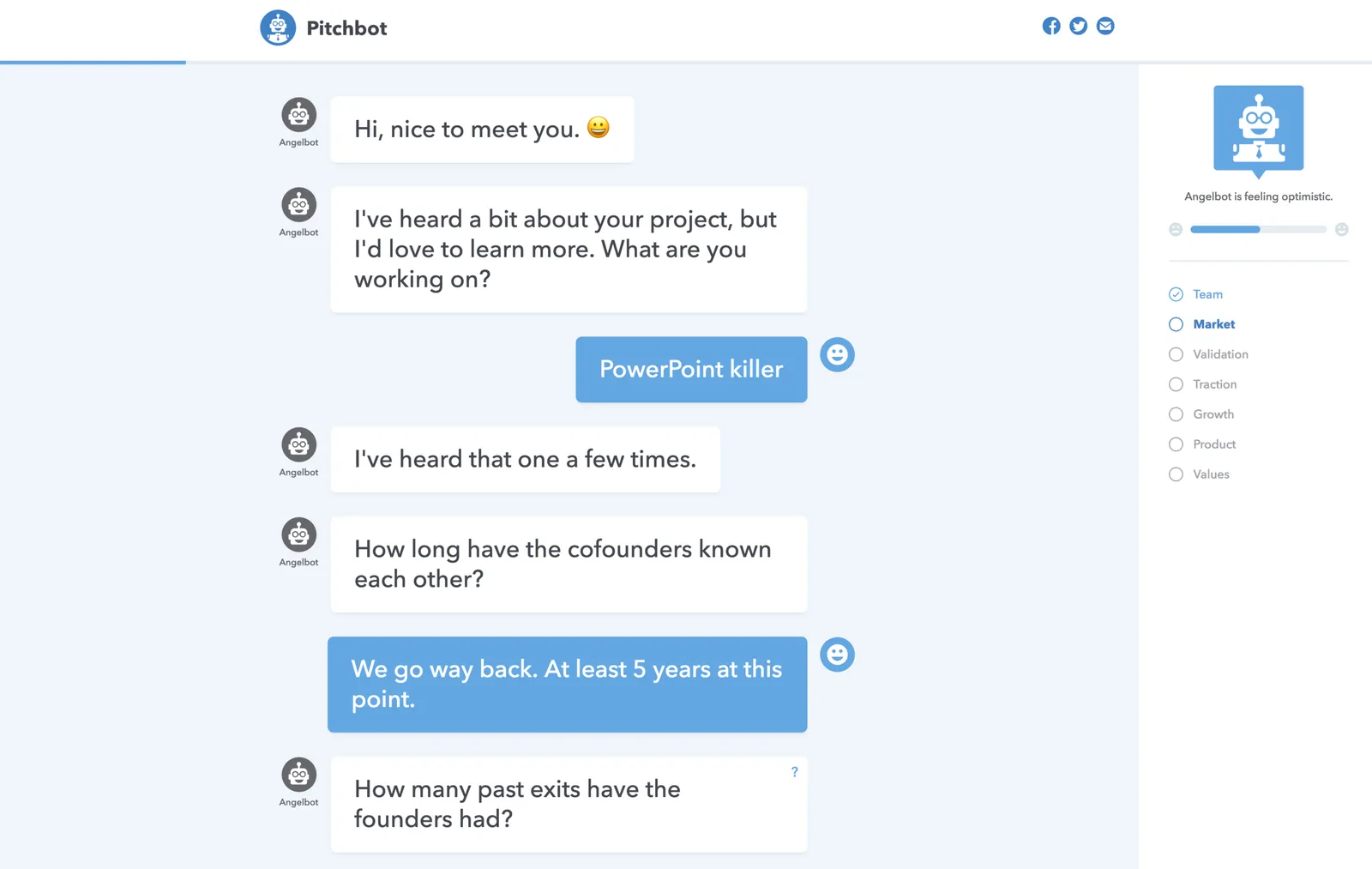
This is nicely done: pitchbot. It gives you a nice feel about what a discussion with different types of investors might look like.