SlideMagic Blog

Frequent updates about all things presentations since 2008. Subscribe to never miss a post.

RSS
all posts

Category Delivery

·Delivery

Khan Academy: Prezi in action at TED?

You should watch this TED talk by Salman Khan, a former hedge fund analyst who is now fully devoted to turning the education system upside down (see his Khan Academy). His key concept is to humanize the class room using technology: have kids watch videos at home at their own pace and use the time of the teacher in the class room to provide individual support instead of one-size-fits-all lectures.

Now to Prezi. I think Salman is using it as his presentation engine. I am still not convinced that it is a good large audience presentation tool (see an earlier discussion on whether Prezi is a PowerPoint killer). However, the tool does a good job in visualizing the enormous video library Salman has constructed, and the carefully thought-through construction of the curriculum he is proposing. What do you think?

·Delivery

The Q&A visual

Many presentations end in some sort of Q&A session. During this discussion, the slide show usually comes to a standstill, and the last visual used stays on the projector for a long time. Make sure it is a useful one, since it might be the image that the audience will remember best. To be avoided:

  • A completely random slide from the deck (the one that sparked the discussion for example)
  • A “thank you” or “Q&A” slide
  • A slide that addresses one of your weaker points (i.e., you got a touch question about the competition and did the best you could using the competitor comparison slide), move it after you used it.
  • A dry list of bullet points recapping the content of your presentation using language full of abstract concepts (“ROI”) and buzz words (“key competencies”)

What could work: a visual that links back to a key point in your presentation. For example, if you spend 5 slides on describing how a teenager will use your mobile social network, just putting a picture of her back up will remind the audience of the story. (This time you can leave out the bullets arrows, boxes, just an image to refresh the memory).

·Delivery

Skip to 4:03

Videos that are posted online often come with an explanation: “skip to 4:03”. Think about that when designing your presentation: the audience is watching a video without a remote control or Tivo. It should be interesting from 0:00 to 15:00.

·Delivery

Notice how you skip the introduction?

Have you noticed how, whenever you start reading an article with a promise in the headline “The 18 secrets to [x]”, “Why is it that [y]”, you usually skip the introduction and/or skim the text to find the answer the headline promised? Introductions usually repeat the headline and contain background information such as the bio of the speaker that we do not have time for. Not the interesting stuff the reader is looking for.

Your audience wants to do the same with your presentation, except, they cannot. Taking the clicker, fast forwarding and asking you to get to the point would be rude. Instead, they start checking email on their mobile device until it gets really interesting.

Detail of an image claimed by John McNab.

·Delivery

Sartre, Beauvoir, and Miles Davis talking presentations

I just returned from a wonderful holiday in France and hope to pick up my posting habits soon. While in France, I read this interesting book: Parisians: An Adventure History of Paris by Graham Robb (affiliate link). Robb uses a variety of styles and settings to describe famous characters living in Paris through the centuries. One chapter is a film-type script set in Cafe de Flore in Paris around 1948, a small fragment:
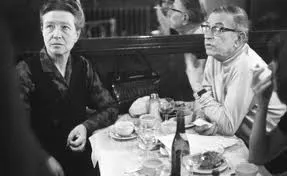
Beauvoir: He [Sartre] was invited to give a conference at the UNESCO. It was the first meeting of UNESCO, two or three years ago, in 1946. At the Sorbonne. The evening before, we went to the Scheherazade, with Koestler and Camus. And Sartre - you remember? - danced with Mme Camus, which was like watching a man lugging a sack of coal. He was very drunk, and he had to give his talk in the morning, but he had not written a line. Miles Davis, pointing at Sartre: The teacher hadn’t done his homework! Beauvoir: Yes, and Camus, who was also drunk said, said, “You will have to do it without my help,” and Sartre said, “I wish I could do it without my help.” Sartre, stubby fingers spread on the the table giggles. Beauvoir: An then - he does not remember this - we had breakfast Chez Victor at Les Halles, soupe a l’oignon, huitres, vin blanc - and then it was dawn, and we stood on a bridge over the Seine, Sartre and me, and we were so sad about la tragedie de la conditione humaine - eh oui! - that we should throw ourselves into the river. But instead of that, I went home to my bed, and Sartre, he went to the Sorbonne to talk about la responsibilite de l’ecrivain… Miles Davis: That’s cool Jean-Paul. They knew you were talking straight because you hadn’t prepared… Beauvoir, shaking her head: No Sartre, he had everything already in his head.

·Delivery

No point in arguing

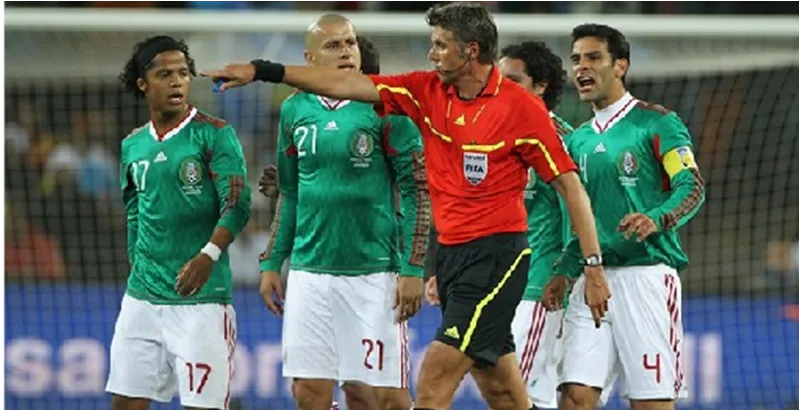
Watching the disputes between players and the referee in the soccer worldcup reminds me of corporate negotiations. After the pitch presentation people start discussing the terms. Often, they are so preoccupied with their own viewpoint that they forget to listen or try to understand what the other party is saying. The same points get repeated, and repeated, and “let me explain to you one more time…”. Nobody is listening, everyone gets annoyed.

·Delivery

Presentation lessons from TEDx Tel Aviv

I had the privilege to attend TEDx Tel Aviv. It was a wonderful day. Some (random) observations:

  • 18 minutes are great: short enough to keep the audience attention, but long enough to cover the most complex subject material. Anyone can present their idea in 18 minutes, if you can’t, it’s the presenters fault, not the audience’s intellectual abilities
  • Personal stories are incredibly powerful, especially if they connect to the interests of the audience. “The doctor told me that my daughter will die soon. I did not accept this”. You are on the edge of your seat.
  • Polish is not everything. Imperfect English, glitches, as long as your story is passionate and genuine, your audience will forgive you.
  • Many different uses for slides, none of them were speaker notes/bullets: 1) relative proportions between numbers [$250m versus $250bn), 2) setting the mood [screen shots of mountain bike trip surroundings], 3) functional video [mosquitos getting zapped by lasers]
  • Building on that. Slides can be incredibly simple and still be effective. And I mean even more simple than stock image + a few words.
  • To keep a conference day interesting you need to shift gears all the time. Spectacular presentations, humor, emotional/touching content. Variety keeps up one’s attention
  • Related: the power of an emotional ice breaker presentation. My organizational behavior professor in INSEAD was a master at this: start a session with a deeply emotional topic or question, and it makes the audience forget their usual defenses, makes them more receptive/open to subsequent content. Hard to explain why, but it works.
  • Unlike you, yourself, the audience is not really interested in your personal background and history, they want to learn from your ideas and perspectives. Talk less about yourself, talk more about what the audience can learn.
  • Props are great (bottles of algae for example).
Continue reading →
·Delivery

Looking back at the UK election debate

I could watch the latest UK election debate live in Israel on Sky News and was fascinated to see these professional debaters in action. In the House of Commons, the UK parliament, debates are very lively and real. In this televised election debate I was a bit disappointed; candidates were hardly listening to one another and tried to find anchor to revert back to their scripts to make a key point.

Where does it get interesting and convincing? When the debaters go off-script and truly try to convince their audience from the heart. They should have the courage to debate like they do in parliament, and stop trying to nail that sound bite. Dry statistics do not move crowds.

The other interesting thing I noticed is the power of the face expression when an opponent makes a point caught by the ever-present cameras. Face expressions reveal one someone thinks an opponent made a really good point.

·Delivery

Boring conference panels

The panel session with the CEO of Twitter bored the audience in a recent on-stage conference interview. And Mark Suster recently wrote another excellent post about conference panels.

I have sat through so many boring panels in business conferences here in Israel. The boring panel recipe:

  1. Try to find as many prominent individuals as possible to feature as speaker on the conference invitation flyer
  2. These people are busy, so you do not require a lot of preparation from the panelists
  3. Get a verbose moderator: long panelist introductions, long questions, [short answer], long recaps of the answer

An easy way to fill 45 minutes, but not a very good way for the audience to spend its time. You cannot wing a presentation, you cannot wing a discussion panel. I wonder why it is that most people go to conferences to meet people in the coffee breaks.

·Delivery

Gaining the confidence to tell your story, your way

The more you practice, the more you rehearse, the more you get on top of your story. And the more comfortable you get with your material, the more confident you get in delivering it. Confidence goes beyond getting rid of fear of public speaking, confidence enters chart design and story telling as well.

  • The confidence to get rid of “business school”-style structuring frameworks: let’s talk about the market, let’s talk about the competition, let’s talk about the distinctiveness, etc. and only spend time on those issues that really matter for your particular story, in the order that best fit your specific situation
  • The confidence to use personal stories and case examples to illustrate your point
  • The confidence to make your charts more minimalist and more abstract
  • The confidence to insert blank/black/white slides inside your presentation to have the audience just focus on you

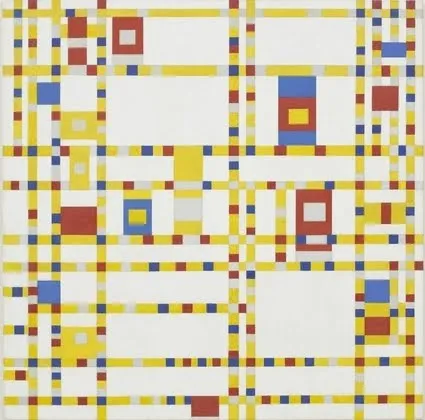
It is a bit like the abstract painters of the last century: having the confidence to communicate emotions and ideas without relying on realistic techniques. For example Piet Mondriaan’s Broadway Boogie Woogie painted in 1942-1943.

The pulse of a Jazz beat, and the energy of the New York traffic squeezing its way through the city’s grid all captured in one painting without showing Jazz bars, Times Square neons, and/or New York traffic jams.