SlideMagic Blog

Frequent updates about all things presentations since 2008. Subscribe to never miss a post.

RSS
all posts

Category Delivery

·Delivery

Sugar levels

It takes some skill to time the right amount of energy for your presentation. Presenting after a very heavy lunch will be difficult. Presenting on an empty stomach is the other extreme. I usually eat a granola bar around 30 minutes before I have to go on stage, to make sure that I am all fired up to go with a fresh shot of energy. Granola bars have a good sugar kick, but also provide some substance that is missing in many processed food snacks and candy.

·Delivery

In between the lines

One of the most important criteria for an investor to invest in your business is you, the entrepreneur, and the in-person presentation is an excellent way to figure you out as a person. Information about all the other elements of your company is covered in the slides, your business plan and/or your website. Investors can read about your CV, but the only way to figure you out is attending that 45 minute presentation. What you present is important, but the other 50%, how you are as a person is also vital. How is to work with you as a Board member with you, the CEO, at the helm of the company?

Can you be trusted? Trust and integrity are one of the most important things a potential investor is looking for. And it does not really work to put a slide on the projector that says “I never lie”. The investor needs other clues that come out in between the lines of your slides. Maybe an investor knows the answer to a question, but asks it any way. If you do not know the answer it is better to say so than make something up. Do you start to gossip, leak information, to people you have just met 20 minutes ago? If you do it to the potential investor, you are likely to do it to others as well.

There is no upside in bending the truth. So maybe you were successful in getting away with some form of reality distortion in the pitch meeting, the investor will eventually find out during the extended due diligence in the weeks (or sometimes) months to come. You enter an exclusivity period, you continue to burn money, and at the end the investors finds out and withdraws from the deal (integrity issues are a huge red flag). Then you are left without an investor, without funds, and a tarnished reputation as you have to explain to other potential investors why this one pulled out. Your entire company is at risk.

Continue reading →
·Delivery

Even CEOs cannot wing it

Everyone would agree that Steve Jobs was a pretty good presenter. But he is said to have practiced two to three full time days before a major product launch speech. Two to three full time days! I bet if you put in that effort before your next presentation, you would be pretty close.

Practice means real practice: standing up, going through the slides first to last without interruption or a quick skip back when you make a mistake, you cannot do this on stage either. Make a video of yourself if you can. Put your screen where your monitor laptop will be (so you do not have to look back at your screen to see what slide is on).

It may sound counter–intuitive, but you actually need to know your story inside out to be really spontaneous. There is no such thing as “winging it”. Your audience will notice, you will use “uh” and “oh” all the time, the key lines will not come out the way they should, you will repeat yourself all the time.

And memorizing the talk line by line is not enough. If an actor has to go back to her memory for every line in the play, she will not have the mental energy to focus on the mood of her character. You need live and breathe your story. Then it will come out naturally, and you can improvise around your story line depending on the reaction of your audience.

The exception here might be webinars. Here, the audience cannot see you and you can probably get away with reading through a presentation line by line.

Continue reading →
·Delivery

Common pitfalls in IPO presentations

I was asked to mention common pitfalls in IPO presentations the other day. Here are some of my thoughts in random order

  • Using an internal strategy deck as the basis for your presentation, rather than starting from scratch. Internal presentations are targeted at insiders, IPO presentations are meant for people who do not suffer from the Curse of Knowledge.
  • Talking management speak, full of buzzwords. Institutional investors are sifting through investor pitches and data all day long, they are trained to cut out the noise. If you provide a lot of noise and padding, they automatically think there is no real substance to talk about.
  • Over-structuring, repeating, repeating again. In a short investor pitch tell a story, do not try to get investors to remember key facts by drilling it in their heads.
  • A generic investment thesis. Very high-level bullet points that could apply to just about any company: growth, profitability, etc. Diluting the core of what is special about your company with many, many other positives that are valid, but not that important. Like in marketing: too many benefits, no benefits.
  • Avoiding the elephant in the room. institutional investors probably are pretty well informed about your company, and the key questions they have (often shared with journalists and bloggers) are pretty clear. Your presentation should address those, maybe not explicitly (here are our weaknesses), but implicitly. These questions are the only thing that people are worried about.
  • Avoid the long-term growth options. There are legal restrictions to what extent management can provide business forecasts in an IPO filing, but that does not mean that you cannot educate investors on how you can think about valuing your business. Give a framework on what value components could be there for the long-term.
  • Focus only on the company, not on trends in broader society. Sometimes the key driver behind the success of a company is a fundamental shift on how people are operating, how things are changing in the world. Your IPO is an opportunity for an investor to invest in that trend. If that is the main driver, discuss it.
  • Confusing financial data. A 30 minute pitch is not enough time to go over the financial data in full detail. Still, there is no reason why you should confuse things instead. Give a good overall picture of the components of your company. Show how the revenue model is working. Show how the cost structure works.
  • Forget the front line. Management talks about a company in terms of top line revenue, overall market share, but the real action is in the front lines. Give customer case examples, they are often a much more powerful illustration of the attractiveness of a business than top line figures.
  • Recording your presentation in front of a camera, without an audience. Unless you are a professional TV host, people find it difficult to look natural in front of a camera. Invite a small audience when you are video-ing your tape. If that is not possible, maybe tape some images of people on some chairs in the studio/conference room so you can imagine talking to the people who are listening/watching you later.
·Delivery

Writing versus speaking

This blog post by YCombinator founder Paul Graham on writing versus speaking is worth reading start to finish.

What he says is probably inspired by the many conference speakers he saw. A big brand gets up the stage, unprepared, slightly rambling, but charismatic and full of catchy sound bites. In the end, when you look back, she actually did not say that much. Writing a good story is much harder.

This is what I encounter in presentation design every day. It is hard to design that story, but when you crack it, it often can be said in very little words but full of real content and insight.

But then again, I think that conference audiences are not always looking for that piece of insight or intellectual stimulation. Maybe they just want to laugh and have a good time.

·Delivery

iPad: Keynote tipping point?

I am continuing my research in mobile presentation platforms, with very useful input from you guys.

Until now, the Keynote versus PowerPoint battle has been a feature debate. While Keynote has some better features in some instances, they are unlikely to be enough to switch people over who just invested years in getting to grips with one user interface.

Mobile devices might change that.

There are two types of presentation decks. The everyday presentation is a PowerPoint file that is used in corporates to make business decisions; it is not really meant for presentation, rather it is a more visual substitute for a word processor. The second one is the key company pitch, sales, or fund raising presentation. You use it all the time. You perfect it all the time with small changes. You use it in different settings, mostly for audiences outside the company.

I would argue that by now, it is better to have that crucial presentation in Keynote than in PowerPoint. Why? Mobile devices, and the integration of PowerPoint with iPads is non-existent, while by now Keynote has pretty decent mobile apps.

Pulling out a laptop in a coffee shop to go through a deck is unnatural. Flipping on your iPad is not. An iPad could also be a powerful replacement of the PC + clicker combination that we use for conference room, or even on-stage presentations.

One scenario. You sitting at the reception of a venture capitalist waiting to be picked up. On your iPhone you click through your slides to do a final mental rehearsal. Ah, a typo, a quick fix. You walk into the conference room and one of the VC partners is late. Instead of an on-screen presentation you tell your story verbally, while pointing at a key chart on your iPad when necessary. The second VC partner walks into the room, and immediately you Airplay the presentation onto the conference room screen. You quickly repeat the main points you made by picking off a few slides from your iPad (because of presenter mode, the audience does not see you browsing through tiles) and finish the discussion with the detailed financials, and the use of the funds that you are trying to raise.


Continue reading →
·Delivery

Martin Luther King day

·Delivery

Teaching teenagers (2)

Last week I did my presentation design workshop to this year’s class of MEET (more details in an earlier post) in Jerusalem. I used grown-up stuff for these 15-16 year olds, a slightly modified version of my deck about investor and sales presentations designed for a senior managers. The results surprised me.

Despite being a 09:30am speaker (teenagers do not get a lot of sleep when they stay away from home in a large group), 95% of eyes were hooked on me (5% were deeply a sleep). In my usual audiences I rarely find someone really sleeping, but there are a lot more people distracted, even if your story is interesting.

Afterwards, I coached the students in the design of the pitch presentation of their ideas. It was interesting to see how these kids were sponges of ideas: the presentations were stitched together over the course of 3 hours and often looked better than finalized version 1s of pitch decks that clients sent me at the start of a project. The new generation has not been programmed by overhead transparencies and Microsoft PowerPoint bullet point templates, but is ready to try a fresh approach to design.

Teaching to present your ideas should be introduced in education much earlier than it is today.

·Delivery

Timing your elevator pitch

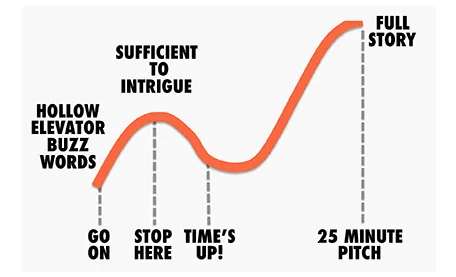
Sometimes there is little time to do your pitch. You meet an investor in the corridor, you got a slot at a pitch competition. Seth Godin said the other day that no one has ever bought anything in an elevator: in other words a very short elevator pitch consisting of 2 sentences with hollow buzz words is not going to excite an investor.

Instead, you need to add more specifics to intrigue the investor to invite you to another occasion where there is more time to discuss your idea.

But sometimes, elevator pitches become less effective when you take too much time. You start adding details, provide facts, that take the energy out of your presentation, that require time to close all all the plot lines. There is a dip between the perfect short pitch, and the full-length 25 minute story. Do not get stopped in the middle, it is better to keep it short.

·Delivery

Room temperature

A room that is too warm will put your audience to sleep, even when you have the most exciting presentation in the world. Climate control is one more thing to add to the pre-presentation technology check list.